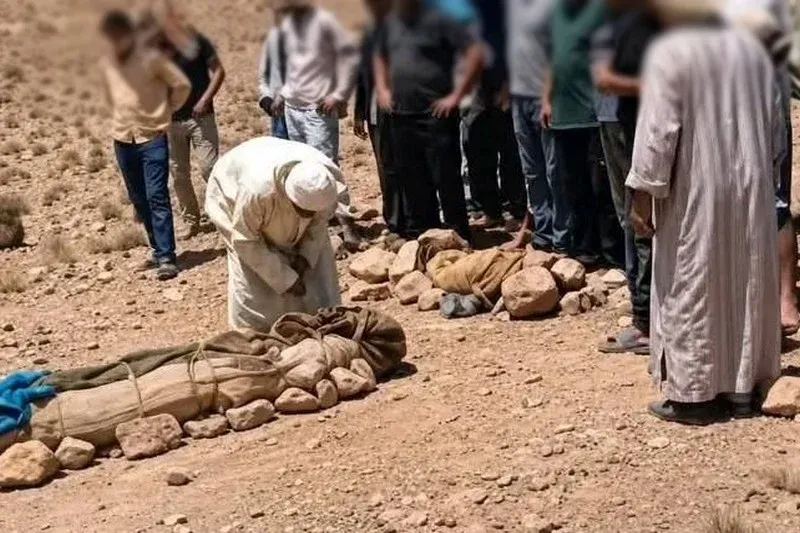

A Moroccan woman was laid to rest on Friday morning in the Agbalo Nkerdous cemetery, following a tense standoff that lasted an entire day and raised significant concerns over her burial rights. This incident prompted a substantial security intervention, leading to an official declaration affirming that the cemetery is public and accessible to all residents of the region. The events unfolded in southeastern Morocco, specifically in the Tighnbout ksar, where local residents resisted the burial of the deceased woman, who belonged to the Ait Abdessamad tribe. They claimed that the cemetery was exclusively theirs, thereby restricting access to the deceased’s family.
The woman’s tribe faced a dire situation as their usual burial ground was reportedly at full capacity, which left them with no immediate options for interment. This led to a tense confrontation over access to the adjacent cemetery, creating a volatile atmosphere that nearly escalated into violence. However, security forces, including the Royal Gendarmerie and local authorities, intervened under the directive of the governor of the Draa-Tafilalet region, working to de-escalate the situation.
In a bid to prevent potential clashes, the area surrounding the cemetery was cordoned off by security personnel, leaving the deceased’s body awaiting burial for over 24 hours. Members of the Ait Abdessamad community organized a sit-in at the cemetery, insisting on their right to bury their relative with dignity. Simultaneously, others made their way to the regional governor’s headquarters to protest against the denial of access to the burial site. The situation ignited widespread outrage among Moroccans, many of whom viewed the refusal to allow a burial as a blatant infringement on religious, social, and legal norms concerning the sanctity of the deceased.
After consultations involving various regional authorities, the Interior Ministry, and the Ministry of Endowments and Islamic Affairs, the burial was finally authorized on Friday morning, albeit under strict security measures. The funeral proceeded without further incident, effectively concluding a day filled with tension that had captured the attention of the local community.
In a significant development, the Agbalo Nkerdous commune officially classified the disputed cemetery as a collective public burial ground, stating that it will accept all deceased residents of the area without regard to tribal or ethnic affiliations. Local observers noted that this dispute underscores a persistent issue faced by rural communities in southeastern Morocco, where the increasing population is exacerbating the shortage of designated cemetery land and the lack of clearly defined legal boundaries for communal burial sites.
In a related judicial action, Morocco’s public prosecutor has directed the Royal Gendarmerie to initiate an investigation into the incident to ascertain responsibilities and take legal action against any individuals found obstructing the burial process. A source from Hespress AR indicated that the Ministry of Endowments and Islamic Affairs intends to file an official complaint to identify those accountable for preventing the burial, aiming to prevent similar occurrences in the future.
Furthermore, the governor of the Draa-Tafilalet region is reported to have closely monitored the situation from its inception and has issued explicit instructions to local authorities to ensure that attempts to block burials based on claims of exclusive tribal ownership over cemetery land are not tolerated. The governor emphasized that collective lands are under state oversight and legal regulation, asserting that the right to a dignified burial is a constitutional guarantee that cannot be infringed upon under any circumstances.
As reported by en.hespress.com.