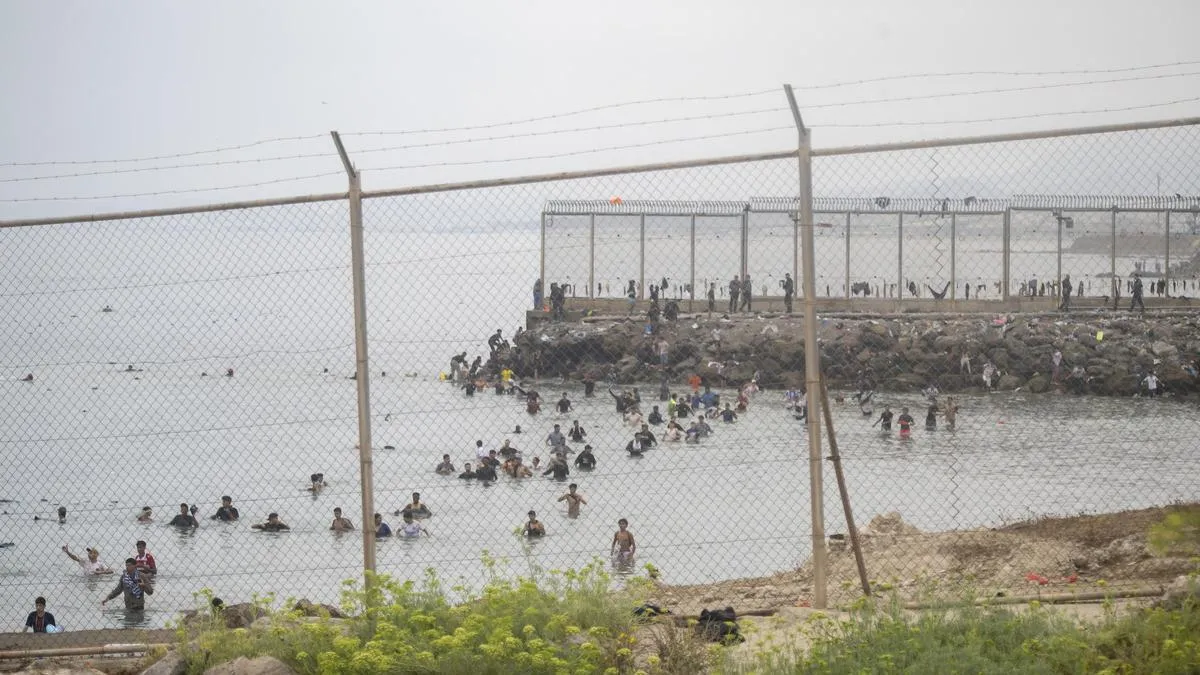

Moroccan authorities have pointed to "misleading information" and the optimism of many not wanting to be returned as the primary reasons that led thousands to head towards Ceuta last Thursday. Until this Sunday, Moroccan officials had remained silent, but the Ministry of the Interior released a statement confirming that, so far, ten individuals have drowned on the Moroccan side, in addition to another fatality from a fall in a rocky area. Furthermore, they have downplayed the Spanish government's figures regarding the total number of arrivals and defended their response to the situation.
Authorities in Morocco assert that the events of last Thursday were not the result of "spontaneous or temporary factors" but were instead influenced by several underlying issues, prominently the malicious exploitation of digital spaces. They also highlighted the role of "human trafficking networks" and "misinterpretations of legal and administrative data," which aimed to create the illusion of easy and consequence-free access to Europe. This statement specifically referenced a recent Spanish court ruling that rejected the practice of "hot returns" for individuals arriving by swimming.
According to Moroccan Interior Ministry reports, a total of 40,000 individuals made their way towards Ceuta and 1,135 towards Melilla, contradicting other circulating figures that they claim are "not based on reliable data or objective foundations." Spanish authorities, on the other hand, estimated that those who successfully arrived numbered between 58,000 and 60,000. The Rabat government explained that they were "aware" of unfolding events and activated several mechanisms, including increased surveillance and bolstered security and rescue services, which they believe helped manage the situation, protect lives, maintain public order, and secure borders.
Morocco has also announced the initiation of an investigation to clarify the circumstances surrounding these events. In the closing remarks of the statement, they defended their role in migration management, asserting, "Morocco will continue to be, as its partners have always known, a reliable and responsible partner committed to strengthening cooperation." They emphasized that this effort can only be achieved through "shared responsibility, effective solidarity, and a fair distribution of burdens."
This marks the first official acknowledgment from the Moroccan side regarding the arrival of thousands in Ceuta since last Thursday. On that same day, Moroccan authorities mentioned an agreement with Spain for the "repatriation" of those who managed to reach Ceuta and to reinforce collaborative efforts.
The Moroccan side of the border has almost returned to normalcy, although it is still characterized by a heavy police presence securing the perimeter and groups of individuals gradually returning from Ceuta, although in decreasing numbers.
Throughout Sunday, dozens of families continued to gather in the plaza in front of the border crossing, anxiously waiting for news about their loved ones; many have not heard from them since Thursday, uncertain if they are alive or if they are in Ceuta. The only certainty is that on that day, alongside tens of thousands of others, they attempted to reach the autonomous city.
Some families hold small paper photographs of their children or relatives as they search through the crowd, hoping that someone returning or another passerby might recognize them or provide a lead. Currently, the total number of missing individuals remains unknown.
A significant issue is that many have lost communication; numerous migrants have either run out of battery or have damaged their phones due to water exposure. Over the past few days, many of those returning have immediately sought out someone to borrow a phone to inform their families that they are safe. This same situation has also occurred on the Spanish side of the border.
The city of Castillejos, the closest to the border, has seen a significant decrease in the number of individuals who initially arrived with the intent of reaching Ceuta. Those returning have found themselves boarding a bus as soon as they set foot on Moroccan soil, destined for larger towns.
As reported by elperiodico.com.