
Diplomacy Through Sports: Morocco and Brazil's Shared Passion
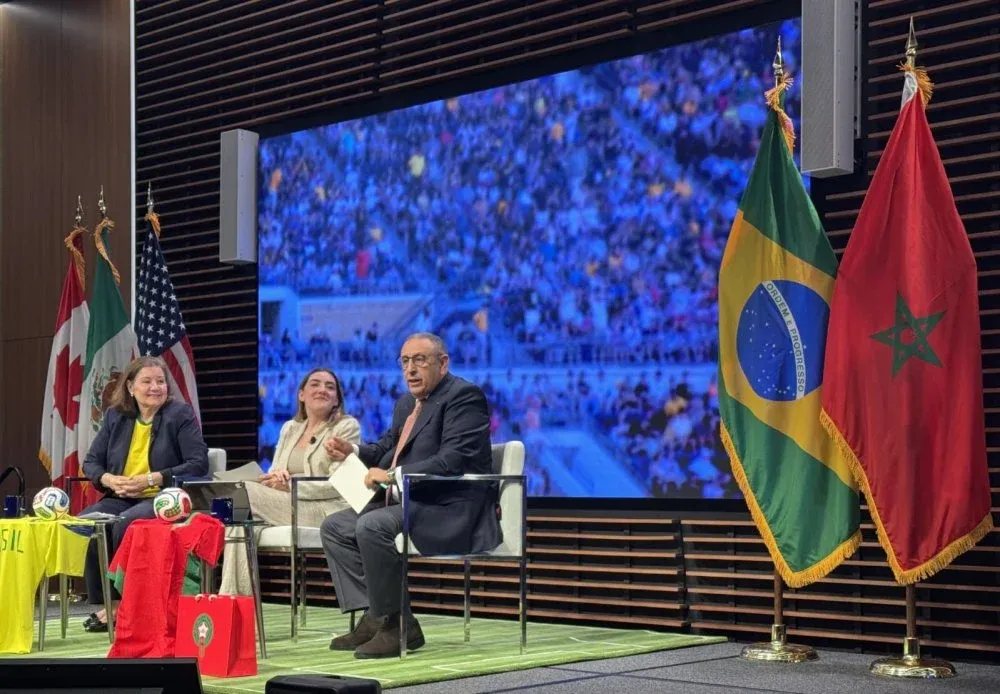
In anticipation of the highly awaited match between the national teams of Morocco and Brazil at the FIFA World Cup 2026, the ambassadors of both countries in Washington recently participated in a nearly 90-minute debate titled “The Power of Sports in Diplomacy.” This event was organized by the American think tank, Atlantic Council. During this discussion, Morocco's ambassador to the United States, Youssef Amrani, and Brazil’s ambassador to Washington, Maria Luisa Ribeiro Viotti, emphasized that the people of both nations are united by a shared passion for football. They highlighted that the Morocco-Brazil relationship has all the elements necessary for further strengthening, thanks to the significant synergies and economic complementarities between the two countries.
In his address, Mr. Amrani articulated the role of sports as a lever for influence, fostering connections between peoples, and enhancing the international projection of nations. He asserted that football is a universal language capable of transcending borders, cultures, and divides. Reflecting on nearly fifty years of diplomacy, he stated, “I have come to understand that football can open doors and forge connections in 90 minutes that diplomacy sometimes takes years to establish. Sports connect instantly; it goes beyond borders, languages, cultures, and politics.”
Looking Forward to the World Cup and Beyond
While discussing the upcoming FIFA World Cup 2026, the Moroccan diplomat commended the “remarkable work” done by the United States in preparing for this global event, which is particularly significant as it coincides with the 250th anniversary of diplomatic relations between Morocco and the United States. Mr. Amrani further underscored the historical importance of the 2030 World Cup, which Morocco will host alongside Spain and Portugal. He emphasized that this event solidifies Morocco’s unique positioning, as envisioned by His Majesty King Mohammed VI, establishing the nation as a bridge between Africa, Europe, the Atlantic, and the Mediterranean.
“Rooted in Africa, connected to Europe, and open to the Atlantic and the Mediterranean, Morocco naturally serves as a bridge between worlds. The World Cup is more than just matches; it is about gathering, dialogue, understanding, and demonstrating that cooperation is possible in a fragmented world,” he asserted. In light of the Kingdom’s sporting strategy, championed by the high directives of His Majesty King Mohammed VI, Mr. Amrani emphasized that Morocco has proactively invested in sports infrastructure, human capital, and territorial development since 2008. “Today, the Kingdom is reaping the rewards of diligent work characterized by commitment, structure, and ambition,” he added, highlighting the world-class facilities developed in the Kingdom and the rise of the Mohammed VI Football Academy as a testament to Morocco’s active sports diplomacy.
In recent years, the results achieved underscore the foresight of this strategic vision, including a historic semi-final appearance at the 2022 World Cup in Qatar and a global championship for the Under-20 team in 2025 in Chile, along with remarkable progress in Moroccan women's football. Beyond the sporting dimension, the ambassador noted that hosting major international competitions acts as a powerful catalyst for economic and social transformation, positioning sports as a strategic investment for youth, development, and enhancing the Kingdom's international stature.
Regarding the relationships between Rabat and Brasilia, Mr. Amrani emphasized the strong convergences that unite Morocco and Brazil around a shared vision of multilateralism, sustainable development, and strengthening South-South cooperation. He reminded that Morocco is currently Brazil's second-largest trading partner in Africa, while Brazil remains a key partner for Morocco in agriculture, food security, fertilizers, and industry. “The Atlantic relationship is no longer limited to North America and Europe; the South Atlantic is emerging as a strategic space for cooperation and growth,” he insisted, emphasizing the significant complementarities between the two economies, which pave the way for strategic cooperation that fosters growth, investment, and jobs.
As the match between Morocco and Brazil approaches, set for June 13 at the New York/New Jersey stadium, the ambassador concluded on a note of fraternity and optimism, stating, “May the best team win. Regardless of the score, Morocco and Brazil are already winning together through friendship, cooperation, and a shared vision for the future.”
In her remarks, Brazil’s ambassador to Washington, Maria Luisa Ribeiro Viotti, elaborated on how football serves as a powerful means of connection between peoples and a universal language capable of creating lasting bridges between cultures and nations. She praised the remarkable journey of Moroccan football in recent years, noting the inspiration drawn from the historic performance of the Atlas Lions during the 2022 World Cup. She stated that Morocco now embodies “a new energy in global football” and anticipates a fiercely competitive match on June 13 between two great nations, two talented teams, and historic partners. She also acknowledged the high caliber of the Moroccan national team, referring to it as “one of the best selections in the world,” recognized for “its tactical intelligence, game discipline, and counter-attack efficiency.” Thus, the encounter between Brazil and Morocco promises a high-level spectacle and has generated significant interest among supporters from both nations.
Looking ahead to the 2030 World Cup, co-hosted by Morocco, Spain, and Portugal, Ms. Ribeiro Viotti expressed her belief that this edition will be “a resounding success.” In a statement to MAP, she emphasized that this global event will provide Morocco with a unique opportunity to enhance its visibility and appeal on the international stage.
As reported by lematin.ma.