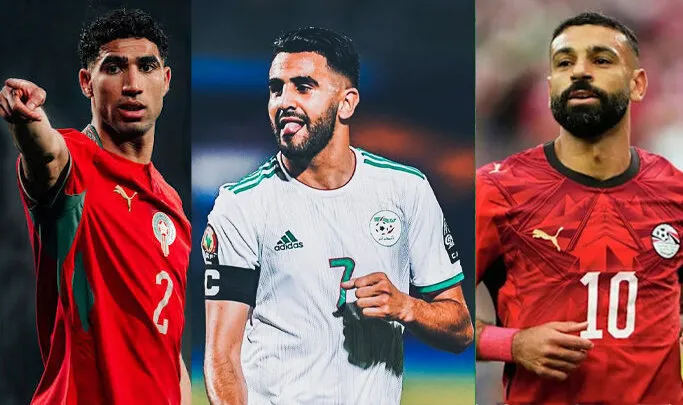

Morocco made a historic entrance into the World Cup, achieving a remarkable milestone during the Qatar 2022 tournament by becoming the first African and Arab team to reach the semifinals. In their quest for glory, they eliminated formidable opponents such as Cristiano Ronaldo's Portugal and the European champions, Spain, showcasing their prowess on the global stage. The Atlas Lions confirmed that their triumph in reaching the semifinals was not merely a fluke, as they progressed to the quarterfinals again, although they still seek that extra edge needed to overcome elite teams and secure the prestigious title.
The expectations have soared to unprecedented heights, with fans now desiring both results and memorable performances. This shift in ambition led to the dismissal of head coach Walid Regragui just three months before the tournament, with Mohamed Wahbi taking over after his impressive victory at the U-20 World Cup. The Atlas Lions kicked off the tournament with a commendable draw against Brazil (1-1), followed by a narrow victory over Scotland (1-0) and a solid win against modest Haiti (4-2).
Morocco faced a serious test in the Round of 32 against the Netherlands, who temporarily led the match until injury time. However, the composure of the team, coupled with the skill of veteran goalkeeper Yassine Bounou, propelled them to victory in a nail-biting penalty shootout. Following their advancement to the Round of 16, Wahbi stated, "Everyone now respects Morocco," and expressed his team's determination to contend for the World Cup title—a notion that would have seemed absurd just a few years prior.
In their encounter with Canada, one of the three host nations, Morocco faced difficulties in the first half but ultimately triumphed with a convincing 3-0 victory in the second half. The stage was set for a rematch against France, who were wary of a potential upset and revenge from the 2022 semifinals. However, the harsh reality of the match was evident as France dominated the game, and Morocco's offense failed to materialize, resulting in a 2-0 defeat.
The Pharaohs' Adventure
The surprise story of the tournament was Egypt, who reached the Round of 16 for the first time in its history, despite having a record seven Africa Cup of Nations titles to their name. Their journey began with an opening draw against Belgium (1-1), followed by a historic first win against New Zealand (3-1), and concluded with another draw against Iran (1-1), which allowed coach Hossam Hassan's squad to progress without a loss for the first time.
The Pharaohs didn't stop at merely qualifying; they overcame Australia in a dramatic penalty shootout before facing off against the reigning champions, Argentina. Egypt believed they were on the verge of one of the biggest upsets in World Cup history, leading 2-0 until the 79th minute. However, Lionel Messi and his teammates had other plans, turning the match around to win 3-2 in a thrilling encounter in Atlanta. Hossam Hassan voiced his objections to the referee's decisions, suggesting that there were motives to keep the world champions in contention and to keep Messi in the race.
Upon their return to Egypt, the national team received a hero's welcome, with Mohamed Salah declaring, "I will do everything in my power to ensure this is a new beginning for Egyptian football on the international stage." Algeria was the third Arab team to qualify, drawing in an exciting match against Austria (3-3) after an opening loss to Argentina (0-3) and a win over Jordan (2-1). The Desert Warriors reached the knockout stage for the second time since 2014, but their journey ended with a 2-0 defeat to Switzerland.
Asian Arabs Fall Short
Arab nations significantly benefited from the expansion of the participant count from 32 to 48, with eight teams competing—split evenly between African and Asian Arabs. The results indicated a clear advantage for the African Arabs, as Qatar, Jordan, Iraq, and Saudi Arabia all faced early exits from the tournament, alongside Tunisia. Only Tunisia deviated from the African Arabs' stellar performance, continuing their struggle to advance past the group stage.
In a historic first for the World Cup, a coach was dismissed after just one match; Sabri Lamouchi paid the price for Tunisia's humiliating 5-1 defeat to Sweden in their opener. Frenchman Hervé Renard was called in as a last-minute replacement, but the team struggled, losing to Japan (0-4) and the Netherlands (1-3), ultimately surrendering hope of advancing. Renard candidly assessed Tunisia's weak performance, acknowledging, "We were not at the required level for this World Cup. This is clear, and there is no discussion about it."
Similarly, Iraq's campaign fell flat, suffering an opening loss to Norway (1-4), followed by another setback against France (0-3), and concluding with a heavy defeat against Senegal (0-5). After completing their second tournament (the first being in 1986) without earning a single point, Australian coach Graham Arnold stated, "When you make the mistakes we made, you get punished in the World Cup. Our group was incredibly tough here." The Iraqi federation has since formed a committee to negotiate with Arnold for a contract renewal.
Despite achieving a historic first point in their opener against Switzerland, Qatar faced a devastating defeat against Canada (0-6). With hopes of a win to secure qualification against Bosnia, the 2022 hosts suffered another loss (1-3). Following their elimination, Qatari Football Association President Jassim Al-Buainein announced his resignation after three years in office.
After much controversy regarding the limited participation of Saudi players in the domestic league due to the influx of global stars, including Ronaldo, the Green Falcons managed to earn two points against Uruguay (1-1) and Cape Verde (0-0), but they suffered a painful defeat to Spain (0-4) in between. Greek coach Georgios Donis admitted after the match against Cape Verde that his team did not feel capable of winning, stating, "The performance was not good; the journey itself was challenging but good... the circumstances were pressuring, which caused us to lose control." Following their early exit, Saudi Federation President Yasser Al-Mashel also submitted his resignation.
Despite their early exit in their first participation, losing two matches to Austria (1-3) and Algeria (1-2), Jordan's coach, Moroccan Jamal Salami, focused on the positives. Before their third match against Argentina, which they lost (1-3), he expressed, "As a first-time participant in the World Cup, we are happy and proud of the performance we exhibited in the previous two matches. It was an important experience for all of us." The Jordanian federation subsequently dismissed Salami, whose contract was set to expire after the 2027 Asian Cup, and appointed his compatriot Badou Zaki as his replacement.
As reported by france24.com.