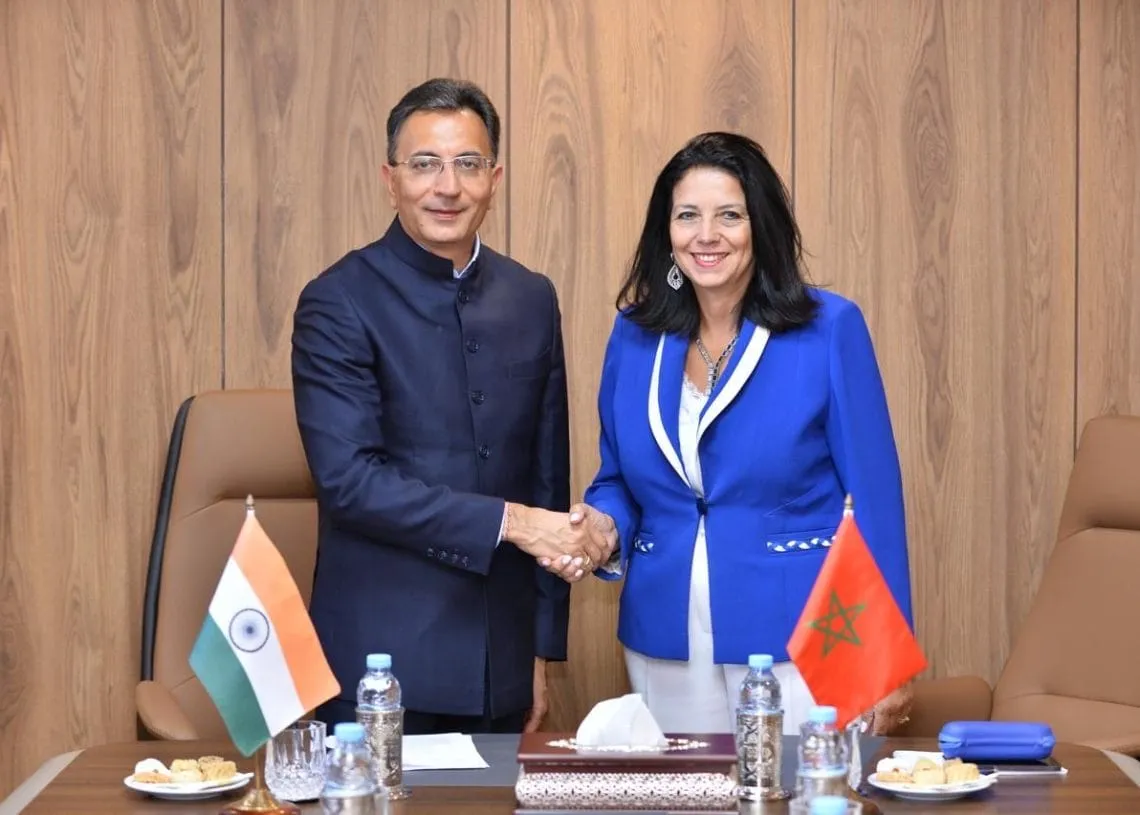

In a significant development, Morocco and India have formalized an agreement to establish a joint commission focusing on languages and digital technologies. This initiative aims to seamlessly integrate Moroccan Darija and Amazigh languages into Idarati, the online platform facilitating access to administrative services for Moroccans. The discussions that led to this agreement took place in Rabat, involving key figures such as Morocco’s Minister Delegate for Digital Transition and Administration Reform, Amal El Fallah Seghrouchni, and India’s Minister of State for Commerce and Industry and Electronics and Information Technology, Jitin Prasada.
Seghrouchni emphasized that the newly formed commission would primarily concentrate on developing large language models, drawing from India’s extensive experience in this domain, which includes a noteworthy application that supports 28 languages. The partnership will also explore the creation of small language models, which are particularly suitable for both Darija and Amazigh—languages characterized by their limited resources. These compact models, which can efficiently operate on modest technological infrastructures, offer a pragmatic solution compared to more demanding systems.
Additionally, Seghrouchni highlighted the role of the Al Jazari Institute, which facilitates communication between citizens and the administration by operating in Arabic, Amazigh, and Darija. Morocco is actively working to expand this institute into a national network, with the first site launched in Guelmim-Oued Noun and a second location planned for Nador in the Rif region.
India's Unique Position in African AI
India's involvement in the African artificial intelligence landscape is less widely recognized compared to its counterparts from other regions. Nonetheless, it offers a distinctive approach. During the GITEX Africa event in Marrakech last year, Indian representatives showcased the country's robust digital public infrastructure stack, which includes Aadhaar for identity verification, UPI for payment processing, and DigiLocker for secure document storage. These systems are state-owned and designed to be open and interoperable, setting them apart from proprietary platforms. India has been proactive in exporting this model, presenting a fresh alternative to the various engagements from the United States, China, and Europe, which have been closely monitored by iAfrica across the continent in recent times.
For Morocco, which has been described by Indian officials as a potential “third voice” in AI governance—distinct from the frameworks of the US, Europe, and China—this partnership aligns perfectly with its strategic vision. The discussions in Rabat encompassed a range of topics related to public digital infrastructure, including digital identity systems, electronic payment solutions, data governance, and leveraging digital tools to modernize public administration. Furthermore, the conversations also touched upon the development of digital skills through training programs, expert exchanges, university collaborations, and professional certifications in emerging technologies.
Aligning with Morocco's Strategic Vision
The commitment to enhance language integration represents a pivotal aspect of Morocco's ongoing efforts in this arena, which have been systematically unfolding over the past two years. The Moroccan government has collaborated with Mistral AI to create a multilingual laboratory aimed at developing language models in Arabic, Amazigh, and various other African languages. A partnership with the CNDP has also been established to design large language models that reflect Morocco’s linguistic, cultural, and legal contexts. The promotion of open-source AI has been specifically aimed at addressing the challenges posed by Arabic, Darija, and Amazigh languages. The Idarati X.0 platform, which serves as a unified administrative system, is currently being developed through eight cooperation agreements, and it will be integrated with a national digital wallet linked to the electronic identity card.
Morocco’s ambitious AI initiative, branded as 'AI Made in Morocco,' aims to contribute 100 billion dirhams to the GDP and create 50,000 AI jobs by the year 2030. This initiative is supported by the establishment of the Nexus AI Factory, a state-of-the-art facility near Casablanca, and plans for a 500MW renewable energy-powered data center in Dakhla.
In the broader regional context, the efforts to integrate Darija and Amazigh into public services align with similar initiatives across Africa. For instance, Egypt has recently launched BelMasry, a free platform designed to cater to Egyptian colloquial Arabic dialects, while Nigeria has introduced N-ATLAS, an open-source project being scaled through the GSMA’s ATLAS Umoja initiative involving five governments. Furthermore, LINGUA Africa is funding various projects to support over 50 languages.
What sets Morocco's approach apart is its focus on creating functional government services rather than merely producing research artifacts. The Idarati platform is a practical tool where Moroccans engage in renewing documents and submitting requests, making it essential that any language model developed for Darija is operationally viable. This practical requirement serves as a more definitive test compared to many other language-AI initiatives.
The recent discussions in Rabat followed earlier meetings between Seghrouchni and Prasada that took place in New Delhi in February during the AI Impact Summit. Prasada was also present in Morocco from August 24 to 25 for the seventh session of the Morocco-India Joint Commission, which focused on broader economic and commercial cooperation.
As reported by iafrica.com.