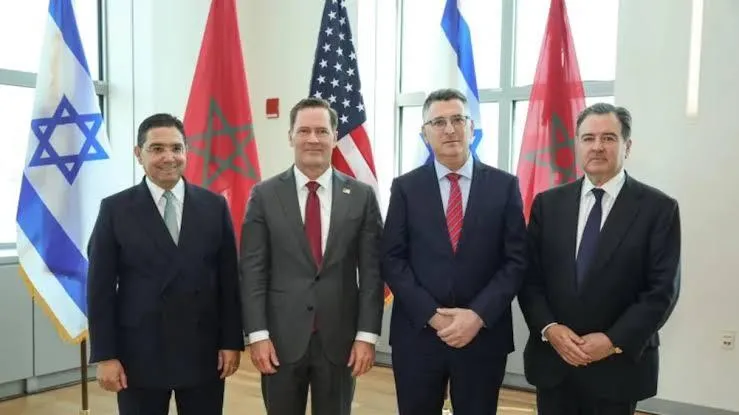

In the wake of the diplomatic normalization initiated by the Abraham Accords in December 2020, Morocco and Israel have transitioned towards a concerning military and technological partnership of significant scale. Over a mere three years, Rabat has plunged into an aggressive arms race, importing approximately a quarter of its military equipment from Israel, while the United States supplies 60% and France's contribution dwindles to 10%. This strategic shift was solidified by the signing of a memorandum of understanding and cooperation following a historic visit by Israeli Defense Minister Benny Gantz at the end of 2021. This development has raised alarms regarding the implications of such a partnership, especially in a region marked by geopolitical tensions.
Backed by Emirati funding, donations, and substantial budget extensions, the Moroccan monarchy is pursuing a dual objective. It aims to redefine the military strategic balance against Spain and Algeria while establishing itself as a pivotal geopolitical lock on the vital axis connecting the Mediterranean Sea to the Atlantic Ocean. This ambition is accompanied by an accelerated militarization of the occupied territory of Western Sahara, with experts noting a massive deployment of forces and surveillance infrastructure along the border strip, stretching from northern Smara to the southern locale of Guerguerat. This includes the famous sand wall erected in the 1980s, which has been modernized with Israeli technical support.
According to analyses published by the Spanish media outlet Escudo Digital, the 2021 agreement laid the groundwork for a comprehensive security architecture encompassing intelligence sharing, sensitive information exchange, military training, and mutual logistical support. This legal framework has rapidly paved the way for sophisticated technological acquisitions. Among the primary beneficiaries of these contracts are the Royal Moroccan Land Forces, whose capabilities have been enhanced through the integration of the multi-layered Barak MX air defense system, purchased in 2022 from Israel Aerospace Industries for approximately $500 million.
The Barak MX missile and air defense system boasts an operational range between 35 and 150 kilometers. Its nerve center has been established at the new military base of Sidi Yahya El-Gharb, located about 200 kilometers from the enclave of Ceuta. Designed to address complex threats, this infrastructure allows for the interception of aircraft, kamikaze drones, cruise missiles, and tactical ballistic vectors, utilizing interceptors such as MRAD, LRAD, and ER in conjunction with the multifunctional radar ELM-2084 MMR. In the realm of heavy artillery, 2025 marked a turning point with Morocco's acquisition of 36 Atmos 2000 self-propelled howitzers of 155 mm caliber, developed by Israeli firm Elbit Systems and capable of neutralizing targets over 40 kilometers away. Additionally, Rabat has also set its sights on the PULS rocket artillery system, obtaining between 8 and 12 units through a contract estimated at around $150 million.
Unmanned aerial vehicles (UAVs) play a central role in this acquisition strategy. The kingdom has considerably expanded its fleet of tactical drones with models such as the WanderB and ThunderB from BlueBird Aero Systems, as well as the Hermes 450 from Elbit Systems. These aircraft complement the already operational medium-altitude long-endurance (MALE) drones, namely Elbit Systems' Hermes 900 and Israel Aerospace Industries' Heron 1. These aerial vectors are strategically positioned at key sites dedicated to monitoring the Atlantic front and the interior desert areas, including the platforms at Ben Guerir, Dakhla, and the Mahbes airport, which is in close proximity to the Algerian border.
The technological partnership also extends to sensitive areas of cybersecurity and electronic intelligence. With the assistance of Israeli experts, Morocco has acquired highly controversial software, such as the notorious Pegasus spyware developed by the NSO Group, which has been documented in targeted phone hacking operations against thousands of Moroccan and international figures, alongside NightHawk solutions from Interionet Systems and Cellebrite's UFED system.
In pursuit of long-term informational supremacy, the report indicates that Rabat has formalized the purchase of two Ofek 13 observation and reconnaissance satellites from Israel Aerospace Industries. Estimated at nearly one billion dollars, this contract includes staggered deliveries through the end of the current decade, overshadowing traditional offers from European manufacturers like Airbus and Thales.
Beyond mere commercial transactions and arms contracts, this alliance has deeply institutionalized through ongoing consultation frameworks. The Moroccan-Israeli Joint Military Committee has institutionalized regular annual meetings since 2020 to maintain a continuous strategic dialogue between the military headquarters of both countries. The Spanish news site revealed that following the latest session of this committee, held in Tel Aviv in January 2026, the two parties formally structured their sectoral cooperation around four fundamental pillars: technological and industrial innovation, operational troop readiness, intelligence coupled with cyber defense, and long-term capacity development of armed forces.
This structural transformation demonstrates that the partnership has definitively shifted away from sporadic purchases, embedding itself within a formal and sustainable military alliance. Numerous keen observers have already pointed out that this security interconnection is accompanied by the construction of specialized military infrastructures on Moroccan soil, ranging from interception and electromagnetic intelligence stations to industrial sites intended for the assembly and manufacture of military drones. This Moroccan alliance with the Zionist entity also aims to target the eastern neighbor perceived by Israel and the Emirates as the enemy to be subdued.
As reported by jeune-independant.net.