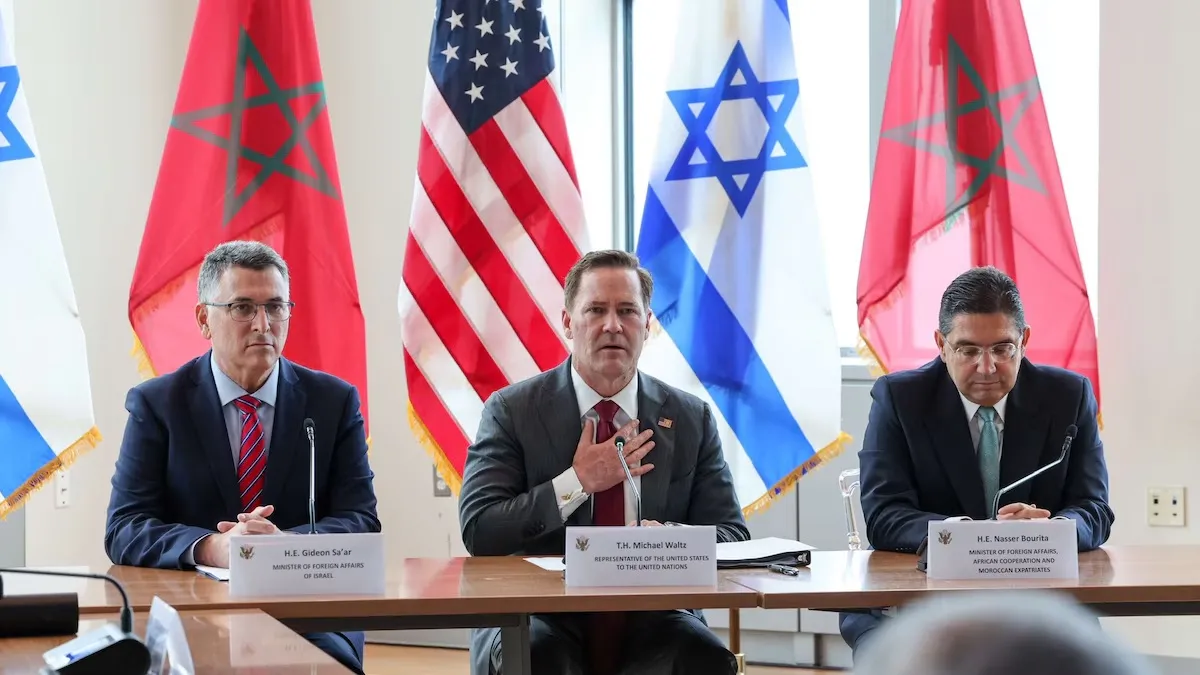

Morocco and Israel have officially agreed to elevate their diplomatic representation from liaison offices to fully-fledged embassies, a significant step in enhancing the bilateral relations that were formally resumed between Rabat and Tel Aviv in December 2020. This announcement follows a trilateral meeting held in New York, which saw Moroccan Foreign Minister Nasser Bourita and Israeli Foreign Minister Gideon Sa'ar discussing this pivotal development in the presence of U.S. Ambassador to the United Nations, Mike Wultz. The Israeli Foreign Ministry stated that the three parties reaffirmed their commitment to a series of measures aimed at deepening Moroccan-Israeli relations.
Under the newly announced understanding, the diplomatic missions in both Rabat and Tel Aviv will be upgraded to embassies, with the appointment of ambassadors anticipated in the near future. Additionally, the two nations have agreed to bolster economic and commercial ties, expand direct flight routes, and prepare for high-level reciprocal visits in the coming months, indicating a robust partnership moving forward.
Transitioning to Embassies
This decision marks a significant transition in diplomatic representation between Morocco and Israel, which had been limited to liaison offices since the resumption of relations in 2020. Morocco had formally severed its official ties with Israel in October 2000, but the relationship was revived in December 2020 as part of a broader framework facilitated by the Trump administration. Since that time, the two countries have seen advancements in various domains, including trade, investment, tourism, and security cooperation, despite the diplomatic representation remaining below that of full embassies.
The recent agreement comes nearly six years after the signing of the Abraham Accords in September 2020, which set the stage for expanded relations between Israel and several Arab nations. The newly announced understanding not only encompasses diplomatic upgrades but also includes agreements on completing two significant economic pacts by the end of 2026. The first agreement focuses on investment protection, while the second aims to prevent double taxation, thereby creating a broader framework for developing investments and trade relations between the two countries.
Strategic Moves Amid Regional Tensions
The meeting in New York, hosted by U.S. Ambassador Mike Wultz, aimed to support the ongoing expansion of the Abraham Accords. Wultz emphasized the importance of advancing relations in security, trade, and regional integration, while Sa'ar praised the historical ties between the Moroccan and Jewish peoples and Morocco's role in fostering bilateral relations. This diplomatic engagement occurs during a sensitive period, as the ongoing conflict in Gaza exerts political and public pressure on the Arab normalization process with Israel.
Despite the challenges posed by the Gaza conflict, the agreement reflects Morocco and Israel's commitment to formalizing their bilateral relations. The current developments highlight a focus on diplomatic and economic collaboration and do not imply that all contentious issues related to the Gaza conflict or Morocco's stance on the Palestinian cause have been resolved. Additionally, the collaboration in defense and security has notably increased since the resumption of relations in 2020, with both nations engaging in defense deals and military technology cooperation.
The upgrade from liaison offices to embassies not only solidifies institutional dimensions to this relationship but also aligns with the trilateral understanding announced in December 2020 between Morocco, the United States, and Israel, which included U.S. recognition of Moroccan sovereignty over Western Sahara. This matter remains a key priority in Morocco's foreign policy, with the U.S. continuing its supportive stance on Morocco's position regarding the region. In the statement related to the recent meeting, both the U.S. and Israel reiterated their support for Morocco’s stance on Western Sahara, indicating that this issue continues to play an important role in the trilateral relations among Washington, Rabat, and Tel Aviv.
As Morocco and Israel embark on this new chapter of diplomatic relations, the announced agreement signifies an essential evolution from liaison offices to embassies, alongside expanded air travel and preparations for new economic agreements and official visits. These developments come six years after the launch of the Abraham Accords and amidst the ongoing challenges posed by the conflict in Gaza, testing the viability of normalization processes in the region. While the new agreements reflect continued cooperation supported by the U.S., their implementation will depend on the necessary diplomatic and legal actions required to appoint ambassadors, elevate the missions, and finalize the economic agreements by year-end.
As reported by watanserb.com.