
Strengthening Bilateral Relations Amid Global Discussions
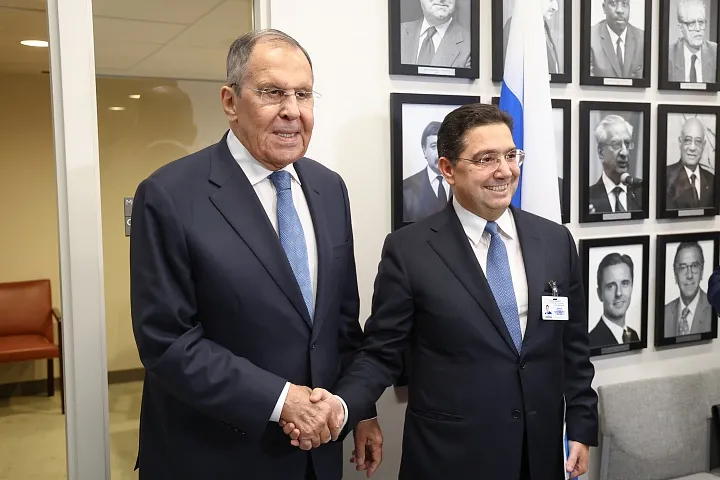
During the high-level week of the 81st session of the United Nations General Assembly held in New York, Morocco's Foreign Affairs Minister Nasser Bourita engaged in significant discussions with his Russian counterpart, Sergey Lavrov, on September 25. This meeting served as a platform for both nations to explore the enhancement of their traditionally friendly relations. The Russian Foreign Affairs Ministry released a statement underscoring the importance of this dialogue, highlighting that it centered around key issues aimed at bolstering the long-standing ties between Morocco and Russia. The ongoing cooperation between these two countries is framed within the context of the Declaration on Enhanced Strategic Partnership, which was signed in 2016, showcasing a commitment to mutual interests and collaboration.
Furthermore, the talks emphasized the necessity for effective coordination in foreign policy, particularly regarding the complex Western Sahara issue and other regional conflicts. Russia's stance on Western Sahara remains strategically ambiguous, as it seeks to balance its geopolitical interests within the region, particularly concerning its relationship with Algeria. While Moscow asserts that it maintains a neutral position, its ties with Algeria, a significant ally and a major purchaser of Russian military equipment, complicate this narrative. Notably, Russia has abstained from voting on resolutions regarding the UN's MINURSO mission, indicating a calculated approach to its involvement in the Western Sahara situation.
Support for the Autonomy Plan and UN Involvement
Morocco's claim over Western Sahara is bolstered by the support of over 130 countries, which regard its Autonomy Plan as the most viable solution to the ongoing dispute. In a recent statement, Russian Foreign Minister Lavrov acknowledged the complexities of the Sahara dispute, which has persisted for five decades. He pointed out that Morocco's Autonomy Plan could serve as a successful resolution if it receives broad agreement from all parties involved and is endorsed by the United Nations. This position reflects a potential shift in Russia's geopolitical stance, as Lavrov previously hinted at a more supportive approach towards Morocco's proposals.
In a related development, US senior advisor Massad Boulos reiterated the significance of the historic Resolution 2797, passed in October 2025, which emphasizes negotiations based on Morocco’s Autonomy Plan. In an interview with France 24, Boulos highlighted the ongoing obstruction faced by the UN-led political process due to the Algeria-supported Polisario Front, which continues to impede progress towards resolution. He noted the lack of responsiveness from Polisario, which is heavily backed by Algeria, in its attempts to contest Morocco’s territorial claims. Despite the momentum gained by Morocco in the international arena, Algeria’s refusal to acknowledge its role in the dispute remains a significant hurdle. As the UN Security Council prepares to convene at the end of October to deliberate on a new resolution, there is increasing pressure from Washington for a decisive conclusion to this long-standing conflict.
As reported by moroccoworldnews.com.