
Strengthening Military Ties: The Morocco-U.S. Defense Initiative
On July 13, 2026, a high-ranking military delegation from Morocco, led by the Inspector General of the Royal Armed Forces, visited the U.S. Africa Command (AFRICOM) headquarters in Stuttgart, Germany. This visit signals a pivotal moment in the evolving military cooperation between Rabat and Washington. The culmination of this visit was the signing of a memorandum of understanding aimed at establishing a joint multidomain training and experimentation center in Morocco, intended to benefit the broader African region. This permanent facility is designed to test emerging technologies and develop combat doctrine, marking a significant shift in Morocco's role from a temporary training destination to a regional hub for military expertise that can be shared with African partners.
A Multidomain Center: A New Approach to Military Training
The training center will operate on the concept of "multidomain" operations, which involves coordinating capabilities across land, sea, air, space, and cyberspace. In modern warfare, the effectiveness of military forces is measured by their ability to integrate sensors with decision-making centers and subsequently with strike capabilities in real-time and under challenging conditions. As such, the center is envisioned to serve as a testing ground for the integration of various systems, rather than evaluating them in isolation. This initiative includes a multidisciplinary training complex, a drone academy, and an innovation and experimentation center, all designed to enhance the readiness of forces in realistic operational conditions, including electromagnetic spectrum operations.
The drone academy will focus on training operators and instructors from Morocco and its African partner nations, emphasizing the integration of unmanned aerial vehicles (UAVs) into military maneuvers while mitigating aerial interference. The innovation center aims to explore low-cost, scalable solutions, which is essential in regions like the Sahel and West Africa, where military forces cannot always rely on expensive and complex systems. The inclusion of drones as a core element of the center reflects lessons learned from recent conflicts in Ukraine, the Middle East, and the Sahel, where drone swarms supported by artificial intelligence have redefined the balance of power in military engagements.
This facility is intended to be much more than a conventional flight school; it will serve as a laboratory for coordinating aerial, terrestrial, and maritime swarms, testing counter-drone systems, and integrating artificial intelligence into tactical decision-making. Such an approach is particularly relevant for Sahel countries facing mobile threats across vast territories with limited security infrastructure. Training personnel to utilize drones for tracking movements, protecting convoys, and relaying information to command centers is expected to be significantly more effective than merely providing advanced equipment without a clear operational doctrine.
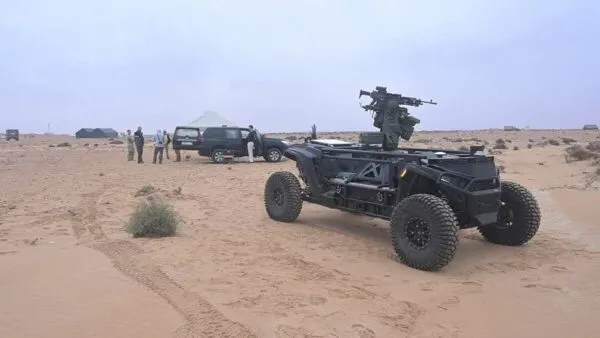
The recent "African Lion 2026" exercise showcased this vision, as major technology companies such as Anduril, Lockheed Martin, and Palantir collaborated with U.S. and Moroccan units to test autonomous vehicles and artificial intelligence platforms, transforming a standard field exercise into a true laboratory for integrating human operators with autonomous robotics.
As reported by resumenlatinoamericano.org.