
Enhancing Financial Ties Between Morocco and the UAE
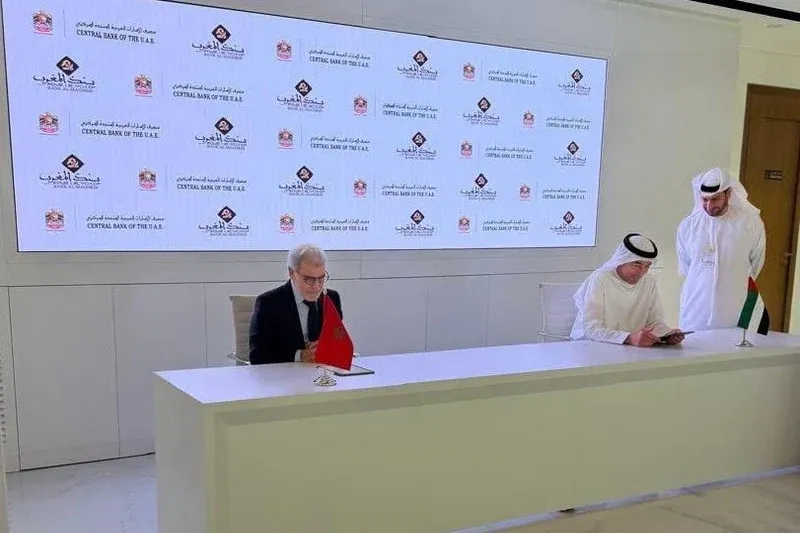
On Saturday, October 3, 2026, in Abu Dhabi, Bank Al-Maghrib and the Central Bank of the United Arab Emirates signed two memoranda of understanding aimed at bolstering collaboration in the areas of banking oversight and Islamic finance. These agreements also seek to explore the integration of payment systems and financial messaging between the two nations, marking a significant step towards enhancing cross-border financial transactions.
The memoranda were signed by Abdul Latif Jakhari, Governor of Bank Al-Maghrib, and Khaled Mohamed Balama, Governor of the Central Bank of the UAE, at the bank's headquarters in Abu Dhabi. This partnership signifies an expansion of cooperation between the two institutions, focusing on improving the efficiency of international financial dealings.
The first memorandum emphasizes the importance of coordinating regulatory and supervisory frameworks, facilitating the exchange of information regarding banks and financial institutions, sharing expertise, and building institutional capacities. Furthermore, it aims to enhance collaboration among entities overseeing the governance of Islamic banking.
One of the key aspects of this agreement pertains to the development of Sharia-compliant financing across borders, particularly in the sectors of trade finance and infrastructure investment. By fostering a robust framework for Islamic finance, both countries aim to attract more investments and streamline financial operations.
The second memorandum focuses on the feasibility of linking instant payment platforms, national card switch systems, and financial messaging networks in Morocco and the UAE. This integration is expected to facilitate the processing and settlement of financial transactions between the two countries, while also promoting the mutual acceptance of local payment cards. This initiative is crucial for enhancing economic ties and supporting the growing trade relations.
Additionally, both parties plan to exchange knowledge on the development of central bank digital currencies (CBDCs), aimed at both individuals and institutions, and explore their potential use in cross-border payments. This forward-thinking approach underscores the commitment to staying abreast of technological advancements in the financial sector.
The collaboration extends to the realms of fintech and the regulatory frameworks governing virtual assets, including cryptocurrencies and stablecoins, as well as consumer protection mechanisms associated with them. Such comprehensive engagement reflects a shared vision for a modern and efficient financial landscape.
In a statement, Abdul Latif Jakhari noted that the signing of these memoranda strengthens the partnership between the two institutions and enhances coordination in regulatory, supervisory, and Islamic finance areas. He pointed out that this collaboration paves the way for the advancement and acceleration of cross-border financial transactions and the potential exploration of CBDCs in payments between the two nations.
Echoing this sentiment, Khaled Mohamed Balama emphasized that the agreement reflects the desire to expand financial and banking cooperation between the UAE and Morocco. He explained that the upcoming phase will involve sharing supervisory experiences, developing Islamic finance solutions, and enhancing the interconnectedness of payment systems to support economic and trade relations between the two countries.
As reported by hespress.com.