
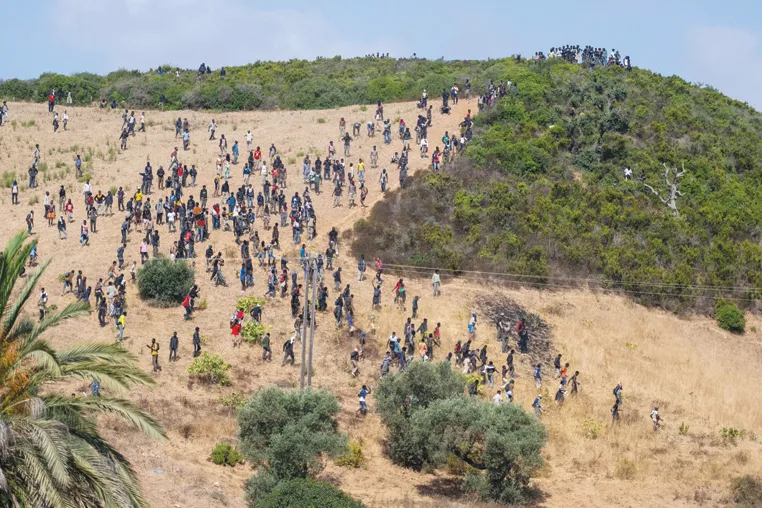

Morocco's Response to Migrant Influx
In a decisive move to control illegal migration, Moroccan authorities have successfully thwarted the attempts of hundreds of migrants seeking to cross the border into the Spanish enclave of Ceuta. This intervention occurred on Saturday when a large group, primarily composed of individuals from sub-Saharan Africa, departed from the vicinity of Fnideq, a town located near the border. Reports from Moroccan media indicate that security forces apprehended a total of 294 individuals during this operation, of which 46 were Moroccan nationals, while the remainder hailed from various sub-Saharan countries.
According to Spain's EFE news agency, Moroccan police and military personnel acted swiftly to disperse the crowd in a mountainous region southwest of Ceuta, resulting in many migrants scattering and several arrests being made. Despite the crackdown, a significant number of migrants remain in the region, likely still hopeful for another opportunity to reach Ceuta.
Previous Incursion and Ongoing Challenges
This recent event follows a troubling incident two weeks prior, where approximately 72,000 migrants, predominantly from Morocco, attempted to breach the border. This chaotic incursion led to the tragic loss of at least 141 lives, mainly due to stampedes and drownings as individuals sought to navigate around border barriers. Following the event, nearly all migrants who successfully reached Ceuta have been repatriated to Morocco, yet the allure of crossing into Europe persists.
A Sudanese migrant, involved in the recent attempts, expressed to AFP the desperation felt by many, stating, "In Ceuta, in Europe, people are better cared for. There's no work here. There's no money. There's no housing. There is absolutely nothing, I swear." This sentiment highlights the dire economic conditions that motivate individuals to risk their lives in pursuit of a better future.
In response to the recent surge in migration attempts, Morocco has beefed up security measures. Spanish criticism of Moroccan handling of the previous incursion has led to the establishment of checkpoints on roads leading to Fnideq, alongside increased naval patrols and the use of surveillance drones in the waters near Ceuta. This situation has not only escalated tensions between Spain and Morocco but has also strained Spain's relations with other EU member states, which have voiced concerns regarding the security of the EU's external borders.
Compounding these challenges, social media platforms have become a breeding ground for misinformation, with numerous posts falsely claiming that crossing into Ceuta guarantees entry into the European Union. Reports from the BBC indicate that various Instagram accounts are promoting the myth that border crossings are easy and even offering services to facilitate such attempts, often for a fee.
As reported by global.chinadaily.com.cn.
