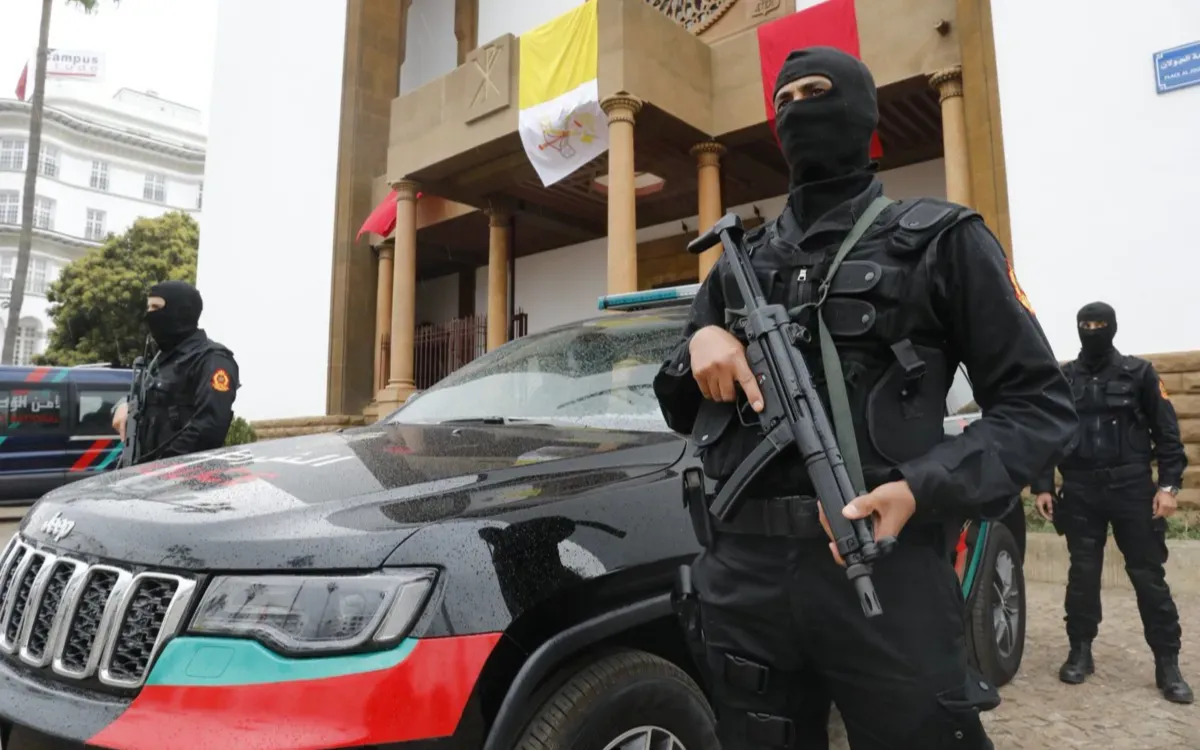

The landscape of law enforcement in Morocco is undergoing a significant transformation, as the country becomes a focal point for the capture of international fugitives. Drug lords, con artists sought by US authorities, kidnapping suspects, and individuals armed with false documents are being apprehended in increasing numbers. Since the beginning of this year, approximately thirty individuals wanted by Interpol have reportedly been intercepted within Moroccan borders, signaling a robust crackdown on international crime.
On July 11, a 35-year-old German national of Kosovar descent believed he could enter Morocco undetected through Casablanca Airport. However, police checks revealed that he was on the run from German authorities due to charges related to international drug trafficking and arson stemming from gang conflicts. Such arrests have become almost routine; according to a report by TelQuel, around thirty individuals sought by Interpol have been apprehended in the kingdom since January alone.
The profiles of these apprehended individuals reveal the serious nature of the crimes they are associated with. In early July, an Indian fugitive wanted in the United States for an alleged scam exceeding two million dollars was captured in Casablanca. A few months earlier, a Dutch national accused of defrauding 135 investors out of nearly five million euros was arrested in Martil. In the same vicinity, authorities also apprehended Indonesian national Michael Steven, who is wanted after allegedly embezzling around 165 million dollars.
The Refuge Becomes a Trap
Notably, these operations are no longer limited to isolated high-profile captures. On June 8, eleven individuals were arrested simultaneously in Marrakech and Tangier. Ten of these suspects were wanted by Interpol, particularly at the request of France, Belgium, and the Netherlands, for cases involving international drug trafficking, money laundering, and organized crime. Some names had already hinted at the effectiveness of these operations. Félix Bingui, known as “Le Chat,” the alleged leader of the Yoda clan from Marseille, was apprehended in Casablanca in March 2024 and subsequently extradited to France in January 2025. The following year, Badiss Bajjou, suspected of orchestrating several kidnappings targeting the French cryptocurrency sector from Morocco, was located and arrested in Tangier after French investigators provided Moroccan authorities with GPS coordinates of his hideout.
Even changing one's identity is no longer a foolproof method for evading capture. On August 6, a 25-year-old Dutch national sought by his home country for alleged involvement in a criminal network was arrested in Oujda while staying illegally in Morocco. This series of arrests can be attributed to the systematic organization of Moroccan law enforcement. The intelligence services of the DGST (General Directorate for Territorial Surveillance) are instrumental in locating certain suspects, while the National Central Bureau of Interpol in Rabat directly shares information with the Central Directorate of Judicial Police. Its head, Mohammed Dkhissi, serves multiple roles, including Director of the Judicial Police, Chief of Interpol Morocco's BCN, and Vice-President of Interpol for Africa.
Rising Extradition Requests Reflect Growing International Cooperation
The trend in extradition requests follows a similar upward trajectory. Morocco received 96 extradition requests in 2025, compared to 63 the previous year, according to data from the public prosecutor's office. This marks an increase of over 50% in just twelve months. Once perceived by some foreign criminals as a potential hideout, Morocco is now becoming a territory where entering the country could mean an end to their freedom. From Casablanca to Tangier, Marrakech, Martil, and Oujda, the recent spate of arrests demonstrates the heightened risks associated with seeking refuge in Morocco.
As reported by bladi.net.