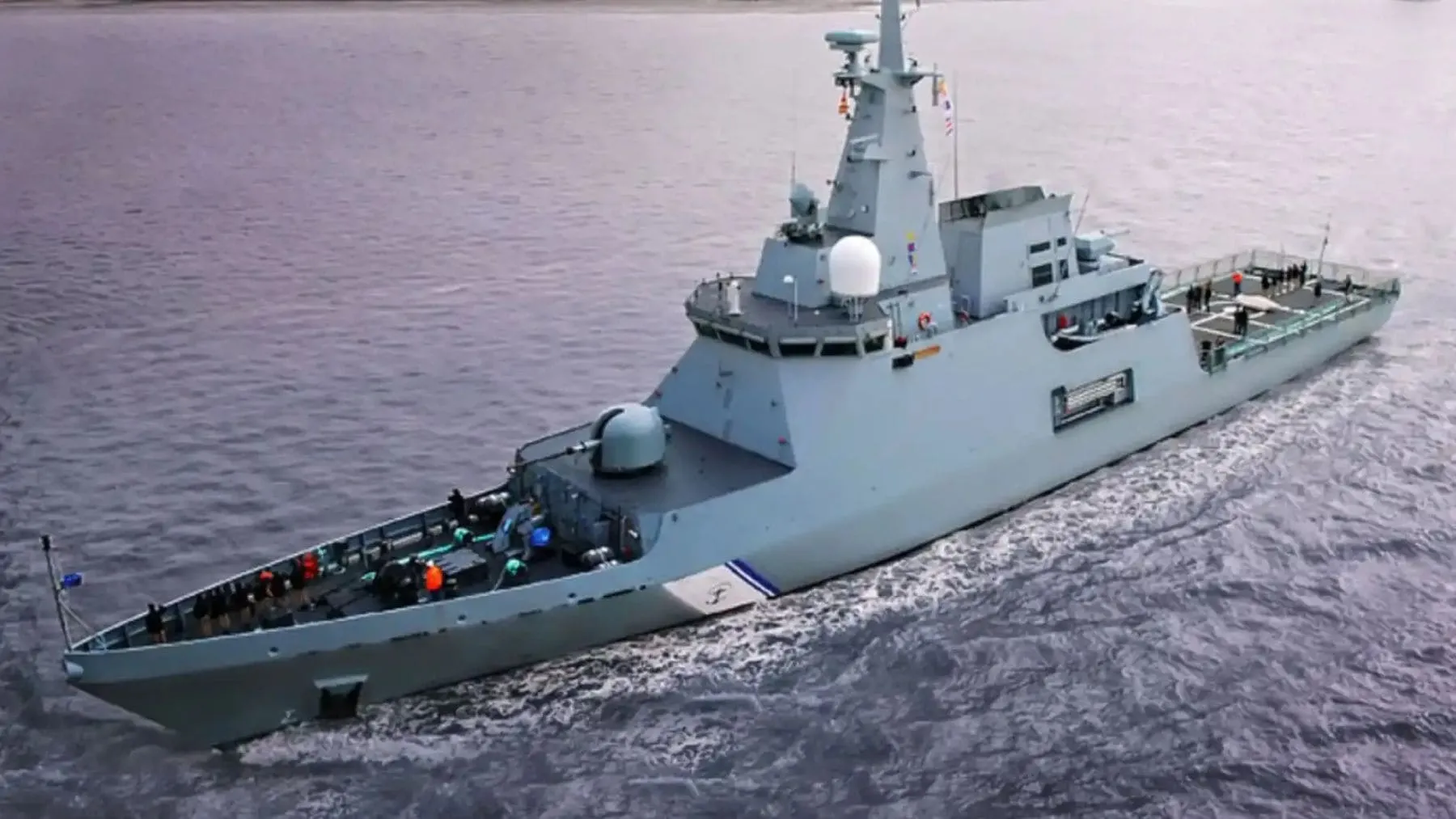

Morocco's Significant Naval Development
A new military vessel has recently embarked on trials in the Bay of Cádiz, which, at first glance, may seem like just another technical evaluation. However, this is far from an ordinary event. The high-seas patrol boat, being constructed by Navantia for the Royal Moroccan Navy, is currently undergoing sea trials, with its delivery slated for the summer of 2026. This development marks a pivotal moment in naval cooperation between Spain and Morocco, as it signifies Spain's return to manufacturing warships for Morocco after nearly four decades. This comes at a time when Rabat is keen on bolstering its naval presence.
Technical Specifications and Strategic Importance
The significance of this patrol vessel extends beyond mere hardware; it represents a substantial industrial, military, and political signal emerging from the shipyards of San Fernando. Infodefensa notes that the last warship constructed by a Spanish shipyard for Morocco was the corvette Lieutenant Colonel Errahmani, delivered back in 1983 from the former Bazán, now integrated into Navantia. This context explains why the new patrol boat is receiving heightened scrutiny. It is not merely a collection of metal, engines, and radar systems; it symbolizes a renewed naval cooperation between Spain and Morocco, which had been largely stagnant for years.
The patrol vessel, classified as a high-seas ship, is designed for prolonged surveillance operations far from the coast. While it may not be as large as a frigate, it is certainly more robust than a simple boat. This vessel is capable of monitoring maritime zones, assisting in rescues, escorting ships, or intervening in complex situations. Based on Navantia's Avante 1800 design, the ship measures 87 meters in length, 13 meters in width, and displaces approximately 2,020 tons at full load. It can reach speeds of up to 24 knots, allowing for swift responses when necessary.
Navantia celebrated the ship's launch on May 27, 2025, at its San Fernando shipyard, where Captain Mohammed El Fadili emphasized the "bonds of friendship and cooperation" between the two nations. Ricardo Domínguez, President of Navantia, hailed the event as a milestone in technological collaboration. The Avante 1800 is designed for extended missions with a reduced crew, which is more significant than it may appear. A smaller crew onboard translates to lower operational costs, greater automation, and simplified operations during lengthy maritime deployments.
Navantia describes the Avante family as adaptable for various missions, ranging from patrol to combat, with customizable options such as flight decks, fast boats, and advanced sensors or weaponry tailored to client requirements. This makes it akin to acquiring a modular naval platform, rather than a fixed product. In this instance, the patrol vessel is equipped with a helicopter deck and has the capacity to carry two RHIB-type fast boats. These smaller crafts are invaluable for inspections, boardings, rescues, or rapid movements near other vessels. Though the final armament configuration has yet to be officially disclosed, the Avante 1800 design accommodates advanced guns and defense systems.
The sea trials are crucial for evaluating whether the ship performs as expected outside the shipyard. Critical checks include engine performance, stability, electronic systems, navigation, and platform responsiveness under real-world conditions. This phase is vital, as it transitions the vessel from being a mere blueprint to demonstrating its operational viability. According to Infodefensa, the patrol boat has already undertaken initial sorties from San Fernando to fine-tune equipment and systems ahead of its delivery. Any issues discovered at this stage can be rectified before the Royal Moroccan Navy officially takes possession; it is preferable to identify problems near Cádiz than during an actual mission.
The contract also encompasses technical and logistical support, including spare parts, tools, technical documentation, and training for Moroccan personnel in Spain. This aspect is critical, as a modern vessel requires more than just a key handover; it necessitates ongoing maintenance, spare parts, and a well-trained crew from day one. The impact on Spain is also substantial, with the construction of the patrol vessel generating over one million hours of work and approximately 1,100 jobs—both direct and indirect—over three years. For the Bay of Cádiz, where the naval industry is a significant contributor, this is no small achievement.
Such projects sustain a comprehensive supply chain, involving engineers, welders, technicians, suppliers, training, logistics, and testing. Ultimately, a ship of this caliber does not emerge from a single workshop; it is the product of a network of companies that rely on contracts to remain competitive beyond Spain's borders. For Morocco, this patrol vessel arrives amid a broader military modernization effort. In recent years, the country has enhanced its drone capabilities, air defense systems, and other technologies, while its navy had lagged behind in comparison to other military capacities. This new vessel helps to bridge that gap.
Maritime control is increasingly critical, as Morocco eyes the Atlantic, the Mediterranean, and the surroundings of the Strait of Gibraltar, where surveillance, commercial traffic, and security are paramount. While a single patrol vessel may not alter the naval balance by itself, it certainly adds to Morocco's presence, autonomy, and responsiveness in maritime affairs.
As reported by okdiario.com.