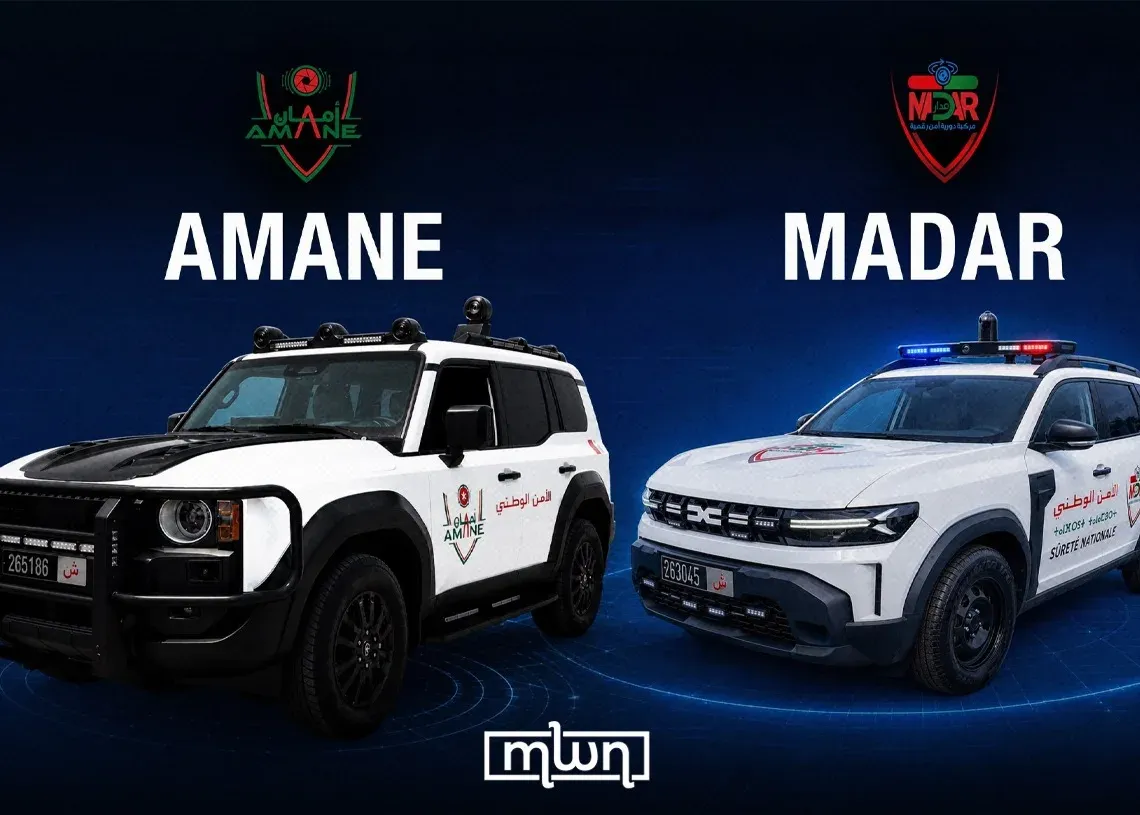

Introduction of AI-Equipped Patrol Vehicles
The General Directorate of National Security (DGSN) in Morocco has initiated a significant advancement in its policing capabilities by deploying state-of-the-art AI-equipped patrol vehicles in the bustling city of Casablanca. These innovative vehicles, named “Amane” and “Madar,” are designed to integrate cutting-edge technology such as facial recognition, automatic number plate reading, and comprehensive 360-degree real-time surveillance into the daily operations of law enforcement. This initiative marks a pivotal step in the DGSN's commitment to modernizing security protocols and enhancing the effectiveness of field officers through the integration of connected technologies.
Features and Capabilities of Amane and Madar
The Amane patrol vehicle is outfitted with an advanced system combining artificial intelligence, real-time reconnaissance capabilities, and impressive operational autonomy. Its sophisticated 360-degree surveillance system is equipped with eleven customized cameras that include roof-mounted units for full-angle coverage and a panoramic camera capable of completing a full rotation in just three seconds, with the ability to zoom in up to 40 meters. Additionally, this vehicle features three Automatic Number Plate Recognition (ANPR) cameras that can identify Moroccan vehicle registration plates with an impressive accuracy rate of 90%, which can increase to 95% under operational circumstances. An internal camera dedicated to facial recognition serves to identify both the driver and passengers, enhancing in-vehicle security measures.
Moreover, the Amane vehicle is directly connected to internal security networks, enabling officers to instantly verify the identities of individuals or vehicles against central databases in real time. Events detected by the vehicle are automatically tagged with precise geolocation data, ensuring that both vehicle plates and identified individuals are accurately recorded. Another remarkable feature of the Amane is its capacity for continuous operation, lasting up to 16 hours without interruption.
On the other hand, the Madar patrol vehicle transforms standard automobiles into advanced mobile surveillance platforms utilizing the same AI technology as the Amane. This vehicle is equipped with a 360-degree vision system that actively monitors the surroundings and identifies individuals and vehicles in real time. A notable highlight of the Madar is its uniquely designed 3D-printed flashing beacon, which houses high-resolution cameras capable of capturing high-speed images without distortion. This system can effectively monitor up to six traffic lanes simultaneously, with three cameras allocated to each lane and a central camera ensuring comprehensive coverage, including capabilities for both license plate recognition and pedestrian identification.
The introduction of these AI-equipped patrol vehicles raises important governance questions regarding biometric identification and automated database matching in everyday policing. This new application of AI technology falls within the jurisdiction of Morocco’s National Commission for the Control of Personal Data (CNDP). In September 2025, the Ministry of Digital Transition and Administrative Reform formalized an agreement with the CNDP to establish a national responsible AI platform. Minister Delegate Amal El Fallah Seghrouchni has positioned Morocco as a potential “third voice” in the global discussion on AI governance, setting it apart from frameworks established by the US, Europe, and China, while emphasizing ethical considerations and national sovereignty.
However, the DGSN's recent announcement has not clarified critical aspects such as data retention periods, oversight mechanisms, or the management of facial recognition and pedestrian identification data collected during patrols. These issues have spurred considerable regulatory efforts in other regions, such as the EU AI Act, which categorizes real-time remote biometric identification in public spaces as a prohibited practice, allowing only limited exemptions for law enforcement. As Morocco continues to scale its AI deployments, these questions are likely to play a significant role in shaping the future of the country's AI governance framework.
As Morocco advances its AI capabilities across various sectors, including public services and infrastructure, the customs authority has begun an AI-driven risk management initiative in collaboration with the World Customs Organization. Furthermore, the country is in the process of establishing the Nexus AI Factory, a $1.2 billion project touted as Africa's first sovereign AI infrastructure platform, located in the suburbs of Casablanca.
As reported by iafrica.com.