
Morocco's Stance on Ceuta, Melilla, and Other Disputed Territories
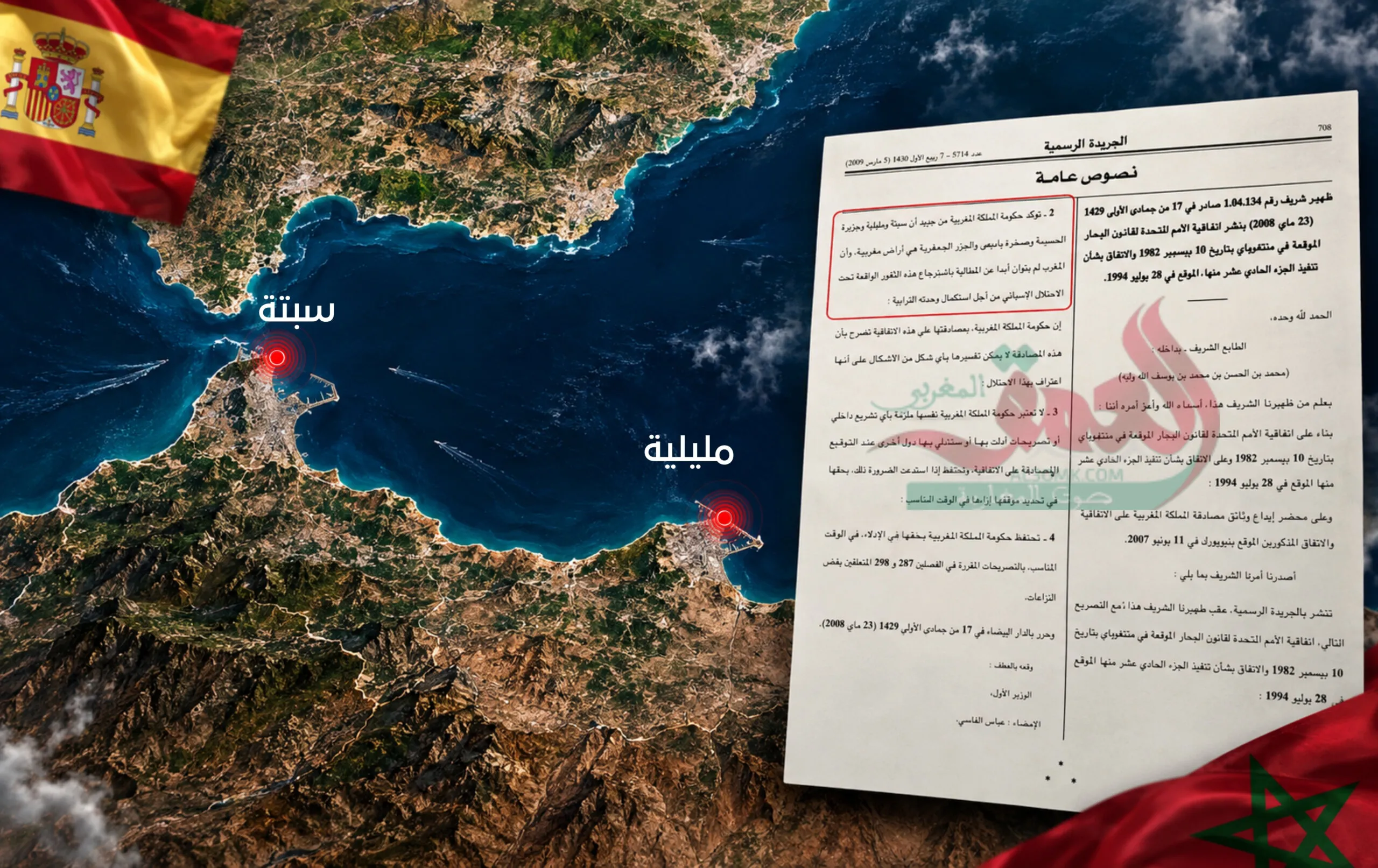
In light of the recent migration crisis that has brought the Spanish enclaves of Ceuta and Melilla back into the spotlight of Moroccan-Spanish relations, a significant official document from Morocco has resurfaced, emphasizing the kingdom's position on these territories. This document, originating in 2009, explicitly states Morocco's claim over Ceuta, Melilla, the island of Alhucemas, the rock of Peñón de Vélez de la Gomera, and the Chafarinas Islands, all of which are currently under Spanish control. As documented in the Moroccan official gazette number 5714, published on March 5, 2009, the Moroccan government affirmed that these areas are indeed Moroccan lands.
The official gazette, which includes a statement from the Moroccan government accompanying the publication of the United Nations Convention on the Law of the Sea, articulates that "Ceuta, Melilla, the island of Alhucemas, the rock of Peñón de Vélez de la Gomera, and the Chafarinas Islands are Moroccan territories." The document further indicates that Morocco has consistently demanded the reclamation of these territories, which are viewed as occupied by Spain, as part of its efforts to complete its territorial integrity.
This declaration is part of a royal decree number 1.04.134 issued on May 23, 2008, which pertains to the publication of the aforementioned UN convention. Former Prime Minister Abbas El Fassi endorsed this decree in Casablanca, underscoring Morocco's legal and political stance regarding these territories. Notably, the document does not merely reiterate Morocco’s claims but also clarifies its legal position, stating that the ratification of the UN Convention cannot be interpreted as an acknowledgment of Spanish occupation.
Furthermore, the archival document emphasizes that the Moroccan government does not consider itself bound by any internal legislation or statements made by other nations regarding the agreement. It retains the right to articulate its position about these issues at a suitable time, including expressing its views on dispute resolution as outlined in articles 287 and 298 of the convention.
The relevance of this document is heightened in the current context, not necessarily because it presents a new position from Morocco—having been articulated over 17 years ago—but because it provides a clear and consistent description of Morocco's perspective regarding Ceuta and Melilla amid the renewed political and diplomatic tensions between the two countries. The current climate has shifted from the migration challenges faced by Ceuta to internal political debates within Spain, alongside intensified discussions regarding the sovereignty of these cities.
Recently, Moroccan Justice Minister Abdellatif Ouahbi reignited the discussion surrounding Ceuta and Melilla, asserting Morocco's historical and geographical rights concerning these cities, emphasizing that the issue remains a priority in Morocco's negotiations with Spain, adhering to a long-term strategy. Shortly thereafter, Minister of Religious Endowments and Islamic Affairs Ahmed Toufiq highlighted the historical significance of Ceuta, reinforcing the commitment of Moroccans to "liberate all of their territories," which sparked media interest in Spain and revived the term "occupied cities" in public discourse.
In response, Spanish Prime Minister Pedro Sánchez disclosed that Madrid summoned Moroccan Ambassador Karima Benyaich on August 21, following the remarks made by Ouahbi and Toufiq, reiterating Spain's stance that Ceuta and Melilla are unequivocally Spanish, while Spanish Foreign Minister José Manuel Albares emphasized that the status of these cities is not subject to negotiation with Morocco, asserting that "there have been, are, and will be no discussions regarding their sovereignty."
As reported by al3omk.com.