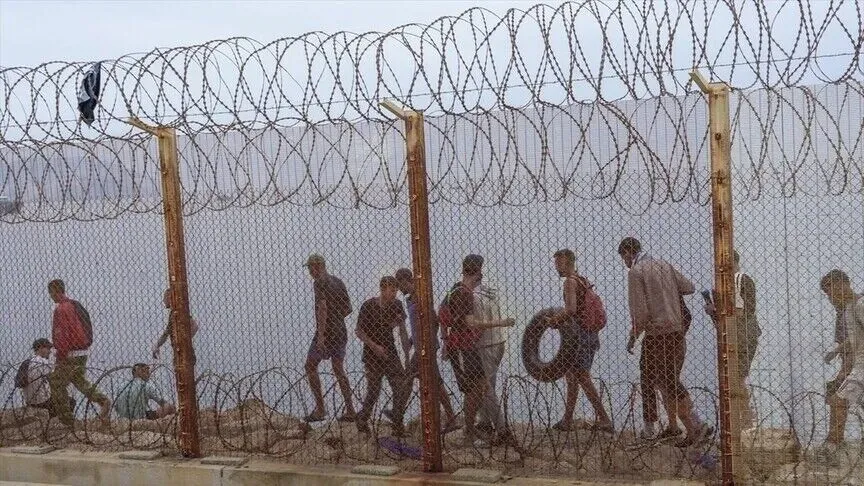

The Moroccan authorities have taken significant measures to strengthen security along the border crossing between the Moroccan city of Fnideq and the Spanish-administered city of Ceuta. As of Friday, August 15, 2026, officials have installed barbed wire along the entire border area, stretching even into the waters of the sea. This action comes in response to heightened security alerts aimed at preventing any illegal mass crossings, especially following anonymous calls on social media that designated Saturday as a day for potential unlawful migration attempts.
According to reports from Anadolu Agency, the implementation of the barbed wire is part of a broader strategy to thwart any repeat of the mass migration waves that have occurred in the past towards Ceuta. In addition to the physical barriers, Moroccan authorities have intensified their search operations and security presence in Fnideq, which is in close proximity to the crossing point.
The timing of these measures is critical, as the Moroccan Ministry of the Interior has indicated it has been monitoring several anonymous posts on social media that allegedly incite individuals to organize collective illegal crossings into Ceuta and Melilla on the specified date of August 15. The cities of Melilla and Ceuta, located in northern Morocco, along with the Chafarinas Islands and other rocky islands in the Mediterranean Sea, are administered by Spain, although Morocco considers them to be "occupied Moroccan territories."
On Wednesday, Rashid Khalfi, a spokesperson for the Ministry of the Interior, revealed that there has been a notable increase in the circulation of posts and messages encouraging unlawful mass crossing attempts towards Ceuta and Melilla on August 15. The ministry denounced these calls as dangerous and exploitative of migration issues, labeling them as acts of incitement that violate Moroccan law.
Khalfi emphasized that the authorities are closely monitoring the situation and have made necessary preparations to counter any illegal crossing attempts and to apprehend those attempting to participate in such activities. The border with Ceuta experienced a surge of tens of thousands of Moroccan migrants between July 29 and July 31, 2026, marking one of the largest waves of illegal crossings, although most returned to Fnideq shortly after.
Recently, the National Human Rights Council of Morocco reported an increase in fatalities related to the crossing attempts, with the number rising to 14, while Spanish data indicated that 80 people had died in these incidents. Moroccan authorities estimated that around 40,000 individuals attempted the crossing, while Spanish officials suggested the number exceeded 70,000. Migrants from various countries continue to seek irregular migration routes through Morocco towards Europe, driven by economic crises and armed conflicts in their homelands.
As reported by aa.com.tr.