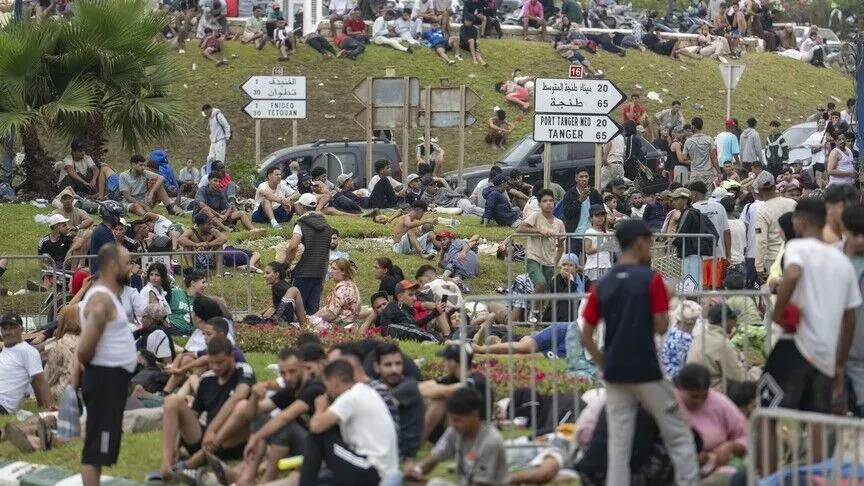

Mass Migration Attempts to Ceuta
On August 2, 2026, the Moroccan Ministry of Interior announced a staggering influx of approximately 40,000 individuals who attempted to cross into the Spanish-administered city of Ceuta. This surge in migration efforts tragically resulted in the loss of 11 lives. The news was conveyed during a video statement by the ministry's spokesperson, Rashid Khalfi, who addressed the recent events unfolding at the crossing points leading to both Ceuta and Melilla, another city under Spanish control.
This incident marks the first official response from the Moroccan government regarding the growing wave of mass migration towards these cities. Khalfi detailed that while the actual number of migrants heading towards Ceuta reached around 40,000, approximately 1,135 individuals were reported to be attempting to reach Melilla. It was noted that all migrants who successfully reached Melilla were subsequently returned immediately.
Factors Behind the Migration Crisis
The tragic events led to one accidental death resulting from a fall from a rocky area near Ceuta, alongside 10 fatalities due to drowning. Khalfi elaborated on the findings from various data collected and analyzed, indicating that these incidents were not spontaneous or circumstantial. Instead, they were attributed to a complex interplay of several factors. Leading these was the malicious exploitation of digital spaces, the propagation of misleading information, the involvement of human trafficking networks, and misinterpretations of legal and administrative data that falsely suggested an easy and consequence-free access to European territories.
Furthermore, Khalfi highlighted that recent judicial decisions by Spanish authorities, which imposed restrictions on the immediate return of certain irregular migrants intercepted at sea, had fostered a belief among some migrants that they could evade immediate repatriation. This perception contributed to a distinct pattern of irregular migration attempts characterized by swimming across the waters, as many believed this method offered better chances of avoiding immediate return.
Responding to reports of additional fatalities in Ceuta, Khalfi confirmed that Moroccan authorities are actively engaged in verifying these claims through official cooperation and coordination channels with their Spanish counterparts. This includes determining the actual number of individuals involved, their identities, and nationalities to ensure that necessary legal, administrative, and humanitarian procedures are followed. Spanish media recently reported that the number of bodies recovered from the waters near Ceuta has risen to 88, with the newspaper El País stating that local authorities have prepared the city’s morgue to accommodate around 200 bodies as search and recovery operations continue in the wake of this recent wave of irregular migration.
Additionally, Spanish security sources indicated that approximately 69,500 irregular migrants who entered Ceuta in recent days have returned to Morocco. In response to these challenges, Spanish authorities have completed the installation of a 500-meter floating security barrier at the Tarajal border crossing, aiming to curb the ongoing attempts at irregular crossings from the Moroccan side. In the days leading up to these events, tens of thousands of Moroccans flocked to the vicinity of the border fence with Ceuta, seeking to reach the city and subsequently Europe through unauthorized means. Ceuta and Melilla, situated on Morocco's northern coast, remain under Spanish administration, while Morocco continues to assert claims for their return.
As reported by aa.com.tr.