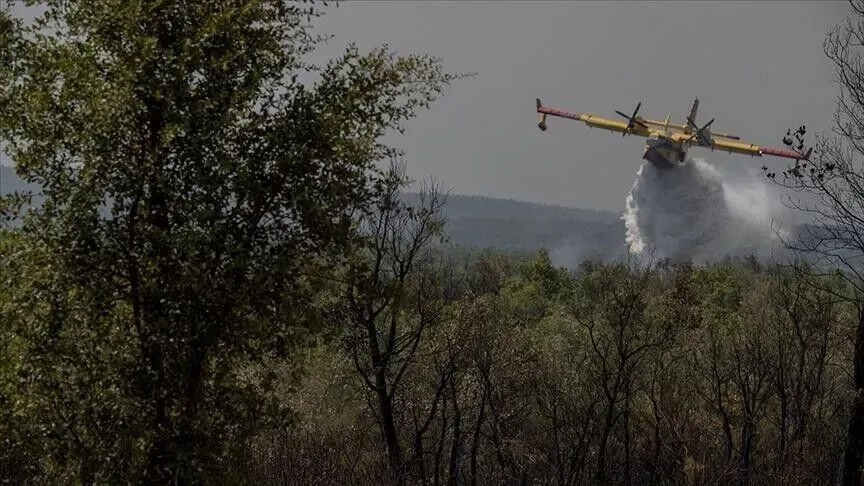

On July 26, 2026, Moroccan authorities successfully extinguished forest fires that had erupted in the provinces of Tetouan and Taroudant, located in northern and central Morocco, respectively. These wildfires had devastating effects, consuming approximately 12 hectares (30 acres) of valuable forest cover; fortunately, there were no reported casualties. A representative from the National Agency for Water and Forests, who spoke on the condition of anonymity due to media restrictions, informed Anadolu that the fires ignited on Friday, but swift action by firefighting teams allowed them to regain control of the situation.
To combat the flames, authorities strategically deployed Canadair amphibious firefighting aircraft along with an EC225 helicopter, which provided essential support to the ground crews battling the blazes. The fire in Taroudant was particularly severe, destroying around 8 hectares (20 acres) of forest, while the Tetouan fire accounted for approximately 4 hectares (10 acres) of damage. In a broader context, the National Agency for Water and Forests revealed that Morocco had experienced a staggering 310 forest fires since the beginning of the year, as of July 20, devastating an estimated 1,850 hectares (4,572 acres) of forest land.
In light of this alarming trend, Morocco has implemented an early warning system designed to assess the risk of wildfires. Managed by the National Agency for Water and Forests, this system issues regular alerts based on current weather conditions and the state of vegetation cover. Under this protocol, a red alert signifies an extreme wildfire risk, while an orange alert indicates a high risk, prompting enhanced preventive measures and the cessation of activities that could potentially ignite fires. To exacerbate the situation, the General Directorate of Meteorology has issued forecasts predicting an intense heat wave, with temperatures soaring as high as 46°C (114.8°F) in several regions, further increasing the threat of wildfires.
As reported by aa.com.tr.