

Strategic Importance of the Tomato Sector for Morocco
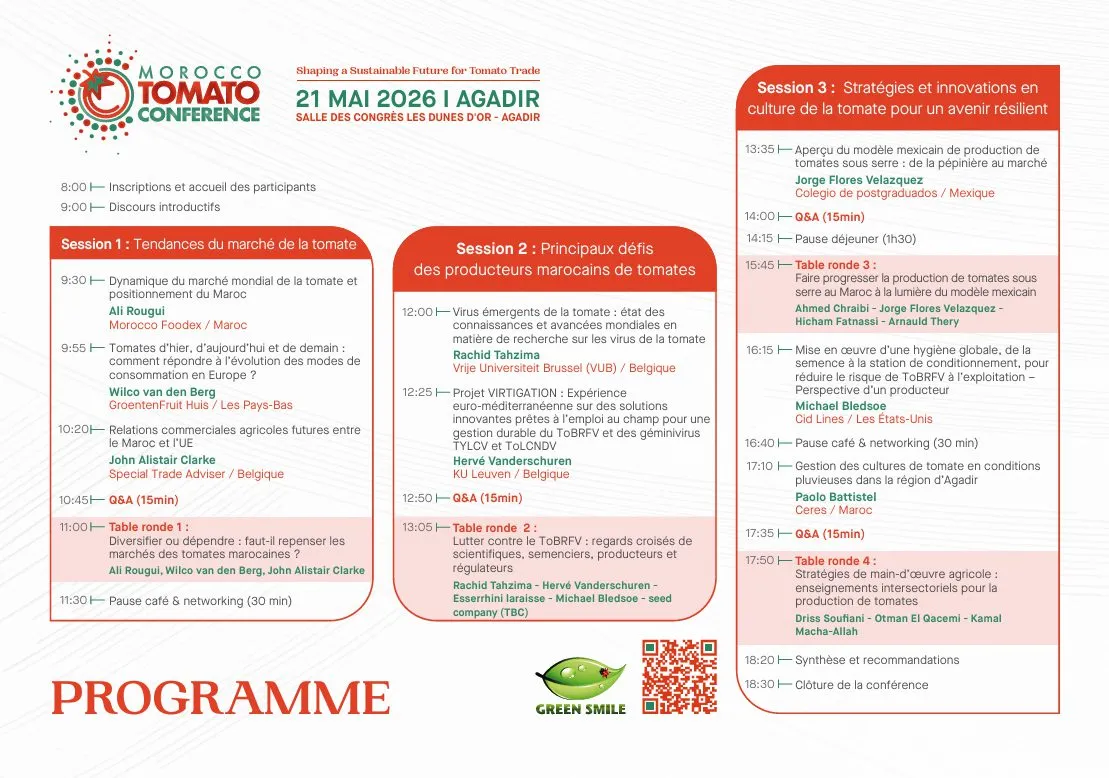
The sixth edition of the Morocco Tomato Conference (MTC), held on May 21, 2026, in Agadir, has emerged as a pivotal event for the technical and strategic discussions surrounding Morocco's tomato industry. Organized by Green Smile under the auspices of the FIFEL and the Souss-Massa Agricultural Chamber, the event attracted over 600 participants, 56 exhibitors, and delegations from more than 25 countries, all converging to address crucial issues of competitiveness, phytosanitary resilience, and the evolution of international markets. Today, tomatoes stand as one of the cornerstones of Morocco's agricultural exports, with the country ranking among the top global exporters of fresh tomatoes. The production is heavily concentrated in the Souss-Massa region, which is recognized as the national hub for greenhouse cultivation intended for European markets. In this context, the Morocco Tomato Conference 2026 distinguished itself with a much more strategic approach compared to previous editions. Discussions transcended mere technical dimensions to encompass international trade challenges, European regulatory pressures, phytosanitary sovereignty, and the overall competitiveness of the Moroccan tomato sector. The central theme for this edition, "Shaping a Sustainable Future for Tomato Trade," reflects this evolution towards a more comprehensive perspective on the industry.
European Markets: Opportunities and Challenges
The first segment of the conference was dedicated to the evolution of global tomato trade and Morocco's positioning against its direct competitors, including Spain, the Netherlands, Mexico, and Turkey. The debates addressed several sensitive topics: the changing landscape of European consumption alongside rising sustainability demands, recurring trade tensions between Spanish producers and Moroccan exporters, the necessity for Morocco to diversify its export markets, and the focus on premium segments that offer greater added value. Many speakers highlighted that Morocco's competitiveness can no longer rely solely on production costs or export volumes; it must increasingly incorporate varietal differentiation, sanitary quality, traceability, and climate resilience. Furthermore, the issue of viral pressure took center stage in the discussions at the 2026 edition, with the Tomato Brown Rugose Fruit Virus (ToBRFV) recognized as a major threat to greenhouse production in Morocco and the Mediterranean basin. Scientific sessions also tackled other viruses such as the Tomato Yellow Leaf Curl Virus (TYLCV) and the ToLCNDV, along with biosafety strategies in agricultural operations and integrated health management solutions. The Euro-Mediterranean project VIRTIGATION was introduced as one of the cooperative programs aimed at developing sustainable responses to emerging viruses affecting tomato production. Several international seed companies present in Agadir showcased their new resistant varieties against ToBRFV, signaling an acceleration of varietal competition concerning viral resistances in the greenhouse tomato sector.
One of the highlights of the conference was the presentation of the Mexican greenhouse production model. Organizers aimed to use Mexico as an international benchmark to identify transferable improvement pathways for the Moroccan sector. Discussions revolved around the organization of greenhouse farms, structuring the export chain, the relationship between nurseries, producers, and markets, logistical competitiveness, and the resilience of production systems. This comparative approach illustrates the Moroccan operators' desire to anticipate future changes in the global tomato market rather than merely adopting a defensive stance against European pressures. Additionally, another significant evolution at the 2026 edition was the integration of agricultural labor issues into strategic discussions, focusing on the availability of skilled labor, organization of work in greenhouses, increasing social constraints in exporting farms, and the need for professionalization. Concurrently, various interventions addressed management strategies under rainy conditions in the Agadir region, particularly following the climate disruptions observed in recent seasons. Overall hygiene issues, from seed to packaging stations, were also underscored as essential levers for reducing sanitary and commercial risks.
In recent years, the Morocco Tomato Conference has gradually established itself as a crucial dialogue platform for the entire tomato ecosystem in Morocco. The 2026 edition confirms several overarching trends: the rising significance of phytosanitary issues in export competitiveness, the growing importance of varietal resistances, European regulatory pressures, the need to enhance climate and organizational resilience, and the emergence of a strategy focused on upgrading Moroccan productions. Given that the Moroccan tomato sector remains highly dependent on external markets, the conference in Agadir now serves as a strategic coordination space among producers, exporters, researchers, seed companies, and technology solution providers.
As reported by agrimaroc.ma.
