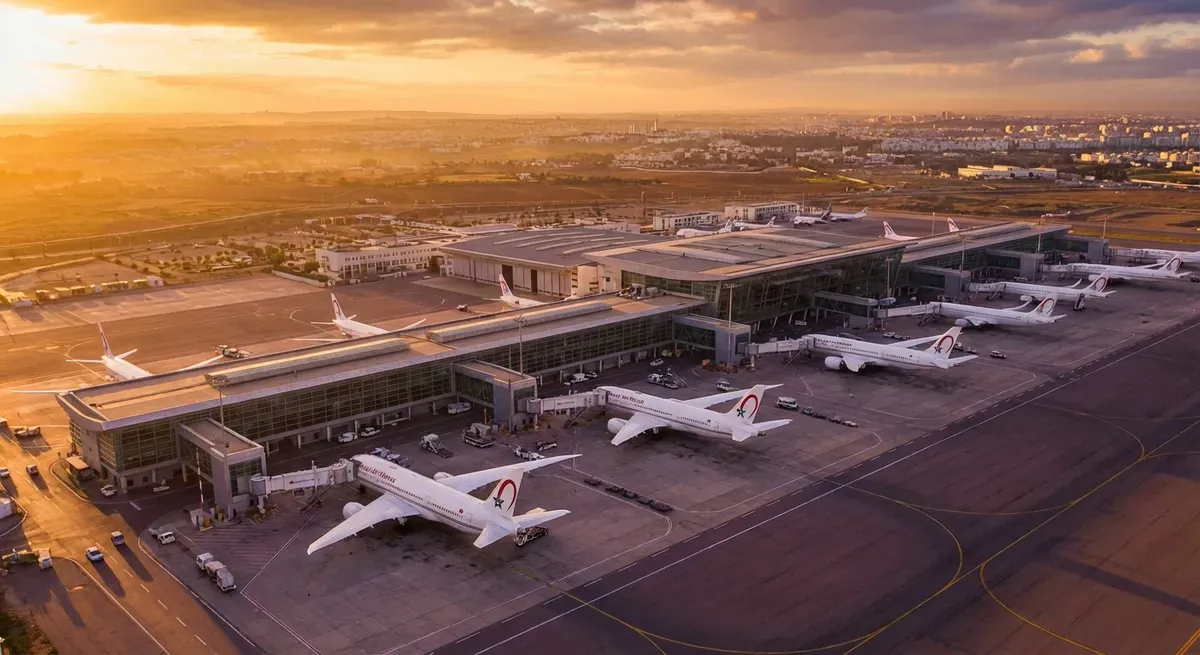

Since late February 2026, over 52,000 flights have been canceled across the Middle East, causing significant disruptions in air travel. Major hubs like Dubai, Doha, and Abu Dhabi—key connectors between Europe, Asia, and Africa—are currently operating at reduced capacities. Amid this chaos, Morocco is strategically positioning itself to emerge as a new aviation power in the region. Royal Air Maroc is in negotiations to acquire grounded Boeing 787 Dreamliners from Qatar Airways and Emirates, with the explicit goal of transforming Morocco into a credible intercontinental airport hub based in Casablanca.
The Middle East's Airspace Closure: A Significant Gap in Global Networks
The current air traffic crisis is unprecedented. Following the American-Israeli strikes against Iran in early March, the airspaces of Iran, Iraq, Kuwait, and Syria have been closed under NOTAM regulations. The airspace of the United Arab Emirates is only partially open, with strictly controlled entry points. The repercussions of these closures are monumental. Qatar Airways has been operating a reduced and temporary flight program since March 18, serving around sixty destinations instead of the usual 150. A portion of its fleet has been sent to long-term storage in Teruel, Spain, according to Flightradar24 data. Similarly, Emirates is functioning at a degraded level, allowing transit passengers through Dubai only if their onward connections are confirmed.
Major airlines are feeling the pinch as well; Lufthansa Group has suspended flights to Dubai, Abu Dhabi, Amman, and Erbil until March 28, while British Airways has extended its cancellations to Dubai, Doha, and Amman until May 31, as reported by Euronews. Consequently, the air corridor that once linked Europe to Southeast Asia and East Africa via the Gulf is now largely unusable.
Morocco's Strategy: 38 Billion Dirhams and a Fleet of Boeing 787s on the Horizon
Morocco's ambition to become a regional aviation hub is not a spontaneous decision. The "Airports 2030" strategy outlines an investment exceeding 38 billion dirhams (approximately 3.8 billion euros) to increase the national airport capacity from 36.6 million to an impressive 80 million passengers per year. Central to this initiative is a new terminal at Mohammed V Airport in Casablanca, designed to serve as a major connection hub with a capacity of 20 million passengers annually. The estimated cost for this terminal is 15 billion dirhams, with completion expected by 2029. The project further includes a new parallel runway measuring 3,700 meters, additional aircraft parking spaces, and direct access to the future high-speed train line connecting Kenitra to Marrakech.
One of the most significant developments comes from Royal Air Maroc (RAM), which is reportedly engaging in advanced technical negotiations with Qatar Airways and Emirates to acquire grounded Boeing 787 Dreamliners, either through leasing contracts or direct purchases. The objective is to secure 15 additional aircraft by the end of 2026, as both Boeing and Airbus have backlogs in their order books until at least 2029. Currently operating a fleet of around fifty aircraft, including ten Boeing 787s, RAM aims to expand its fleet to 200 planes by 2037, with the 2030 World Cup—co-hosted with Spain and Portugal—serving as a catalyst for this growth.
For French travelers, Morocco's expansion presents new travel options. RAM has announced nine new international routes for 2026, including Casablanca to Los Angeles, set to launch on June 7, with three weekly flights operated on the 787. Casablanca could thus become a credible alternative to Istanbul (Turkish Airlines) or Helsinki (Finnair) for intercontinental connections, particularly to West Africa and the Americas. While Casablanca does not yet cover routes to Asia, it is establishing itself as a vital hub for connections between Africa and the Americas.
In terms of pricing, flights from France to Casablanca remain among the most affordable in Europe, beginning at just 37 euros one-way with Ryanair or easyJet, and around 300 euros round trip on Royal Air Maroc. The low-cost offerings are expanding, with Ryanair recently launching its fifth Moroccan base in Rabat in April 2026, offering 20 routes and an investment of 200 million dollars. Passenger figures support this upward trend, as Moroccan airports recorded a record 36.6 million passengers in 2025 (+11%). In January 2026, the monthly passenger count surpassed 3 million for the first time, with Mohammed V Airport alone accounting for over a million passengers (+20.9%).
However, the Moroccan gamble has its limits. Despite the fast-paced developments, there remains a considerable gap between Morocco and the Gulf aviation giants. RAM operates about fifty aircraft, while Emirates had over 260 prior to the crisis. The new terminal in Casablanca will not be operational until 2029, creating a disconnect between the ambitious goals and actual capacity. The competition is fierce, with Istanbul handling 85 million passengers in 2025 and already possessing a fully operational hub at the crossroads of three continents. Ethiopian Airlines in Addis Ababa dominates connections to Africa. While Morocco leverages its geographical advantage—proximity to Europe and a gateway to West Africa and the Americas—it still needs to prove that the quality of connections at Mohammed V can compete effectively.
Furthermore, if the situation in the Middle East stabilizes, the Gulf hubs will quickly reclaim their positions. Dubai was servicing nearly 100 million passengers annually before the crisis, and the window of opportunity for Morocco could close just as swiftly as it opened.
For travelers from major French cities, Casablanca is becoming increasingly accessible. Daily direct flights connect Paris to Casablanca (offered by Royal Air Maroc, Air France, and Transavia) starting from 80 euros one-way, taking approximately 2 hours and 40 minutes. From Lyon, Transavia and Royal Air Maroc provide direct routes from 50 euros, while Ryanair and Air Arabia Maroc offer direct flights from Marseille starting at 37 euros. Cities like Bordeaux, Toulouse, and Nantes benefit from seasonal low-cost connections (Ryanair, easyJet), often priced below 60 euros one-way. Royal Air Maroc has also launched six new routes from Tangier and Nador to Europe, including Barcelona, Madrid, and Frankfurt.
In conclusion, while Morocco's aspirations to become an airport hub are still in the development stage, the increasing flight options and routes could make Casablanca a more attractive choice for connections to Africa and the Americas in the near future, albeit not yet for Asia. For savvy travelers, combining a low-cost flight to Morocco with a long-haul RAM flight to destinations like Dakar, Abidjan, São Paulo, or New York could be an advantageous strategy. As RAM continues to announce new long-haul destinations, the global air traffic landscape is shifting, and Morocco is determined to play a pivotal role in this transformation.
As reported by ulysse.com.