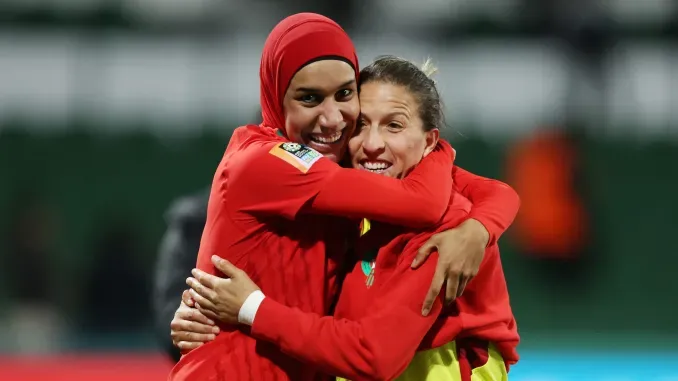

Nouhaila Benzina and Najat Badri of Morocco celebrate after their triumphant 1-0 victory in the FIFA Women’s World Cup Australia & New Zealand 2023. Morocco has diligently spent four years crafting one of the most formidable teams in Africa. With a harmonious blend of momentum, maturity, and the right opportunities converging, the Women's Africa Cup of Nations (WAFCON) 2026 could very well be the pinnacle of the Atlas Lionesses' ambitious project.
Football often has a captivating way of transforming long-term endeavors into perceived overnight successes. When a team reaches a significant final, qualifies for a prestigious World Cup, or lifts a historic trophy, the narrative quickly shifts to one of surprise and disbelief. Yet, as seasoned fans understand, the finest football teams are forged over years through consistent investment, continuity, and an unwavering commitment to a distinct identity. The journey of Morocco’s women’s football team is a testament to this reality.
As the Atlas Lionesses gear up for another WAFCON semi-final, the chatter surrounding the tournament bracket has intensified. With Nigeria and South Africa, two of Africa's most successful teams, eliminated from contention, one might be tempted to simplify Morocco's prospects to the absence of their rivals. However, that perspective entirely overlooks the essence of the situation. Morocco is favored not merely due to the misfortunes of others, but because they have quietly developed into one of Africa's most tactically astute and well-rounded teams. This tournament has not created an opportunity for Morocco; rather, it has unveiled the progress they have been diligently crafting since 2022.
A Journey Four Years in the Making
When Morocco hosted the 2022 WAFCON, the atmosphere was charged with expectation, albeit tempered by a sense of cautious optimism. The Royal Moroccan Football Federation made substantial investments in women's football, yet few anticipated that the hosts would be able to challenge the continent’s elite. Contrary to expectations, Morocco not only participated but changed the narrative entirely. Following a quarter-final victory over Botswana, they achieved a historic upset by defeating Nigeria in a nail-biting penalty shootout, securing their place in their first-ever WAFCON final. Although they ultimately fell 2–1 to South Africa, the tournament delivered something far more invaluable than mere silverware: a newfound belief that they belonged among the continent's best.
This belief carried over to the 2023 FIFA Women’s World Cup, where Morocco refused to settle for mere participation. After a harsh opening defeat, they rebounded impressively, defeating both South Korea and Colombia to become the first Arab nation to advance to the knockout stage of a Women’s World Cup. Their performances confirmed that their remarkable run to the WAFCON final was not merely a result of home advantage but a manifestation of a national project that was beginning to bear fruit.
As we approach WAFCON 2026, Morocco no longer appears as an up-and-coming nation yearning for recognition; instead, they exude the confidence of a team that expects to win.
Morocco: The Most Complete Team at WAFCON 2026
The strongest argument for Morocco's potential lies in their coherence, resilience, and the way each match seems to unlock a higher level of performance. Throughout four matches, the Atlas Lionesses have remained unbeaten, securing three victories and one draw, with an impressive tally of seven goals scored and only one conceded. Notably, they completed the group stage without allowing a single goal for the first time in their WAFCON history, a remarkable achievement that speaks volumes.
These statistics tell a compelling story. Morocco averages 1.75 goals per match while conceding a mere 0.25, showcasing their ability to blend attacking prowess with defensive solidity. This balance is often what distinguishes genuine title contenders from entertaining outsiders. Their commanding 4–0 victory over Kenya set the tone, demonstrating their capacity to control the game without falling into predictable patterns. They exhibited patience in ball circulation before launching rapid attacks in the final third, with Sakina Ouzraoui Diki, Maryame Atiq, and Ibtissam Jraïdi all contributing to the scoreline. The fourth goal was a result of relentless attacking pressure that forced a defensive error from Kenya, exemplifying Morocco's ability to dictate the pace of play.
In their narrow 1–0 win over Algeria, Morocco faced a disciplined defensive setup and showcased a different facet of their game. Rather than succumbing to the temptation of forcing play, they relied on their tactical structure, recycling possession and stretching Algeria's defense until substitute Sanaa Mssoudy found the back of the net late in the match. Championship-caliber teams understand that not every victory needs to be dazzling; sometimes, patience proves to be the most effective strategy. Their quarter-final clash against South Africa served as a defining moment for Morocco. Four years prior, the Banyana Banyana had thwarted their ambitions for a continental title, but this time, the Atlas Lionesses delivered one of their most comprehensive performances of the tournament. A well-worked opener from Sakina Ouzraoui and a calm penalty conversion from Hanane Aït El Haj secured a 2–1 victory, showcasing their disciplined approach even in the face of adversity.
The tactical adaptability demonstrated by manager Jorge Vilda has been key to Morocco's success. Rather than imposing a rigid system, he has tailored his strategies to align with the strengths of his squad. While they maintain a commitment to building from the back, their possession play is utilized to control matches rather than merely dominate statistics. Defensively, the Atlas Lionesses operate in a compact 4-4-2 mid-block, carefully managing distances to prevent opponents from advancing through central areas. Instead of pressing recklessly, they expertly guide rivals toward the flanks, setting up coordinated pressing traps near the sidelines.
Morocco's evolution has also diminished their reliance on individual brilliance. While captain Ghizlane Chebbak remains a pivotal figure, the team has diversified its attacking threats. Sakina Ouzraoui has emerged as a key contributor, while Sanaa Mssoudy has made impactful contributions off the bench, and Ibtissam Jraïdi consistently proves to be a reliable presence inside the box. Yasmin Mrabet has emerged as one of the tournament's most influential midfielders, while Nouhaila Benzina has established herself as a dependable center-back. Goalkeeper Khadija Er-Rmichi adds the assurance that every championship-winning team requires. The distribution of their seven goals across various players highlights Morocco's growth as a unit.
Every great footballing nation experiences a moment when meticulous preparation aligns with opportunity, and for Morocco, that moment appears to be upon them. Having reached two consecutive WAFCON finals and advanced past the group stage of a Women’s World Cup, they have built one of Africa's most formidable defensive units while maintaining the attacking quality needed to challenge opponents in diverse ways. Most importantly, they have cultivated a distinct football identity. The absence of familiar rivals such as Nigeria and South Africa may have altered the competitive landscape, but Morocco's case for winning this tournament is firmly rooted in their own performances. They have earned the right to be considered favorites.
Through four matches, Morocco has exhibited disciplined defending, diverse attacking strategies, and the maturity necessary to manage games effectively—qualities that were notably absent just a few years ago. They no longer rely solely on moments of brilliance but instead trust a cohesive system capable of delivering consistent performances irrespective of the opponent. Four years ago, Morocco surprised the continent; two years later, they astonished the world. This summer, the narrative surrounding Morocco should come as no surprise. They are no longer in pursuit of the elite; they have firmly established themselves among them.
If the Atlas Lionesses ultimately lift the Women’s Africa Cup of Nations trophy, the celebration will undoubtedly be one for the history books. However, those who have closely followed this journey will understand that the title, if secured, will not be the result of just two matches; it will be the culmination of a dedicated four-year journey.
As reported by herfootballhub.com.