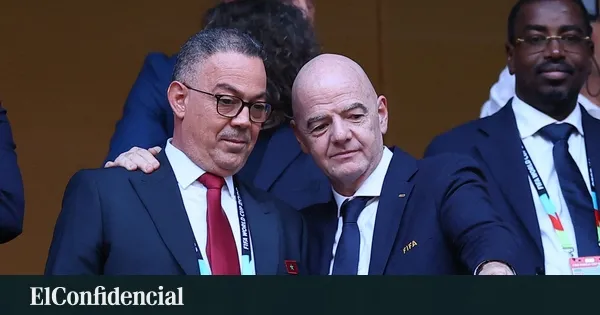

Morocco is actively seeking support across Africa to ensure that the final of the 2030 World Cup is hosted near Casablanca. In the absence of spontaneous backing, the Moroccan press has taken on the role of gathering statements from various football federation presidents and sports commentators. They emphasize that if the grand match takes place at the Hassan II Stadium, it will not merely be a final in Morocco but a significant event for the entire African continent. This ambition underscores Morocco's desire to position itself as a leading hub for football in Africa.
Upon its completion in late 2027, the Hassan II Stadium, located in Benslimane approximately 55 kilometers northeast of Casablanca, is set to become the largest stadium in the world, boasting a capacity of 115,000 spectators, even surpassing that of Pyongyang in North Korea. A significant portion of this capacity, around 8% (9,000 seats), will be designated as VIP. Moroccan authorities are eyeing this venue as the stage for the World Cup final, envisioning it as a pivotal moment for African football.
Abdoulaye Fall, the president of the Senegalese Football Federation, voiced strong support for this vision in an interview with the Moroccan newspaper Le 360, declaring, "Africa is today the beating heart and the main breeding ground for talent in world football. It is therefore a logical conclusion that the continent should once again host the World Cup and its final." Fall's remarks, however, seem to overlook the controversies surrounding the recent Africa Cup of Nations final, which featured Senegal against Morocco in Rabat.
Said Ali Said Athouman, president of the Comorian Football Federation, also supports the choice of Hassan II Stadium for this prestigious event, suggesting it would be a way to reward the development and progress of African football. Similarly, Oumarou Sawadogo, head of the Burkina Faso Football Federation, emphasized that it is high time for Africa to be the venue for another final, akin to the one held in Johannesburg in 2010, which saw Spain emerge victorious.
The Vision of Pedro Sánchez and Morocco
Despite the enthusiasm from some African football leaders, not all are publicly backing the Hassan II Stadium's candidacy. Consequently, the Moroccan press, particularly Le 360, which is thought to be aligned with the Royal House, has sought out various voices to rally public support. Ahmed Cheikh, director of the Mauritanian weekly Le Calame, expressed his pride in advance of the FIFA decision, while Togolese sports journalist Jacques Pekemsi went so far as to wish that the entire World Cup could take place in Morocco.
The idea of including Morocco in the joint Spanish-Portuguese bid for the 2030 World Cup originated from Spanish President Pedro Sánchez early in 2023. He was the first to announce that his kingdom had joined the Iberian duo. The Moroccan Royal House also preemptively announced that the tripartite bid had been chosen by FIFA.
In the early part of this year, the first voices in Morocco began to emerge through the press, advocating for the Hassan II Stadium to host the final. They cited that Madrid had hosted a final in 1982 and pointed out that Europe had already seen ten finals throughout history, suggesting Spain should be content with having won the 2026 World Cup at MetLife Stadium near New York.
Subsequent reports in the Moroccan media highlighted instances of flooding in Spanish stadiums, such as Camp Nou during a match between Barcelona and Feyenoord, and the Ciutat de València, where heavy rains prevented a match. These comparisons aimed to illustrate that Morocco possesses better sports infrastructure than Spain, despite the Hassan II Stadium still being under construction.
Criticism of Spain and the RFEF
Simultaneously, Moroccan media began to criticize the so-called "arrogance and stupidity" of Rafael Louzán, president of the Royal Spanish Football Federation. The publication Le 360 expressed outrage at Louzán's prediction that a Spanish stadium would host the final, highlighting his insistence that "he wants to impose the final in Spain," as reported by the digital outlet Yabiladi.
Just before the start of the electoral campaign for legislative elections in Morocco, Fouzi Lekjaa, president of the Moroccan Football Federation, entered the political arena by aligning himself with the victorious Authenticity and Modernity Party (PAM). In his first electoral rally on September 10, Lekjaa boldly declared that the final would "take place in Benslimane." However, FIFA will only make its decision next year, leaving the future uncertain.
Aziz Akhannouch, then Prime Minister, publicly admonished Lekjaa, who, in addition to being federation president, was also the Minister of Budget. This dual role raised concerns as public spending on sports infrastructure has come at the expense of healthcare and education. Akhannouch urged Lekjaa to act with "prudence and respect towards the partners in the joint candidacy." Lekjaa has since moderated his tone but promised to spare no effort in achieving what the Moroccan press describes as the "cherry on top" of the upcoming World Cup—the final.
Despite these efforts, Morocco's sports infrastructure still lags behind that of Spain. While Morocco has enjoyed successful years in football, its historical trajectory and traditions are comparatively recent. Additionally, the tragedy in Ceuta has marred the image of the Alawite kingdom abroad, as it has struggled to control its borders, leading to numerous young people attempting to flee for better opportunities, with many tragically losing their lives in the process. This situation complicates Morocco's aspirations for hosting the coveted final.
As reported by elconfidencial.com.