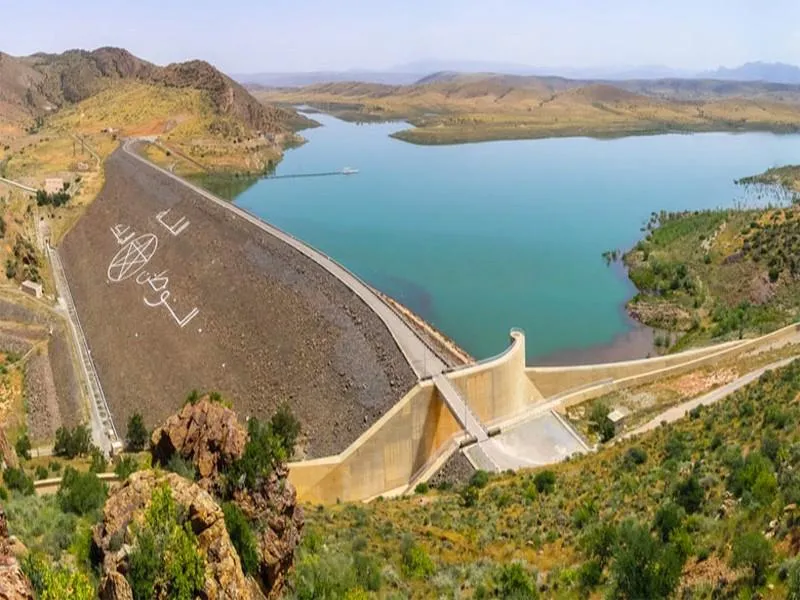

Significant Increase in Water Reserves
As May draws to a close, Morocco's dams have reported an impressive total filling rate of 75.94%, translating to a substantial water reserve that is particularly crucial as the nation grapples with early heat waves and heightened evaporation risks. According to the latest figures released by the Directorate of Water Research and Planning within the Ministry of Equipment and Water, the reservoirs currently contain 12.93 billion cubic meters of water, out of an overall capacity of 17.03 billion cubic meters. This figure represents a remarkable improvement compared to the same period last year, when the dams were only 40.02% full, with reserves of around 6.8 billion cubic meters. This year’s increase in capacity is timely, as temperatures have surged in the final days of May, with some central and southern provinces experiencing highs exceeding 40 degrees Celsius. The national meteorological service has noted that such elevated temperatures typically accelerate evaporation from stored surface water, yet the current water volume significantly mitigates this impact, ensuring adequate supplies for drinking and irrigation in the months ahead.
Regional Highlights and Future Outlook
The distribution of water reserves across various regions of Morocco reveals that the strongest reserves are found in the northern part of the country. The Sebou basin leads with a remarkable 4.75 billion cubic meters and a filling rate of 88.39%. Much of this reserve is attributed to the Al Wahda dam, Morocco's largest, which stands at 88.76% full, holding over 3 billion cubic meters. Meanwhile, the Loukkos basin boasts the highest filling rate nationally at 97.23%, with 1.79 billion cubic meters fully stored across several dams, including Nakhla, Chefchaouen, and Charif Al Idrissi. The Bouregreg basin, vital for supplying major Atlantic cities, has reached 89.74%, securing water supplies for the Rabat-Casablanca corridor without the need for summer rationing or austerity measures. Additionally, the Tensift basin has reported an impressive filling rate of 94.78%, ensuring strong water supplies for Marrakech and its surrounding areas amidst rising summer demand.
In contrast, the Oum Er Rbia basin shows a filling rate of 65.72%, with 3.29 billion cubic meters stored, while Bin El Ouidane has reached 93.83%. Al Massira, however, has only recovered to 42.74%, retaining over 1 billion cubic meters. On the eastern front, the Moulouya basin has achieved a filling rate of 73.03%, supported by melting snow from the eastern Middle Atlas, accounting for 512.27 million cubic meters. Conversely, the Souss Massa basin stands at 54.53%, significantly better than last year’s low of 21.80%. The Draa Oued Noun basin has the lowest water level nationally at 38.17%, closely followed by Ziz Guir Ghris at 51.47%. As the summer approaches, authorities and environmental organizations are emphasizing the need for prudent water management and reduced consumption, given the ongoing challenges posed by elevated temperatures, evaporation, and pressure on water reserves.
As reported by moroccoworldnews.com.