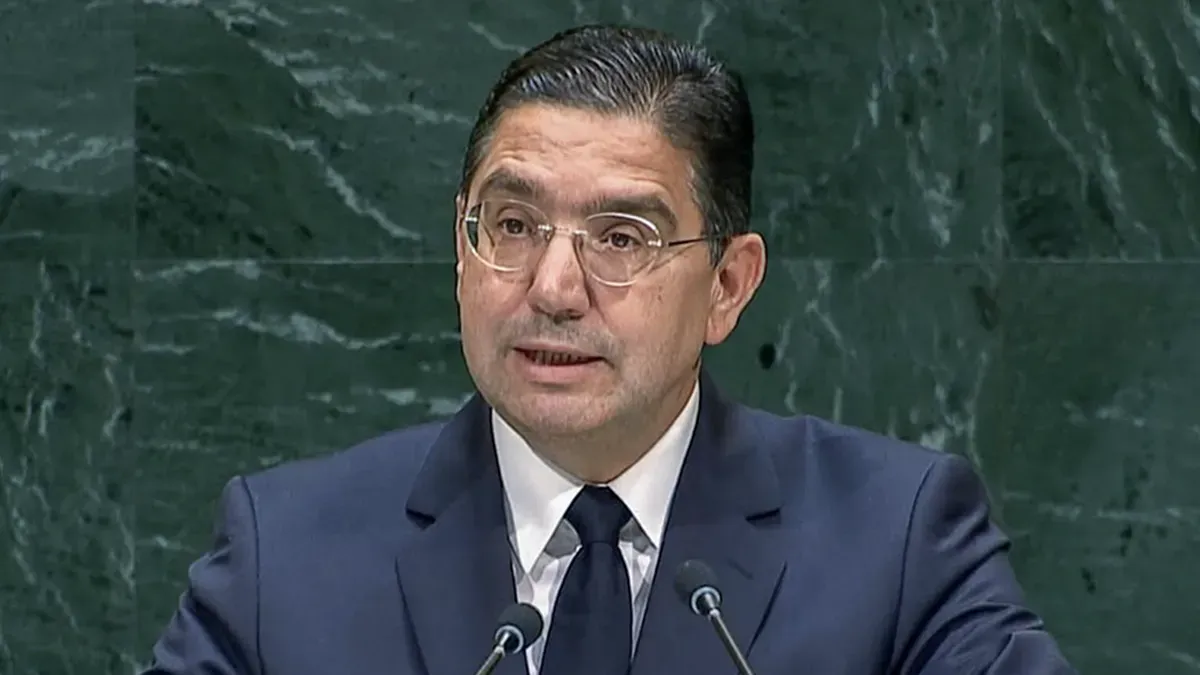

In a significant address during the 81st General Assembly of the United Nations (UN), Moroccan Minister of Foreign Affairs, Nasser Bourita, unveiled pivotal foreign policy initiatives that could reshape the Kingdom's role on the global stage. Morocco has formally declared its intention to pursue an elected non-permanent seat on the UN Security Council for the 2028–2029 biennium. Additionally, Bourita announced the deployment of military operational assets to contribute to international stabilization efforts in the Middle East. This announcement highlights Morocco's ambition to play a more active role in addressing pressing global issues.
During his address, Bourita emphasized the growing challenges facing the multilateral global architecture, noting that traditional diplomatic mechanisms are often ineffective in de-escalating armed conflicts and managing geopolitical crises. He urged member states to undertake the long-overdue structural reforms of the UN Security Council, arguing that the current status quo, established in 1945, perpetuates a structural injustice against Africa, which remains largely excluded from influential decision-making processes regarding international peace and security. This sentiment resonates strongly with the core positions held by the African Union (AU).
The Operational Roadmap for the Middle East and Palestinian Governance
Addressing the ongoing crisis in the Middle East, Bourita reaffirmed that the Palestinian issue is a critical aspect of Morocco's foreign policy. He reiterated the vision articulated by King Mohammed VI, stating that sustainable regional stability hinges on the realization of a viable two-state solution. This solution must result in an independent and sovereign Palestinian state based on borders established before June 1967, with East Jerusalem as its capital. Furthermore, he called for mutual security guarantees to be established between Israel and Palestine.
In light of the humanitarian crisis in Gaza, Bourita called for an immediate and durable ceasefire, alongside unrestricted humanitarian aid delivery managed by international agencies. He outlined Morocco's commitment to contributing actively to a multilateral stabilization mission in the Palestinian enclave, detailing how the Royal Armed Forces (FAR) will offer logistical support and specialized personnel. Key components of this mission include:
- Emergency Medical Infrastructure: Deployment of a military field hospital equipped with advanced surgical units to provide urgent care to civilians in need.
- Civil Police Training: Tactical instructional programs for the Palestinian police force, with senior Moroccan military officers serving as liaisons within the internal security framework.
- Counter-Radicalization Initiatives: Programs designed to counter violent extremism and support community stability following periods of conflict.
Bourita also urged international partners to provide structured support for the Palestinian Authority, facilitating reforms to ensure effective governance. He emphasized the critical role of the UNRWA in delivering frontline humanitarian aid and warned against the dire consequences of obstructing its operations.
Proxy Warfare: A Systemic Threat to Global Security
A significant portion of Bourita's address was dedicated to the emerging threat of proxy warfare and the rise of non-state armed actors, which he described as a fundamental challenge to modern warfare. He presented alarming statistics, indicating that over 200 million individuals worldwide are currently under the control or coercion of irregular factions, with more than 130 non-state armed groups engaged in active conflicts. This surge in irregular warfare poses serious risks to global maritime security and international trade, particularly as these groups often attempt to disrupt strategic chokepoints and waterways.
Bourita firmly rejected any notion that these irregular armed groups could serve as constructive partners in peace negotiations, highlighting their connections to transnational crime, terrorism, and mercenary activities. He called on the international community to hold accountable the states that provide sanctuary, funding, or arms to these groups, thereby undermining international law.
In conclusion, Bourita articulated Morocco's vision for its candidacy for a non-permanent seat on the UN Security Council, emphasizing the importance of translating the Kingdom's diplomatic and operational experiences into actions that reinforce the principles of national sovereignty, territorial integrity, and the peaceful settlement of international disputes. This strategic positioning of Morocco not only aims to strengthen its role within the UN but also underscores its commitment to regional stability, humanitarian assistance, and the promotion of peace in the Middle East.
As reported by atalayar.com.