
Understanding the Shift in Morocco-Spain Relations
In the heart of Madrid, there are still those who struggle to comprehend that the Morocco of today is not the same nation that Europe interacted with two decades ago. While Spain may argue with Rabat about historical claims, insisting that Ceuta and Melilla are Spanish territories and preferring to overlook the complex history of these cities, one undeniable truth remains: Morocco has undergone significant transformations, and the balance of power has shifted accordingly. If Spain seems oblivious to the intricate past of Ceuta and Melilla, the present circumstances serve as a powerful reminder of that history.
Today's Morocco is no longer an isolated nation awaiting recognition of its strength from others. Over the past several years, Morocco has built a vast network of partnerships that extend from the United States to Israel, and from the Gulf to Africa and Europe. It has developed its military, economic, and diplomatic capabilities, becoming increasingly prominent in Mediterranean, Atlantic, and African affairs.
Migration Policy and the Spanish Paradox
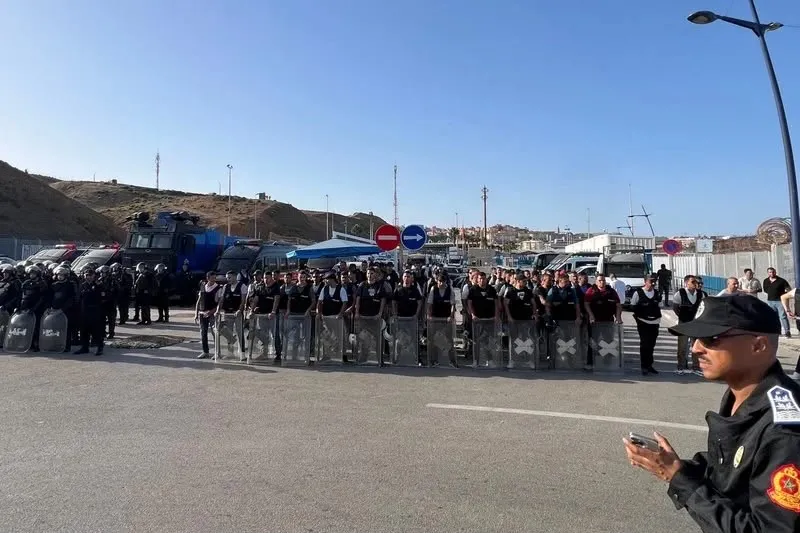
Particularly in the context of migration, the Spanish paradox becomes glaringly evident. Madrid expects Morocco to tighten its border controls to prevent migrants from reaching Ceuta and Melilla, thereby assisting in the protection of European borders. Simultaneously, Spain adopts diverse policies towards migrants already on its soil, including regularizing the status of some and integrating them into society. The problem arises when Madrid seeks to impose the costs of its open immigration policy onto Morocco. Spain’s legal system and its government want to appear as champions of human rights while delegating the heavy lifting of migration control to Morocco.
If Spain wishes to safeguard its borders, it must take responsibility for them. If Europe desires a more open migration policy, that is its prerogative. However, asking Morocco to shoulder the burden of preventing migrants is inherently contradictory. Ironically, Morocco sometimes finds itself portrayed as the “bad cop,” the state that stops Africans from reaching Europe, while Europe presents itself as a welcoming sanctuary that grants legal status to some migrants.
The reality is much simpler. Morocco protects its borders while Europe manages its frontiers according to its own interests. There should be no expectation for one party to act as a guard for another. Spain insists that Ceuta and Melilla are Spanish, refusing to negotiate sovereignty, while Morocco views the continued Spanish presence in these cities as an occupation. Even if some attempt to reduce this discussion to a historical question of who ruled the cities and when, political realism compels a different query: can a strong and independent Morocco consider the existence of European enclaves on its coast as a permanent arrangement?
Morocco does not need a military adventure to answer this question. Nations alter their realities over time through diplomacy, economic strategies, alliances, and the accumulation of power. Thus, it is Morocco's right to maintain a clear strategic objective: to end the exceptional status of Ceuta and Melilla and reclaim sovereignty over them through political and peaceful means. While this may not occur overnight and could take many years, having a strategic goal does not necessarily imply seeking confrontation. This is where the significance of alliances, often criticized by certain misguided leftist and Islamist factions within Morocco, becomes apparent.
Those on the left and the Islamists who occasionally demand that Morocco abandon its relations with the United States and Israel in the name of “Arab interests” must answer a simple question: where was Arab solidarity when Morocco needed tangible support for its strategic interests concerning Ceuta? When it comes to Palestine, there is often talk of Arab unity and shared destiny. Yet, regarding Ceuta and Melilla, silence prevails. Algeria, which boasts of anti-colonial resistance, urges Morocco to respect inherited colonial borders and recognize Spain's sovereignty over the two enclaves!
No state can build its national security on a hypothetical Arab solidarity. Therefore, the relationship with Washington or Israel should not be measured by slogans but by the capacity they provide Morocco to protect its interests. This does not imply that Morocco must fully adopt the positions of its allies or become subservient to them. The value of an alliance is that it enhances a state's autonomy rather than diminishes it. Morocco can support Palestinians, advocate for a two-state solution, and criticize Israel when there are disagreements, all while maintaining its partnerships with Washington and Tel Aviv. This is the kind of foreign policy that prioritizes realism over ideology.
Perhaps it is time for a segment of Moroccan political discourse to redefine the concept of “national interest.” Morocco is not a branch of an Arab national project, nor is it an ideological state that transcends borders, nor is it a party in a global religious conflict. Morocco is a nation with borders, interests, security, economy, adversaries, and partners. Its geographic location necessitates a realistic approach: Algeria to the east, Spain to the north, the Sahel to the south, and the Atlantic Ocean to the west. In such a position, a state cannot afford to choose its alliances based solely on the criterion of “Arab nationalism.”
Spain may speak in a hostile and semi-military tone about Ceuta and Melilla and refuse to open the sovereignty debate. However, it must recognize that the Morocco of today is not the Morocco of yesterday. If Madrid desires a stable relationship with Rabat, the path forward is not through pressure, contradictions, or demanding that Morocco perpetually serve as a guardian of European borders. The way forward is to acknowledge that Morocco has become a regional power with its own interests and calculations, and that partnership must be based on equality and mutual respect. The message that Madrid must absorb this summer is clear: manage your borders, handle your migration policies, and bear the consequences. Meanwhile, Morocco will safeguard its borders, interests, and sovereignty. And if Spain has forgotten some aspects of the history of Ceuta and Melilla, Morocco does not require a historical lecture to remind it of that. It suffices to look at the Morocco that stands before them today: a different Morocco, stronger, more connected to the world, and more capable of choosing its allies.
As reported by goud.ma.