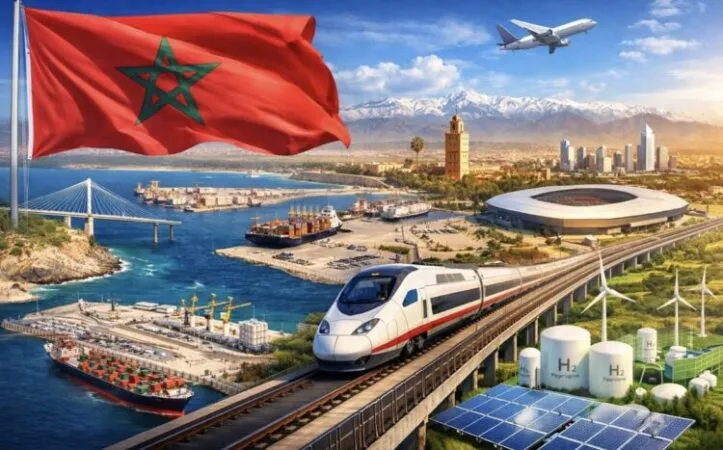

Analyzing Morocco's Export Potential Amid Global Tensions
In a recent statement to alyaoum24.com, economic expert Youssef Krawi Al-Filali, who also serves as the head of the Moroccan Center for Governance and Management, commented on the resilience of global trade in goods despite ongoing geopolitical tensions. He emphasized that the growth of Moroccan exports remains feasible, particularly due to the robust performance of various industrial sectors, most notably the automotive sector, including both vehicles and their components, as well as the aerospace industry and aircraft parts.
Krawi Al-Filali elaborated that Morocco possesses integrated industrial systems that are actively engaged in exporting. However, he pointed out that the primary issue does not lie in the growth of exports itself, but rather in the persistent trade balance deficit. He highlighted the alarming levels of Moroccan imports, noting that many essential goods are still imported due to the lack of self-sufficiency in their production.
Despite the advancements in Moroccan exports, they do not sufficiently cover the volume of imports, which prevents the country from achieving a surplus in its trade balance. Krawi Al-Filali indicated that Morocco faces a trade balance deficit primarily due to insufficient competitiveness and the limited number of productive sectors capable of exporting. He stressed that aside from the automotive and aerospace industries, there is a pressing need for the development of additional productive and export-oriented sectors, including textiles and clothing, food and agricultural products, as well as electrical and electronic goods.
Enhancing Morocco's Role in International Production Chains
Krawi Al-Filali asserted that the goal should be to increase the pace of Moroccan exports in a manner that not only promotes growth but also aims to achieve a surplus in the trade balance, rather than perpetuating the structural deficit that has plagued Morocco for several years. Regarding Morocco's position in international production chains, he noted that the kingdom has emerged as a leading country in the field of subcontracted manufacturing. The opening of Morocco to European markets has yielded significant results, with numerous European partners investing and conducting production operations within the country.
Moreover, the interest in Morocco is no longer limited to European companies; it now includes Asian firms and businesses from the Middle East, which have also started relying on subcontracted manufacturing operations in Morocco. The products manufactured in Morocco are now being exported not only to Europe but also to the United States, marking Morocco's evolution into a major industrial and production hub.
Krawi Al-Filali believes that the subcontracting manufacturing services offered by Morocco are poised for substantial growth in the coming years, particularly in light of the kingdom's ambition to enhance its industrial systems, accelerate manufacturing processes, and develop new industries, alongside the establishment and enhancement of free zones for this purpose.
Regarding the factors that attract investments to Morocco, Krawi Al-Filali emphasized that the political, security, and military stability enjoyed by the kingdom is a critical factor in enhancing its investment appeal. He also highlighted Morocco's geographical positioning as a significant strength, given its location along the Mediterranean Sea, which, combined with its stability, enables the country to attract foreign investors.