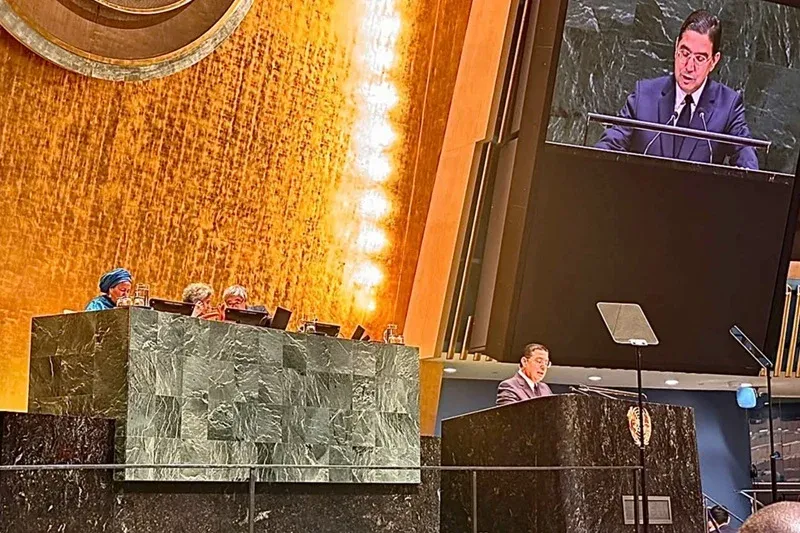

On Tuesday evening, Nasser Bourita, Morocco's Minister of Foreign Affairs, African Cooperation, and Moroccans Abroad, addressed the United Nations General Assembly, asserting that the Western Sahara issue has entered a historic turning point thanks to the dynamic initiatives launched by King Mohammed VI. This statement underscores Morocco’s commitment to resolving this long-standing territorial dispute, which is characterized by the adoption of UN Security Council Resolution 2797 in October 2025.
Western Sahara: A New Path Towards Resolution
In his speech, Bourita emphasized that since the adoption of this resolution, the regional dispute has embarked on an irreversible path of separation from the past, focusing on a future resolution. He noted that this new direction is based on principles and determinants that are clear-cut and cannot be misinterpreted, despite attempts by some to misconstrue the realities on the ground. The core principles outlined by Bourita include: firstly, that there is no solution outside the framework of autonomy under Moroccan sovereignty; secondly, that no other approach or mechanism exists outside of political negotiations under the auspices of the United Nations, with the sole basis being the autonomy initiative; thirdly, there is no room for debate regarding the responsibilities and obligations of the four parties as clearly defined by Resolution 2797; fourthly, the status quo preferred by other parties is untenable, as the train for a political solution has already left the station; fifthly, there is no credibility in interlocutors who violate ceasefire agreements and disregard UN Security Council resolutions; and sixthly, there will be no tolerance for the continued detention of camp residents as hostages for over half a century, in blatant violation of international law and humanitarian law.
Bourita, who leads the Moroccan delegation at the 81st session of the UN General Assembly, reaffirmed Morocco's unwavering commitment to a final resolution of this regional dispute. Under the wise leadership of King Mohammed VI, Morocco continues to advance social and economic development in its southern regions, particularly in infrastructure, higher education, healthcare, and airport facilities. He highlighted that the population in the Sahara region is fulfilling its national and political duty by participating in the legislative elections scheduled for Wednesday, which would enhance the structure of genuine democratic representation and solidify their active engagement in the daily management of local affairs.
Palestine: A Constant Priority for Morocco
Bourita reiterated that the Palestinian cause remains a "constant priority" in Morocco's foreign policy, stemming from the Kingdom's support for the establishment of an independent, sovereign, and viable Palestinian state based on the borders of June 4, 1967, with East Jerusalem as its capital, coexisting peacefully alongside Israel. He renewed Morocco's call for respect for the ceasefire in Gaza and the assurance of sufficient and unobstructed humanitarian aid, emphasizing the need for financial, technical, structural, and humanitarian support for the Palestinian Authority, as well as backing its reforms within its institutions. He also commended the role played by the United Nations Relief and Works Agency for Palestine Refugees in the Near East (UNRWA).
Furthermore, Morocco decided to participate in the international force aimed at stabilizing Gaza and contributing to humanitarian and security initiatives, which include training the Palestinian police, deploying high-ranking military officers in internal security forces, establishing a field military hospital, and expressing readiness to lead a program to combat extremism. Bourita warned of the developments in the West Bank, particularly laws and measures affecting the legal status of Palestinian territory that open the door to expanding settlements, alongside violence from Israeli settlers against Palestinians. He deemed these actions as leading toward "displacement of populations and undermining the material foundation for the establishment of an independent Palestinian state." He expressed Morocco's concern over unilateral Israeli actions and repeated violations of the sanctity of Al-Aqsa Mosque, highlighting that King Mohammed VI, as the President of the Al-Quds Committee, continues to work towards preserving the historical, cultural, and spiritual identity of the city and its legal status, alongside the field programs implemented by the Al-Quds Bayt Mal Agency for the benefit of Jerusalemites.
Africa: A Continent of Opportunities and Solutions
On the African front, Bourita stated that Africa, contrary to the stereotypical image often associated with conflicts and issues, is a land of opportunities and potentials capable of producing solutions and offering initiatives. He referenced King Mohammed VI’s vision encapsulated in the phrase “Africa must trust Africa.” The Minister highlighted the existing gap between the size of international commitments made in favor of the continent and the actual achievements on the ground, asserting that Africa has matured sufficiently to participate effectively in decisions related to its issues and contribute to formulating solutions to international challenges.
Bourita elaborated on several Moroccan initiatives in this context, including the royal initiative aimed at enabling Sahel countries to access the Atlantic Ocean, the Atlantic African States Process, the African Atlantic Gas Pipeline project, investments in regional infrastructure, cooperation in food security and fertilizer production, training programs for African frameworks, and partnerships in health, renewable energy, and water resource management. He called on the international community to reorder its priorities to confront the growing threat from non-state armed groups amidst interconnected military, economic, energy, and environmental crises, which have diminished the capacity of existing institutional frameworks to prevent conflicts and manage crises. He cited indicators showing that over 200 million people worldwide live under the influence of these groups or in areas experiencing power struggles, with the number of legally classified non-state armed groups exceeding 130. Bourita warned that some of these groups are extending their activities to maritime corridors and straits, jeopardizing international navigation.
Connecting non-state armed groups with separatist militias, terrorist organizations, transnational criminal networks, and mercenaries, Bourita urged for accountability of the states that harbor, fund, and arm these groups, advocating for imposing stringent sanctions on such groups and their protectors and holding accountable those involved in financing or supplying weapons to them.
As reported by hespress.com.