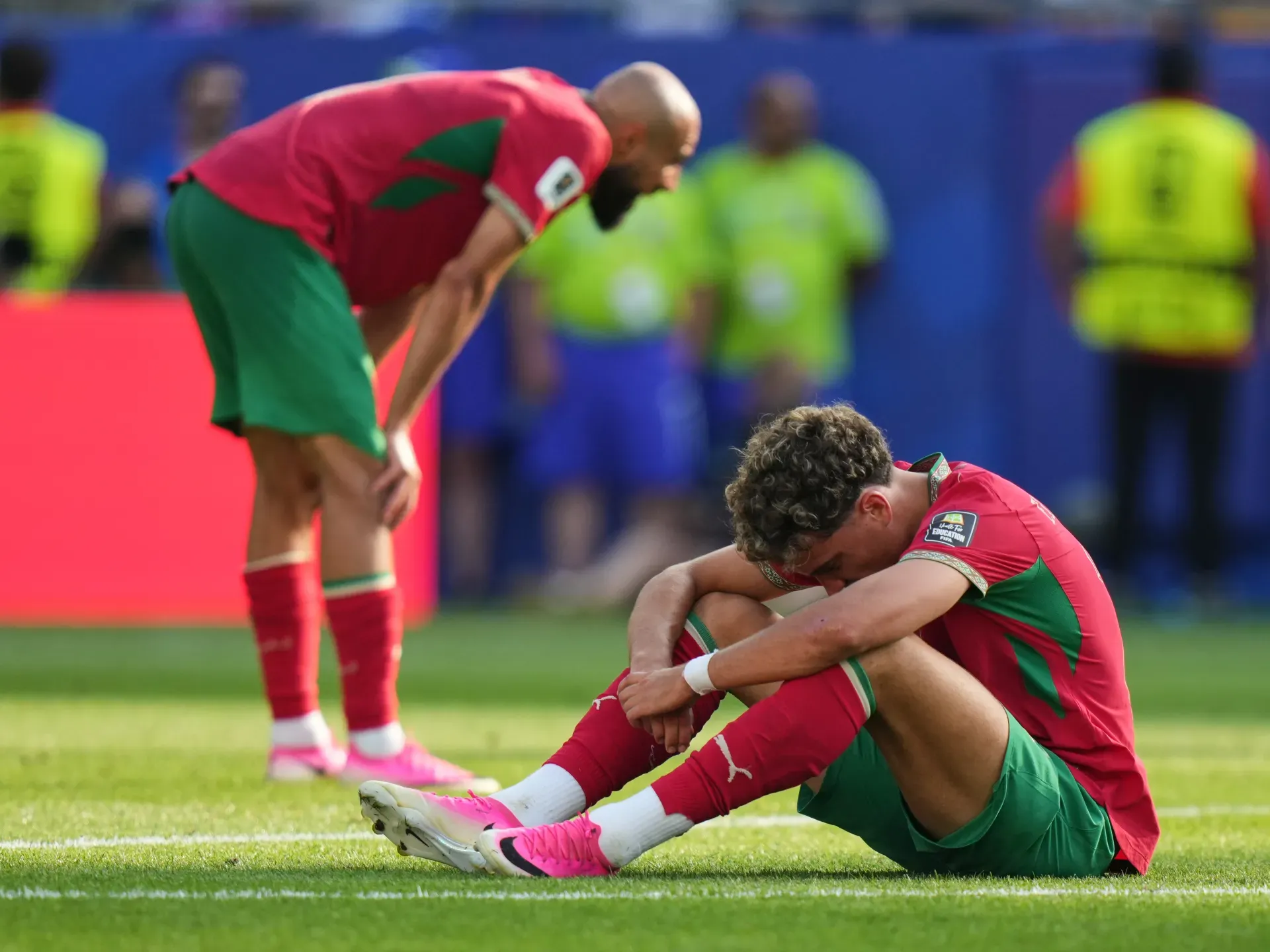

On July 10, 2026, the Moroccan national team bid farewell to the 2026 World Cup, exiting in the quarterfinals after suffering a 2-0 defeat to France. In this match, the French team demonstrated why they are considered one of the leading contenders for the championship title, while Morocco paid the price for some tactical details that ultimately made a significant difference in the outcome.
Morocco's coach, Mohammed Wahbi, made two changes to the lineup that had triumphed over Canada 3-0 in the Round of 16. He opted for defender Anas Salah Eddine to start in place of Ridouan Halhal, who had filled in for the injured Shadi Riyad, and brought in Shams Eddin Talabi to take the spot of his top scorer in the tournament, Ismail Saibari, who was sidelined with a hamstring injury.
The Match Dynamics
France commenced the match at a high tempo, applying intense pressure right from the start, which forced Morocco to retreat into their defensive zones. The French side did not give their opponents sufficient time to construct attacks or organize their play, prompting Moroccan goalkeeper Yassine Bounou to intervene multiple times to keep his team in the game. Notably, he made vital saves against a header from Dayot Upamecano and a penalty taken by Kylian Mbappe.
Throughout the match, France maintained better possession and created numerous genuine scoring opportunities, but Bounou was on form, particularly during a penalty awarded to the French captain and all-time top scorer, Mbappe of Real Madrid. In the first 18 minutes alone, France produced four scoring chances, one of which hit the woodwork, while Morocco failed to threaten the French goal.
Despite Morocco's resilience in the first half, the French dominance in possession and chance creation was evident, signaling potential dangers for the Moroccan defense in the second half.
Tactical Insights and Key Absences
Perhaps the most impactful absence for Morocco was that of defender Shadi Riyad, who had been a crucial element of their defensive setup throughout the tournament. Riyad's partnership with Aissa Diop provided Morocco with the ability to effectively close down the central areas, cover behind defenders, and limit space for skillful attackers. His absence against France significantly disrupted the defensive balance, as highlighted by repeated French incursions between the center-backs.
Coach Wahbi's decision to deploy Noussair Mazraoui in central defense was an attempt to counteract the speed and skill of France's attacking quartet, which included Mbappe, Ousmane Dembélé, Désiré Doye, and Michael Olise. While this idea had merit due to Mazraoui's versatility in individual duels, its execution revealed some drawbacks. The presence of a player typically positioned as a full-back in central defense diminished Morocco's strength in physical contests and their ability to win second balls.
Moreover, the absence of a traditional central defender capable of asserting dominance in the penalty area and dealing with aerial threats and physical confrontations was keenly felt. In high-stakes matches like this, the need for a specialized center-back such as Ridouan Halhal may have proven more beneficial than relying on a player with greater technical prowess but less defensive solidity.
Ismail Saibari’s absence further complicated matters. His influence on the team was irreplaceable, as his skill set not only created opportunities and maintained possession but also enabled key players like Ibrahim Diaz to perform at their best. Saibari’s ability to unsettle defensive units and create spaces for advancing teammates was sorely missed against France, making Morocco's attacking options appear limited.
Ultimately, while Morocco managed to hold firm for extended periods, the decisive factor came from the quality of the French players in the final third. Kylian Mbappe required minimal space to score the opening goal with a brilliant shot, while Ousmane Dembélé exploited gaps that emerged as Morocco pressed for an equalizer, securing the second goal that effectively sealed the match.
Despite the loss, the performance of the Moroccan national team should not be viewed negatively. They faced one of the tournament's strongest and most complete teams, competing robustly for significant stretches of the match. For the second consecutive World Cup, the Atlas Lions have established themselves as a team capable of advancing to the later stages, having reached the semifinals in the 2022 edition and the quarterfinals in 2026.
This participation has solidified Morocco’s competitive identity, confirming that their achievements four years ago were not an anomaly but rather the result of a footballing project capable of competing against the world’s best teams, even if individual skills ultimately decided the match's finer points.
As reported by aljazeera.net.