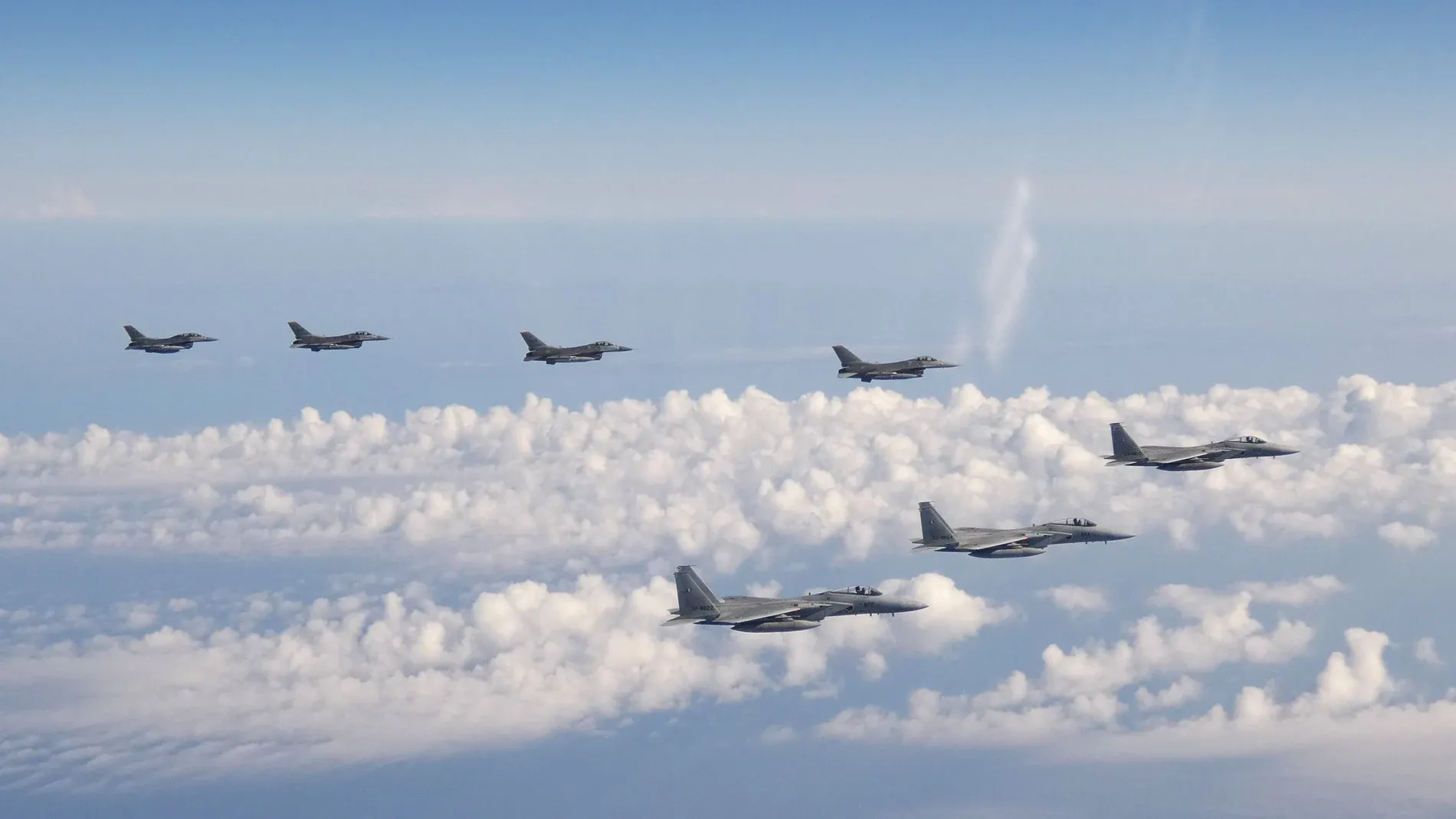

Morocco Enhances Military Aviation with Advanced F-16 Fighters
In a significant development for its military capabilities, Morocco has ordered 25 new F-16 fighter jets from Lockheed Martin, as announced in 2019. Although these aircraft maintain an appearance similar to older models, they are equipped with a comprehensive internal electronic overhaul that dramatically enhances their operational efficiency. Aerospace engineer Sergio Hidalgo has aptly described these jets as "flying computers" due to their advanced information processing capabilities. They feature all-weather radars integrated with interactive digital maps, which represent a substantial leap in combat technology. Furthermore, this procurement program allows for the modernization of older fighters, integrating new sensors and systems. It is estimated that out of the 25 units ordered, approximately 16 to 17 will be operational at any given time, factoring in maintenance and planning requirements.
This military reinforcement is largely driven by escalating regional tensions and Morocco's imperative to bolster its geopolitical stance. The complexities in Northern Africa and the Sahel region, the instability in Libya, the lurking threats of terrorism, and the ongoing rivalry with Algeria—armed heavily with Soviet-era weaponry—are all contributing factors. Additionally, the territorial disputes surrounding Western Sahara add another layer of complexity. While there is no direct evidence linking these developments to Spain, it is prudent for the latter to monitor the evolving military landscape of its neighboring country closely.
U.S. Support for Morocco amid Strategic Interests
The supply of F-16s and military support from the United States to Morocco is reflective of deeper strategic interests rather than purely altruistic motives. The U.S. aims to solidify its influence in Northern Africa, especially as Russia and China expand their presence in Algeria. The instability in the Sahel region, where Western troops are being expelled following coups in Burkina Faso, Mali, and Niger, has led to new governments forming military alliances with Russia, particularly through the paramilitary group known as Africa Corps.
Currently, the Sahel is recognized as the epicenter of global extremist activities, with groups affiliated with Al-Qaeda posing a significant threat that could disrupt key maritime routes if their influence spreads to Gulf of Guinea coastal nations such as Ghana and Ivory Coast. Meanwhile, China has been establishing economic dominance by financing strategic infrastructure projects, effectively trading investments for resource exploitation. This situation has prompted the U.S. to view Morocco as a vital partner in its economic security strategy, particularly in securing supply chains for essential minerals like uranium, lithium, and gold, which are not reliant on China's refining monopoly.
The Abraham Accords have further solidified U.S.-Morocco relations, recognizing Moroccan sovereignty over Western Sahara in exchange for normalizing ties with Israel. In February of this year, a Memorandum of Understanding was signed to explore critical minerals in Western Sahara and its Atlantic surroundings, again aiming to reduce dependency on China.
Amidst rising tensions between Spain and Morocco, highlighted by the recent influx of up to 80,000 immigrants on July 30, the U.S. has made its stance clear regarding Spain's leadership, with Donald Trump commenting on the lack of border control in the country. Some Republican factions even question Spain's sovereignty over Ceuta and Melilla, illustrating how Morocco's influence has risen in the strategic priorities of the United States.
These tensions have intensified, particularly after Spain denied the use of Rota and Morón bases for U.S. operations related to the war in Iran early in 2026. Additionally, discrepancies over defense spending within NATO and Prime Minister Sánchez's calls for a more autonomous European military have further complicated matters. The recognition of the Palestinian state in 2024 has also strained relations with Israel, a key U.S. ally.
According to security expert Andrés González, the primary risk to Spain's security lies in the potential diminishment of its qualitative air superiority if Morocco's modernization, operational capability, and maintenance outpace Spain's defensive enhancements. To counter this, González identifies several priorities for Spain, including:
- Maintaining air superiority through continued upgrades of Eurofighter jets, ensuring the integration of advanced sensors and long-range weaponry, and securing a stock of spare parts, munitions, and training hours.
- Enhancing situational awareness and integrated intelligence, focusing on key regions such as the Strait of Gibraltar and the Canary Islands through satellites, radars, ISR aviation, and drones.
- Improving electronic warfare capabilities and protection for critical bases against aerial and drone threats.
- Strengthening national defense industrial autonomy and engaging in active diplomacy with both Morocco and within the transatlantic alliance to avoid a symmetrical arms race.
As the future unfolds, the implications of the Morocco-Algeria conflict will significantly influence Spain's position, given that Morocco is a crucial partner in immigration control, drug trafficking combat, police cooperation, and trade. Conversely, Algeria remains a strategic energy partner, providing vital gas supplies to Spain through the Medgaz pipeline and liquefied natural gas shipments.
As reported by larazon.es.