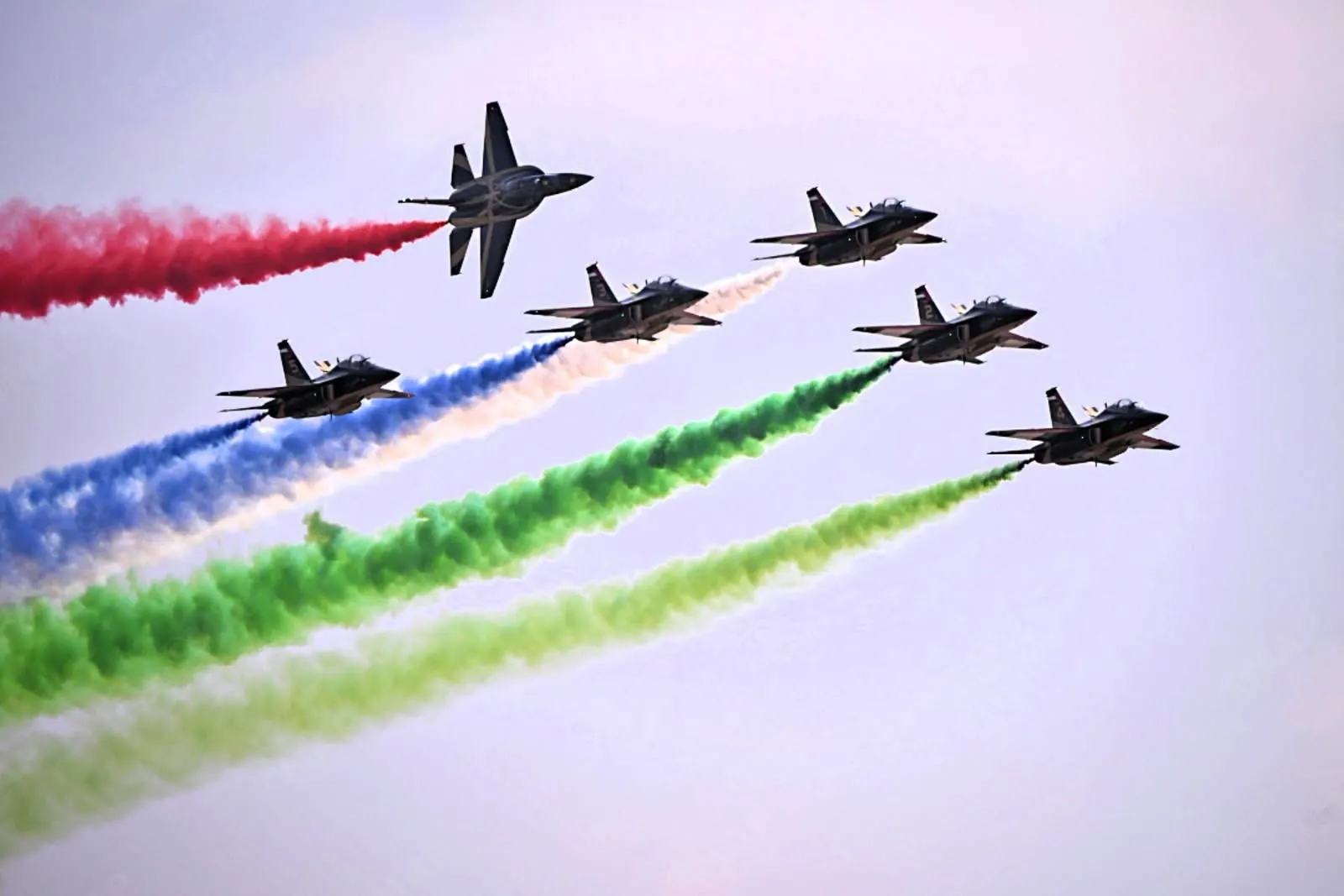

Morocco's Strategic Shift in Defense and Aerospace
Morocco is leveraging the Marrakech Air Show 2026 to strategically align its military modernization efforts with the establishment of a domestic aerospace and defense industry. Scheduled from October 7 to 10, the event will host around 200 companies from 27 countries at the Moroccan Air Force base in Marrakech. The presence of the United States and Israel is particularly notable, as they account for the majority of Morocco's imports of major weapon systems. Additionally, companies from the United Arab Emirates, France, Turkey, China, India, and South Korea are actively seeking partnerships with Rabat, indicating a robust international interest in Morocco's defense sector.
This eighth edition of the Marrakech Air Show transcends the traditional boundaries of an aerospace exhibition, showcasing not only fighter jets, drones, and air defense systems but also cutting-edge technologies in artificial intelligence, space technology, industrial manufacturing, maintenance, and the integration of Moroccan firms into international supply chains.
U.S. and Israel's Role in Morocco's Military Development
The United States continues to play a pivotal role in the modernization of the Moroccan armed forces. According to data from the Stockholm International Peace Research Institute, approximately 60% of Morocco's imports of major weapon systems from 2021 to 2025 were sourced from the U.S., with Israel contributing 24% and France 10%. Morocco has increased its weapons imports by 12% compared to the 2016-2020 period, making it the largest importer of major weapon systems in Africa in recent five-year comparisons.
This trend is prominently visible at the Marrakech Air Show, where Lockheed Martin is serving as a platinum sponsor, presenting capabilities in combat aircraft, air defense, and precision weapons. Featured displays include a cockpit demonstrator of the F-35 and Moroccan F-16s, along with a C-130J Super Hercules from the U.S. Air Force. Lockheed Martin's extensive collaboration with Morocco spans nearly five decades, involving the supply of F-16 fighters, C-130 transport aircraft, radar, and helicopter technology. In 2022, the company also participated in establishing a joint venture for the maintenance, repair, and overhaul of Moroccan F-16 and C-130H aircraft.
As military procurements continue alongside the exhibition, the U.S. approved a potential sale of up to 600 Stinger anti-aircraft missiles to Morocco in 2025, valued at approximately $825 million, along with a potential delivery of 500 GBU-39B precision bombs worth around $86 million. Other approved U.S. systems include AH-64E Apache attack helicopters, HIMARS rocket artillery, and various missile, surveillance, and air defense systems.
Since 2004, Morocco has held the status of a major non-NATO ally of the U.S., with Washington recognizing it as the largest African buyer of American military equipment. In parallel to its long-standing relationship with the U.S., Morocco has also formalized its security cooperation with Israel. Initially established through the resumption of official relations in late 2020, in the context of the U.S.-brokered Abraham Accords, this partnership has evolved to encompass procurement, intelligence sharing, cyber defense, training, military planning, and increasingly industrial collaboration.
In summary, the Marrakech Air Show 2026 serves not only as a platform for showcasing military hardware but also as a significant indicator of Morocco's evolving defense strategy and its commitment to building a self-sufficient aerospace and defense industry. The integration of international partnerships, particularly with the U.S. and Israel, highlights Morocco's proactive approach in addressing regional security challenges while enhancing its military capabilities.
As reported by fokus-afrika.de.