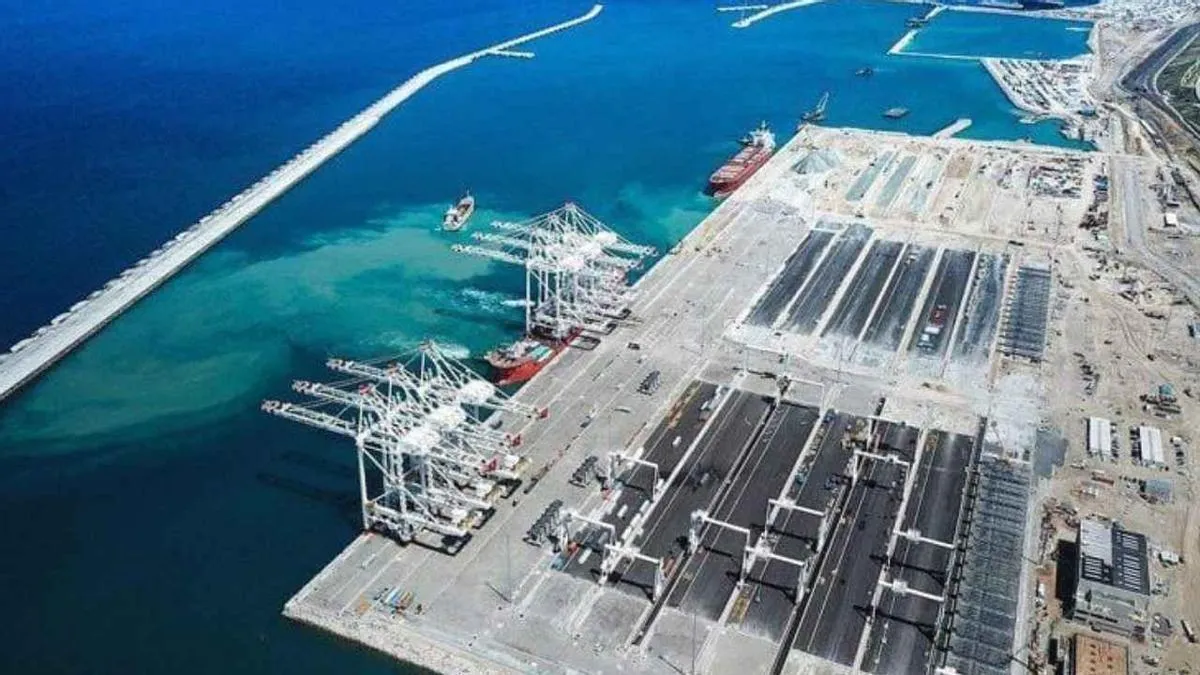

Morocco is poised to launch a significant new maritime hub, the Nador West Med port, designed to rival the established ports of Algeciras, Valencia, and Barcelona. Announced earlier this year by King Mohammed VI, this ambitious development is strategically located just 50 kilometers from Melilla and features a sprawling 5.4-kilometer dock. Set to commence operations in the last quarter of 2026, the port will boast a depth of 18 meters, allowing it to accommodate the largest container ships in the world. With an initial capacity projected to handle between 3 and 5.5 million TEUs (twenty-foot equivalent units), the port aims to enhance Morocco's presence in international shipping routes and assert its competitiveness in the Mediterranean Sea. The establishment of Nador West Med comes at a time of heightened migration challenges in Ceuta, and amid the remarkable growth of Tangier, which is now only surpassed by the major European ports of Rotterdam and Antwerp. This new logistical facility is expected to pose a direct challenge to the economic competitiveness and logistical leadership of Spanish ports.
The Strait of Gibraltar is one of the world's most complex geopolitical chessboards, akin to pivotal maritime passages like Hormuz, Malacca, and Bab el-Mandeb, as well as the Panama and Suez Canals. Approximately 10% of annual maritime trade transits through these waters, translating to nearly 100,000 vessels each year. The proximity of these new megahubs to Europe, combined with lower operational and tax costs, attracts multinational corporations and exporting industries, leading some businesses to prefer operations from the Moroccan side. This development reflects significant economic interests at stake.
Nador West Med has already conducted trials for roll-on/roll-off cargo and other goods, with full operations anticipated by 2030. This port represents the second megaport constructed by Morocco in the Strait in just two decades. King Mohammed VI oversaw a follow-up meeting from Casablanca to assess the progress of this port and industrial complex, which has amassed a public investment of approximately 1 billion euros, with 310 million euros sourced from the European Bank for Reconstruction and Development (EBRD). This situation has sparked considerable discontent among the Spanish business community, particularly in Andalusia, which sees its own contributions to funds being used to finance a direct competitor that seeks to undermine the strategic position of Spanish cities and ports.
Attracting Investments and Competing on a Global Scale
The Spanish Institute of Strategic Studies (IEEE) has raised alarms regarding Morocco's strategy to capture investments and maritime traffic in the western Mediterranean. To counter this, the institute advocates for enhancing the Campo de Gibraltar region with investment incentives, tax exemptions, and tariff reductions. The new Nador dock is expected to operate with a maximum capacity of 5.5 million containers, matching the current throughput of Algeciras and Valencia, while exceeding Barcelona's 3.8 million TEUs. Morocco aims to replicate the successful model of Tangier-Med, which has fundamentally shifted regional economic dynamics since its inception and expansion.
The state agency overseeing Nador West has indicated that it will initially manage up to 25 million tons of hydrocarbons, 7 million tons of coal, and 3 million tons of other goods annually, effectively transforming the port into an energy hub. Morocco is actively pursuing projects to connect this port with the Maghreb-Europe gas pipeline and another gas pipeline along the Atlantic coast, involving multi-million euro investments. The Moroccan statistics agency (HCP) predicts that Nador West Med and its free and industrial zone will generate over 100,000 jobs, comprising 45,000 direct and 55,000 indirect positions.
According to a report titled 'The New Ports of Tangier and Nador: Morocco's Encompassing Strategy,' published by the University of Navarra, Morocco's aspirations extend to gaining geopolitical influence in the Strait of Gibraltar. The crown jewel of this strategy remains Tangier Med, which, since its inauguration in 2007 and subsequent expansion in 2019, has irreversibly altered the region's economic landscape. Statistics from 2024 show that Tangier Med handled 10.24 million TEUs, more than doubling Algeciras' throughput of 4.7 million. This growth has positioned Moroccan infrastructure as the largest port in Africa, raising critical survival questions for Ceuta in light of this competition. Rabat's strategy appears aimed at stifling the growth of the autonomous city or, alternatively, creating total dependency on Moroccan services.
Environmental Regulations and Competitive Challenges
Morocco has long emphasized that its port model is not merely about adding more facilities, but rather about creating complementary nodes that alleviate pressure on Tangier Med while enhancing traffic capture capabilities. The International Center for Numerical Methods in Engineering (CIMNE) at the Polytechnic University of Catalonia estimates that over 75% of shipping routes from the Far East and transatlantic routes to Europe could eventually be diverted to Africa. This scenario has led major shipping lines such as MSC, Maersk, and Hapag-Lloyd to shift thousands of transshipment containers to North African ports, where they can avoid environmental taxes imposed by the EU. Once in Africa, these goods can be transported to Europe on smaller vessels, incurring significantly lower fees.
This strategic maneuvering has allowed Morocco to skillfully leverage certain regulatory factors within the European Union to expedite this process. One pivotal regulation is the EU Emissions Trading System (ETS), which requires shipping companies docking at European ports to pay for their polluting emissions, a cost that is set to escalate to 70% by 2026 and reach 100% by 2027. This tax could impose an additional financial burden of up to 150,000 euros per ship. Faced with this scenario, many exporters prefer to offload their goods at Tangier Med, merely 10 kilometers from the peninsula, where such environmental levies do not exist, thereby directly penalizing ports under Spanish sovereignty.
In light of these developments, Vicente Boluda Fos, president of the Spanish Shipowners Association (Anave), recently issued a warning during a meeting at the association's headquarters: "The EU ETS could become just another revenue-generating tax for shipowners if the funds collected are not reinvested directly into decarbonizing the sector." The environmental taxes imposed by the EU on ship emissions pose risks and forecasts of traffic diversion towards North African ports. Boluda emphasized that the revenue from these taxes should be reinvested in the maritime sector, in line with the recommendations of the recently approved conclusions by the Council of Transport regarding the European Maritime Industrial Strategy, which encourages member states to utilize the income generated from including maritime transport in the ETS to support the sector's energy transition.
Spanish ports such as Algeciras, Barcelona, Las Palmas, and Valencia are increasingly concerned about losing transshipment business to North African competition. Nations like Algeria, Tunisia, Morocco, and Egypt are poised to capture a portion of the shipping market. The design of Nador includes a colossal industrial free zone intended to house heavy industries, automobile assembly centers, and logistics platforms that will benefit from immediate maritime connections. The underlying concept is straightforward yet powerful: manufacture and export from the same location, thereby minimizing friction in the supply chain—an aspect increasingly valued by European companies in light of recent global supply chain crises.
In addition to containerized cargo, Nador has a clear focus on energy. The port will feature specialized terminals for the storage and distribution of hydrocarbons, natural gas, and, in the near future, green hydrogen. This positions Morocco as a strategic energy partner for the European Union, offering a secure platform for the transit and storage of critical resources. The complex is not merely designed for moving goods; it aims to be a cornerstone of regional energy security, capitalizing on Morocco's potential in renewable energy to lead the transition towards clean fuels.
In the race for clean energy development, Spanish ports like Barcelona, Valencia, and Algeciras—along with others in the Mediterranean such as Tarragona, Cartagena, and Huelva—aim to boost Spain's energy autonomy, as envisioned by the central government, through substantial investments in green hydrogen, particularly in light of recent conflicts in Ukraine and the Middle East. With lower labor costs and bilateral agreements with Germany, Morocco, utilizing maritime platforms like the ports of Tangier and Nador, aspires to become the preferred exporter of green hydrogen in Southern Mediterranean.
According to a report from the Defense Ministry, published last June and authored by naval captain Tomás García-Figueras, the energy geopolitics of Europe has historically operated under an east-west paradigm, characterized by Russian natural gas flowing into Central Europe via pipelines crossing Ukraine, Belarus, the Baltic, and Turkey. However, green hydrogen introduces a radically different paradigm, establishing a south-north corridor where renewable energy from the Mediterranean and North Africa is transformed into hydrogen and flows towards industrial centers in Germany, the Netherlands, and northern France. In this new landscape, Spain aspires to transition from an energy island—like it was for decades regarding gas, despite having six regasification plants with limited connections to the continental market—to becoming an energy export hub, as outlined in the aforementioned report.
In response to the competitive threat posed by Morocco, the Andalusian port most affected is Algeciras. This summer, its president, Gerardo Landaluce, announced a strategic shift to maintain its leadership against Tangier Med, planning to mobilize 1.383 billion euros by 2030—683 million in public funding and an additional 700 million in private investment. Meanwhile, the Green Energy Hub aims to attract up to 7 billion euros in the Bay area. This port aims to reach a capacity of 7.5 million TEUs and handle 9 million containers by 2035, compared to the nearly five million currently processed. To achieve this, plans include completing phase B of Isla Verde Exterior, enhancing depths, and modernizing container terminals.
Simultaneously, Valenciaport is executing works on a new container terminal (managed by MSC following a public-private investment of 1.6 billion euros), initiated at the end of 2024 with a duration of 54 months. This infrastructure will significantly increase operational and ship management capacities. With the ability to accommodate 5 million containers across 137 hectares, it will become the largest in the Mediterranean, enabling Valenciaport to handle up to 12 million containers, double its current capacity.
In contrast, the port of Barcelona has approved its strategic plan for 2026-2030, with investments totaling 1.2 billion euros, focused on current logistical and energy challenges. Of this amount, 859 million euros will be allocated to expanding and improving infrastructure and facilities.
Morocco's competitive edge extends beyond location and costs; it encompasses operational efficiency. Both Tangier Med and Nador West Med have been designed from the ground up as highly automated ports, allowing for a significantly faster unloading and transfer of goods compared to more traditional facilities. In contrast, Spanish ports often face higher costs due to labor and operational scale.
Antolín Goya, general coordinator of the State Coordinating Committee of Maritime Workers (CETM) and head of the European Stevedoring Council, maintains a firm and critical stance regarding the competition posed by Moroccan ports against Spanish ones. His argument extends beyond mere salary comparisons to encompass a broader structural issue. Goya contends that the competitive advantage of Moroccan terminals arises not only from lower base wages—where labor in Morocco operates at drastically reduced costs compared to Europe—but also from a crucial regulatory factor: European environmental regulations.
Interestingly, Vicente Boluda, a prominent shipping operator, does not share the same apprehensions regarding Morocco. His company, Boluda Corporation Maritime, has formed a significant alliance with Moroccan port operator Marsa Maroc, a move that has generated controversy and political debate, particularly in the Canary Islands, due to the entry of strategic Moroccan capital into national ports. Marsa Maroc, which manages twenty-five terminals across eleven African ports and handles over sixty million tons of cargo annually, has acquired a 45% stake in Boluda Maritime.
As reported by levante-emv.com.