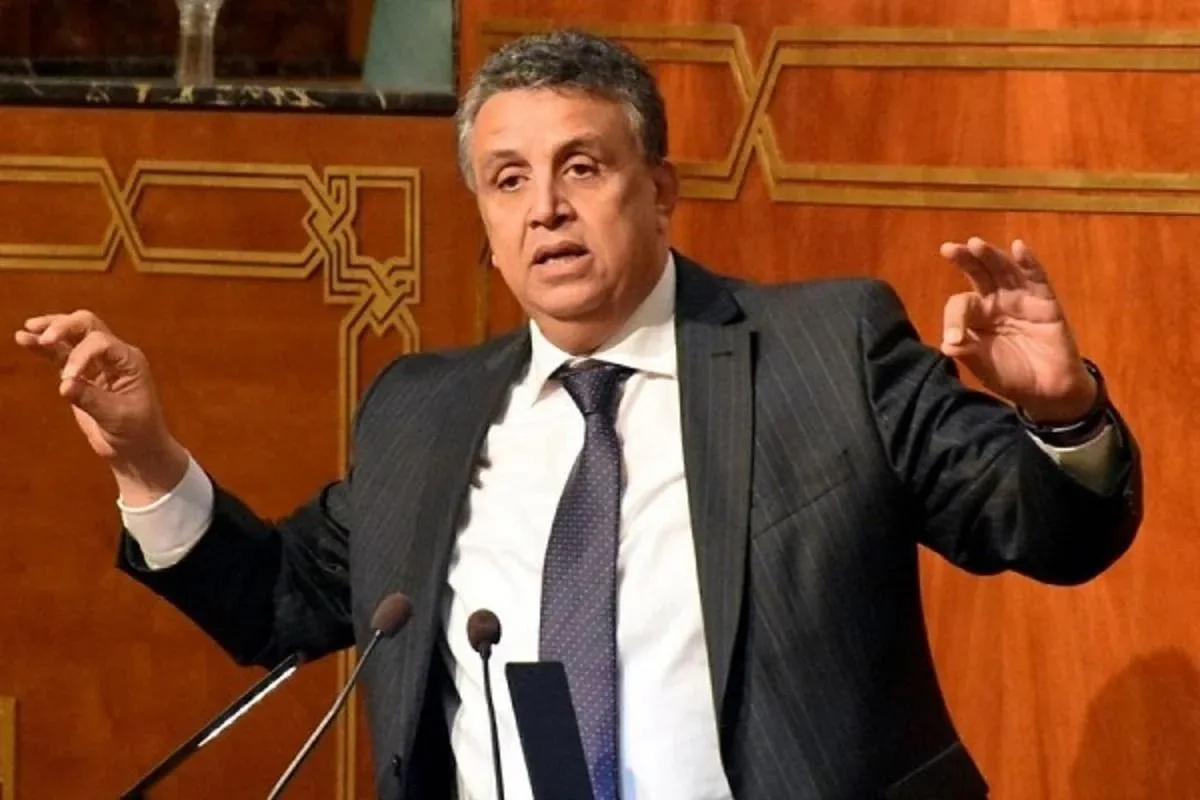

Morocco has publicly reaffirmed its claim over the enclaves of Ceuta and Melilla, urging Spain to engage in discussions regarding the future of these cities. Justice Minister Abdellatif Ouahbi's remarks come amidst rising tensions following a surge of border crossings at the end of July. Additionally, Ouahbi questioned Morocco's previous migration control measures and hinted at the potential suspension of an agreement with Spain. In response, Madrid swiftly stated that discussions regarding its sovereignty over Ceuta and Melilla are off the table.
Ouahbi: Ceuta and Melilla Remain "On the Table"
In an interview with _Asharq Bloomberg_, Ouahbi emphasized that Rabat maintains its historic claims over the two Spanish-administered cities on the North African coast. He expressed Morocco's desire to address this issue through dialogue and with a long-term perspective, noting that it remains "on the table" and is frequently discussed in meetings between representatives of both nations. This statement brings the longstanding conflict back into focus, a topic that both governments had largely kept out of the public eye during their recent political rapprochement.
The day following Ouahbi's comments, Spain issued a firm rebuttal. The Spanish Foreign Ministry declared to the newspaper _ABC_ that sovereignty over Ceuta and Melilla has "not been discussed and will never be discussed," asserting that both cities are integral to Spain's internationally recognized territorial integrity.
Migration Disputes Intensify Dialogue
Ouahbi's statements extended beyond the sovereignty issue, linking the dispute over Ceuta to a broader criticism of European, particularly Spanish, migration policies. He highlighted that Morocco is currently preventing irregular departures of both its nationals and migrants from other countries, even as those who manage to enter Spain are afforded legal processes. Ouahbi recounted that migrants from Sub-Saharan Africa challenge Moroccan authorities, questioning, "Why are you holding us up when Spain will ultimately take us in?" He further escalated the rhetoric by suggesting that if Spain is willing to accept migrants, Morocco could simply open its borders, questioning the rationale behind stopping them from crossing into Spain.
While he did not announce a cessation of Moroccan border controls, his comments clearly critique the established division of labor between Morocco and Spain in curbing irregular migration. Ouahbi stressed that Morocco cannot indefinitely serve as Europe’s "border police," demanding shared legal standards and coordinated procedures with Spain. He pointed out the contradiction where Spain expects Morocco to prevent irregular crossings while also requiring humane treatment of individuals upon their arrival, in accordance with Spanish and European law.
This confrontation follows massive border crossings into Ceuta on July 30 and 31, leading both Moroccan and Spanish authorities to focus on repatriations and stabilizing the border situation. The Moroccan Interior Ministry has also issued warnings against new calls on social media for large-scale crossings into Ceuta on August 15, declaring a "shared responsibility" between the two nations in combating irregular migration and smuggling networks.
As of August 12, there were 1,527 unaccompanied minors in Ceuta, a topic that remains highly contentious. Not all of these minors arrived during the recent border crisis, as Spain had previously indicated that at least 1,400 minors entered during the latest mass crossings. Morocco has expressed its willingness to repatriate its minors, a position welcomed by Spanish Foreign Minister José Manuel Albares during his visit to Ceuta, who noted that Rabat had offered a swift return for the youth from the very beginning.
The contention lies not in the basic acceptance of minors but rather in the procedural aspects. Since 2007, an agreement exists between Morocco and Spain regarding unaccompanied Moroccan minors, facilitating cooperation in family identification and coordinated returns. However, Spanish law prohibits the blanket deportation of all minors, requiring individual assessments to ensure that repatriation aligns with the best interests of the child, incorporating information about family situations and hearings for the minors.
This requirement stems from the Ceuta crisis of 2021, when hundreds of minors were returned to Morocco, an action later deemed unlawful by Spain's Supreme Court in January 2024 due to insufficient individual evaluations. As a result, Spanish authorities cannot initiate collective return proceedings, even when Morocco expresses its readiness to accept the minors.
Ouahbi has increased pressure on Madrid regarding this matter, revealing that the Moroccan Justice Ministry is considering the suspension of the agreement with Spain if Spain refuses to respect the transfer procedures. Juan José Imbroda, the President of the Spanish exclave of Melilla, strongly criticized Morocco, questioning why it seeks to claim Ceuta and Melilla when it cannot manage its current issues and youth migration effectively. He labeled the recent migration crisis as an international embarrassment for Rabat, urging Moroccan authorities to regain control.
In contrast, Foreign Minister Albares, during his visit to Ceuta, focused on collaborative efforts regarding the return of minors and acknowledged Morocco's cooperation in handling the recent border crisis. Thus, while both governments are working closely on migration and repatriations, Morocco's renewed claim over Ceuta and Melilla reopens one of the most sensitive issues in their bilateral relations, making it a focal point in political discussions once again.
As reported by fokus-afrika.de.