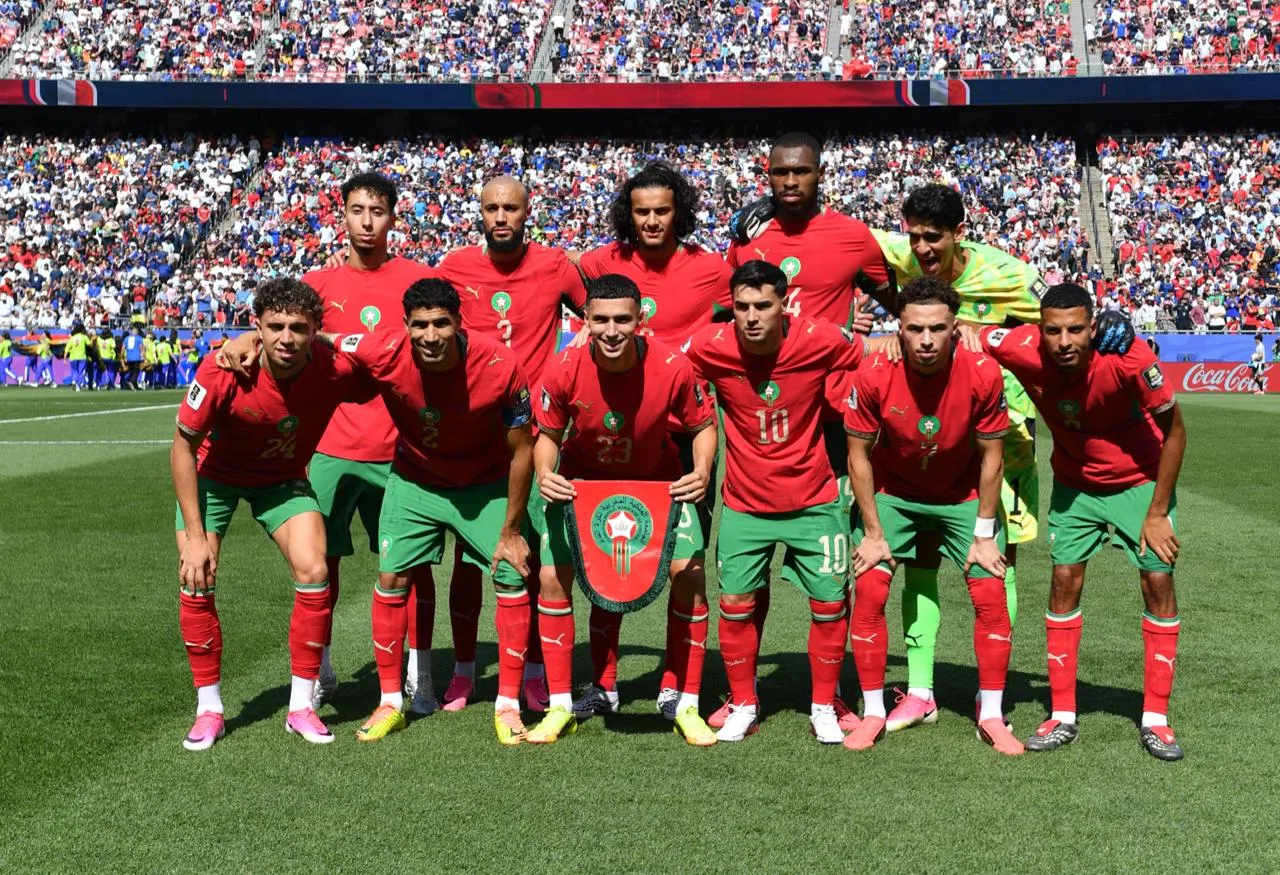

The British Broadcasting Corporation (BBC) has highlighted Morocco's significant presence in the global football landscape, marking the nation's second consecutive appearance in the quarter-finals of the World Cup. The report emphasizes that Morocco has embarked on an ambitious football project that is meticulously crafting its identity as a burgeoning global power in the sport.
Neil Ward, a Welsh football expert who has closely observed the Moroccan football revolution, summarizes Morocco's potential succinctly: "Morocco possesses all the qualifications to become one of the major forces in global football." Ward, who previously served as the CEO of the Football Association of Wales, joined the Royal Moroccan Football Federation in 2020 as the Director of Technical Operations. His tenure has allowed him to witness firsthand how football in Morocco has transformed into a national project, embodying the true meaning of a state-driven initiative.
Ward was present in Rabat when the Atlas Lions made history during the Qatar 2022 World Cup by reaching the semi-finals for the first time in African football history. He recalls the celebrations that erupted in the capital city, lasting into the early hours, with King Mohammed VI sharing in the national joy over this historic achievement. Although the Moroccan team faced defeat against France at that stage, their ambition only grew stronger. As Morocco approaches the co-hosting of the 2030 World Cup alongside Spain and Portugal, the nation appears unwavering in its quest to inscribe a new chapter in its football history.
According to the report, this achievement is not a fleeting moment but rather the result of a clear vision. Simon Jennings, a British football development consultant who oversaw youth programs in Morocco from 2020 to 2024, affirms that the current success is no coincidence. He states, "This success was not born out of luck but is a result of a clear national ambition and a well-thought-out vision." Investment in football has garnered direct support from King Mohammed VI, who has prioritized the development of sports, particularly football, as a strategic project for the kingdom.
These investments have led to the establishment of the Mohammed VI Football Academy, recognized as one of the premier training centers globally, along with the national academy, regional training centers, and the rehabilitation of stadiums, as well as the construction of thousands of grassroots football fields. Ward notes that these facilities provide Moroccan players who are professionals in Europe with a strong sense of belonging to a comprehensive professional project, stating, "When a player arrives at a center of this caliber, they realize that the officials are serious about creating success."
The Moroccan approach to football transcends the mere pursuit of trophies; it aims to leverage football as a means to enhance the kingdom's international image through what is known as soft power. Morocco has evolved from merely participating in major tournaments to entering them with a mindset of contending for the title. The report recalls what former national coach Walid Regragui told his players before the World Cup in Qatar, emphasizing that they were not traveling merely to play three matches but to create an achievement that would be etched in Moroccan football history.
One of the crucial elements behind Morocco's success is its ability to effectively harness the talents of Moroccans dispersed across the globe. The Royal Moroccan Football Federation has established an extensive network of scouts in countries such as France, Spain, the Netherlands, Germany, Belgium, and the Scandinavian nations to monitor Moroccan talents from a young age. Jennings asserts that these players do not see Morocco as a second choice. "They are Moroccan in every sense of the word, feeling a strong connection to their homeland and harboring a deep passion for representing its colors," he explains.
The statistics validate this strategy, as 19 out of the 26 players on the Moroccan squad that participated in the 2026 World Cup were born outside Morocco, with six of them also eligible to represent the French national team. Among them is rising star Ayoub Bouaddi, a player for Lille in France, who ultimately chose to represent Morocco despite his history with French youth teams. Ward also reveals that the federation had been tracking Lamyn Jamal since he was 12 or 13 years old at the Barcelona academy, demonstrating the high level of professionalism involved in talent scouting, even if not all attempts lead to success.
Looking ahead, despite the successful strategy of attracting diaspora talent, Chris Van Puyvelde, the former technical director of the federation, argues that the next phase requires producing a greater number of players within Morocco. According to him, the goal is to enter the 2030 World Cup with a squad comprised of half homegrown players and the other half from the diaspora, while also emphasizing the importance of continuing to develop the local system and not becoming complacent with immediate results. The report cites national coach Mohamed Wahbi, who faced challenges after the under-20 team's failure to win the Africa Cup of Nations but later steered them to victory at the youth World Cup in 2025. This achievement opened doors for him to coach the senior national team with a contract extending until the 2030 World Cup.
In conclusion, the report conveys a clear message: Morocco is not merely building stadiums in preparation for the 2030 World Cup; it is constructing a comprehensive football ecosystem capable of ensuring sustainability and nurturing champions for generations to come. Van Puyvelde emphasizes, "Morocco is not just erecting stadiums; it is building the structure of football from the grassroots to the summit. The moment Moroccan football breathed the oxygen of the Qatar World Cup achievement, this spirit spread throughout the country." This sentiment likely explains the growing consensus among many international experts that Morocco's recent accomplishments are not a fleeting phase but the beginning of a long journey that will establish the Atlas Lions as a permanent fixture among the elite of global football.
As reported by almountakhab.com.