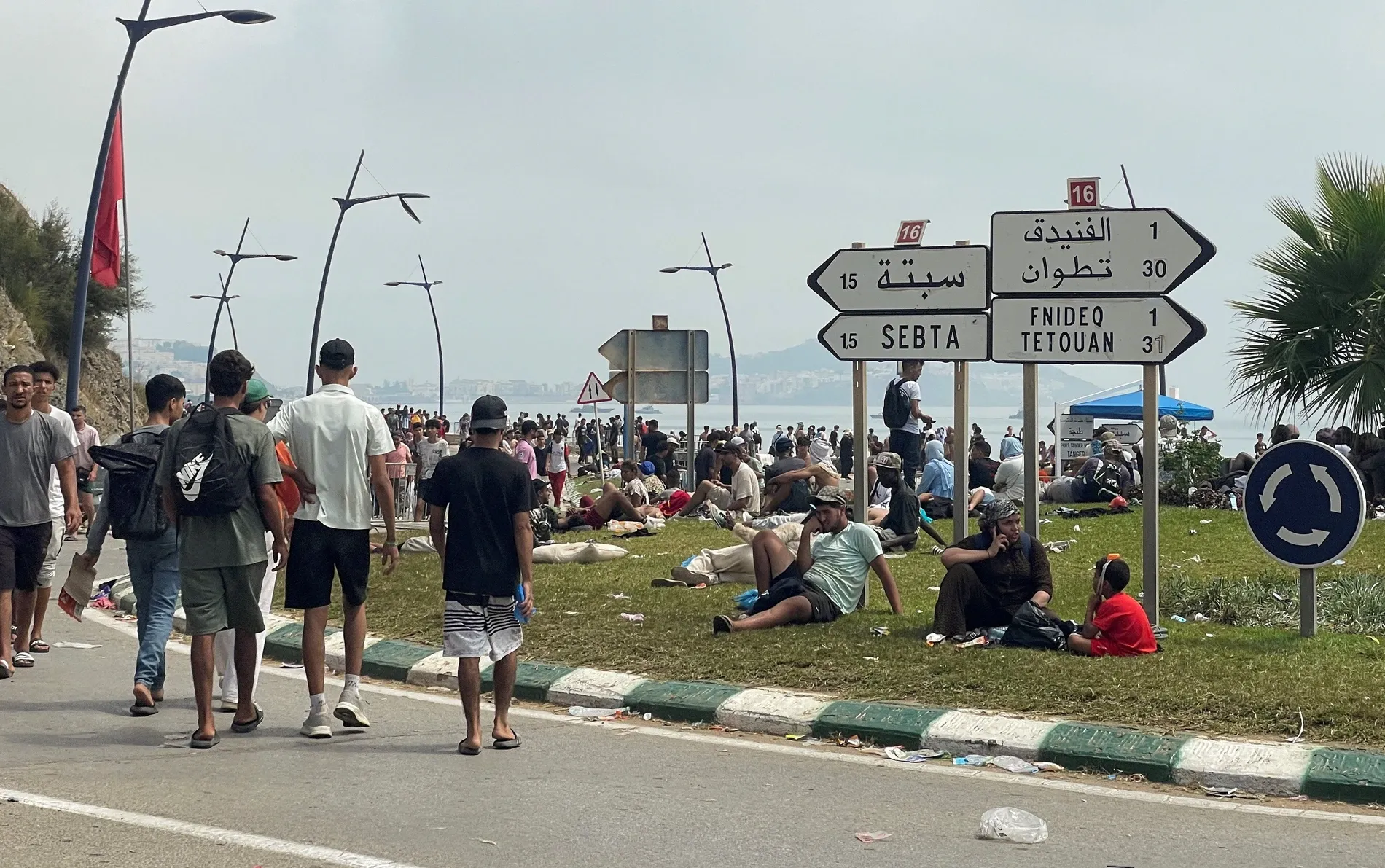

Initially, it appeared that Morocco had reverted to its old reflexes, as there was a notable silence from official sources regarding the mass influx of migrants into Ceuta. The absence of any information on casualties or the scale of the crisis was interpreted by many in Spain as a tacit acknowledgment of Morocco's involvement in the situation. However, as the situation developed, the Moroccan Interior Ministry reported on Sunday evening that eleven individuals had drowned, while Spanish authorities had previously confirmed 88 fatalities, and that approximately 40,000 people had crossed the border into Ceuta.
A spokesperson for the Moroccan Interior Ministry attributed the migration crisis to the "malicious exploitation of the digital space and the activities of human trafficking rings," while also highlighting the misinformation and misunderstandings surrounding a recent ruling by Spain's Supreme Court, which prohibited the immediate return of migrants who swim to Ceuta. This ruling has been viewed by many as a significant pull factor in the surge of migrants.
Morocco has positioned itself as a "reliable and responsible partner" in addressing this crisis, with officials expressing readiness to collaborate with Madrid and the European Union. This sentiment was echoed by the Moroccan ambassador to Spain earlier in the week. In both Moroccan and Spanish media, the Supreme Court ruling from July 8 was identified as a crucial factor, following successful legal challenges by migrants against expedited deportations at the borders of Ceuta and Melilla, which had reached the European Court of Human Rights.
The court ruling determined that such "hot returns" to Morocco were illegal for migrants who arrived by swimming. Nonetheless, Morocco and Spain agreed on a rapid return of the new arrivals, with military personnel intercepting migrants on the streets of Ceuta and transporting them to the border, where buses were reportedly waiting to take them back to their remote hometowns.
Spanish Prime Minister Pedro Sánchez and his Interior Minister Fernando Grande-Marlaska have repeatedly asserted that cooperation with Morocco is functioning well. However, there seems to have been a significant miscalculation regarding the scale of the influx from Rabat, which was reported to be as high as 100,000 people heading towards the city of 84,000 residents.
Concerns Over Intelligence Failures
In the days leading up to this crisis, over 1,200 Moroccans and migrants swam to Ceuta, marking a notable increase. The Spanish government appeared distracted by the ongoing battle against devastating forest fires, as Grande-Marlaska reportedly only spoke with his Moroccan counterpart on Thursday afternoon, after tens of thousands had already gathered at the border.
Grande-Marlaska has insisted that the Spanish intelligence services did not provide any warning about the impending influx, a failure that the opposition has termed scandalous if proven true. Eyewitness accounts suggest that Moroccan police did not resist the surge, with claims that some officers even directed young Moroccan men towards the quickest routes to the border. A video circulating online purportedly shows a police officer assisting dozens of men from the back of a large truck, although the authenticity of this footage has not been verified.
According to eyewitnesses, Moroccan authorities reportedly minimalized border controls during the days surrounding the national Throne Day celebrations, which coincided with the influx. At the time, King Mohamed VI was only about 20 kilometers south of Ceuta at his summer residence.
While there is a growing belief in Spain that the Moroccan regime orchestrated the surge, Spanish intelligence agencies have reached different conclusions, suggesting that there was no premeditated plan. Instead, they believe the Moroccan authorities not only failed to prevent the crowd but may have facilitated it, taking political advantage of the international outcry.
The Digital Realm and Youth Unrest
The "digital space" that the Moroccan Interior Ministry claims migrants utilized has not been effectively monitored by the typically efficient Moroccan intelligence services, which were caught off guard by large-scale protests last autumn. These protests saw tens of thousands of young Moroccans taking to the streets, organized not through social media but via the relatively unknown gaming platform Discord.
Despite the protests subsiding, the frustration and despair among the youth remain palpable, with official statistics indicating that nearly one-third of Moroccans aged 15 to 24 are unemployed. Many of those who streamed to Ceuta were in this age group and reported that they had set out in response to social media claims that the border was open. It seems unlikely that the regime could orchestrate such a widespread online campaign.
The images emerging from Ceuta have once again drawn international attention to the Spanish enclaves that Morocco has claimed since its founding. Reports from the pro-monarchy online portal Le 360 referred to the "geographical anomaly" of Ceuta and Melilla, posing the question of not whether these enclaves would return to Morocco, but rather how long that process would take and what tragedies might occur in the meantime. Similar sentiments were echoed across various other platforms.
In Rabat, there is keen interest in the growing calls within the U.S. political sphere, particularly around former President Donald Trump, to recognize Ceuta and Melilla as Moroccan territory, akin to the recognition given to the former Spanish colony of Western Sahara in 2020. Influential American analysts have even suggested a new "Green March" to Ceuta and Melilla, harking back to the mass civilian march from Morocco into Spanish territory in November 1975. Simultaneously, the Israeli UN ambassador described Ceuta as a "colonial enclave," further complicating the discourse.
Additionally, Morocco has been closely monitoring the recent agreement between the EU and the UK regarding the former Crown colony of Gibraltar which came into effect on July 15. This agreement, which opened Gibraltar to the Schengen area amidst a sovereignty debate, sparked outrage in Morocco, particularly due to the cessation of direct ferry services between Morocco and Gibraltar.
On July 20, Prime Minister Sánchez made a conciliatory visit to Algeria, Morocco's regional rival, after years of diplomatic tension primarily rooted in the Western Sahara conflict. Algeria remains a staunch supporter of the Polisario Front, which advocates for an independent Western Sahara.
Simultaneously, the Spanish parliament is considering legislation that would grant residents of the former Spanish colony the right to Spanish citizenship, a diplomatically sensitive issue that could be interpreted as an indirect recognition of their status as Moroccans in the eyes of Rabat.
Historically, tensions surrounding Western Sahara have strained relations with Spain far more than they do today. Prime Minister Sánchez has made significant concessions to King Mohamed VI, abandoning Spain's previous neutrality and signaling support for autonomy under Moroccan control rather than insisting on a referendum for independence.
This drastic shift in policy has its roots in Ceuta's recent past, which remains fresh in the minds of its residents. In May 2021, the Moroccan police ceased border controls, leading to an influx of 8,000 to 10,000 Moroccans into the city, only for them to disappear shortly thereafter. This incident was preceded by Spain's secretive permission for the Polisario leader to receive treatment for a severe COVID-19 illness in Spain, which infuriated Rabat.
Following this, Sánchez took significant steps to mend relations with Morocco, recognizing its key role in combating illegal migration and international drug trafficking for the EU. However, Spain has come to realize that its partnership with Morocco is not as dependable as once thought, revealing how vulnerable Ceuta and Melilla truly are. Historically, Morocco has used migrant flows as leverage for its political interests, a tactic observed as far back as 2014 when a diplomatic incident involving the Spanish coast guard resulted in a sudden surge of over 1,200 migrants crossing from Morocco into Spain.
This time, however, Moroccan leadership has maintained open lines of communication with Spain, emphasizing their willingness to collaborate with Madrid and the EU moving forward, especially as they prepare to co-host the 2030 World Cup alongside Portugal, which will undoubtedly result in significant travel between the EU and Morocco.
As reported by faz.net.