
The Shared Responsibility of Migration Management
A government source has recently emphasized that managing migration flows is a collective responsibility, attributing the recent migratory pressure towards Ceuta to a Spanish court ruling that, according to them, has undermined deterrent measures. The source asserted that Morocco has always acted as a "sovereign, loyal, and responsible" partner in combating illegal immigration, underlining that migration management is a "shared responsibility" where Morocco has consistently played its part. The source stressed that "Morocco has never acted under pressure, nor has it acted out of obligation or coercion"; rather, the commitment and responsibility have always been the driving forces behind their actions.
According to the same source, migration is a "complex phenomenon where everyone must assume their responsibilities," clarifying that "we fully assume ours." This commitment is reflected in "visible results for all to see, even if sometimes they are taken for granted and the achievements are no longer recognized for the feats they represent." The government source also recalled that "if the western flank of the Mediterranean has been the least problematic for Europe for years, it is not because it is not targeted by human trafficking networks, but because Morocco has effectively mobilized considerable resources—and continues to do so today."
Significant human, technical, and financial resources are deployed to combat illegal immigration, and the cooperation between Rabat and Madrid has been described as "exemplary." Supporting this assessment, the government source indicated that 74,000 illegal migration attempts were thwarted in 2025 and 79,000 in 2024, totaling nearly 160,000 over the two-year period. Furthermore, 632 illegal immigration networks were dismantled during this time, alongside more than 32,000 sea rescue operations and over 360,000 thwarted illegal immigration attempts in the past five years.
Impact of the Spanish Court Ruling
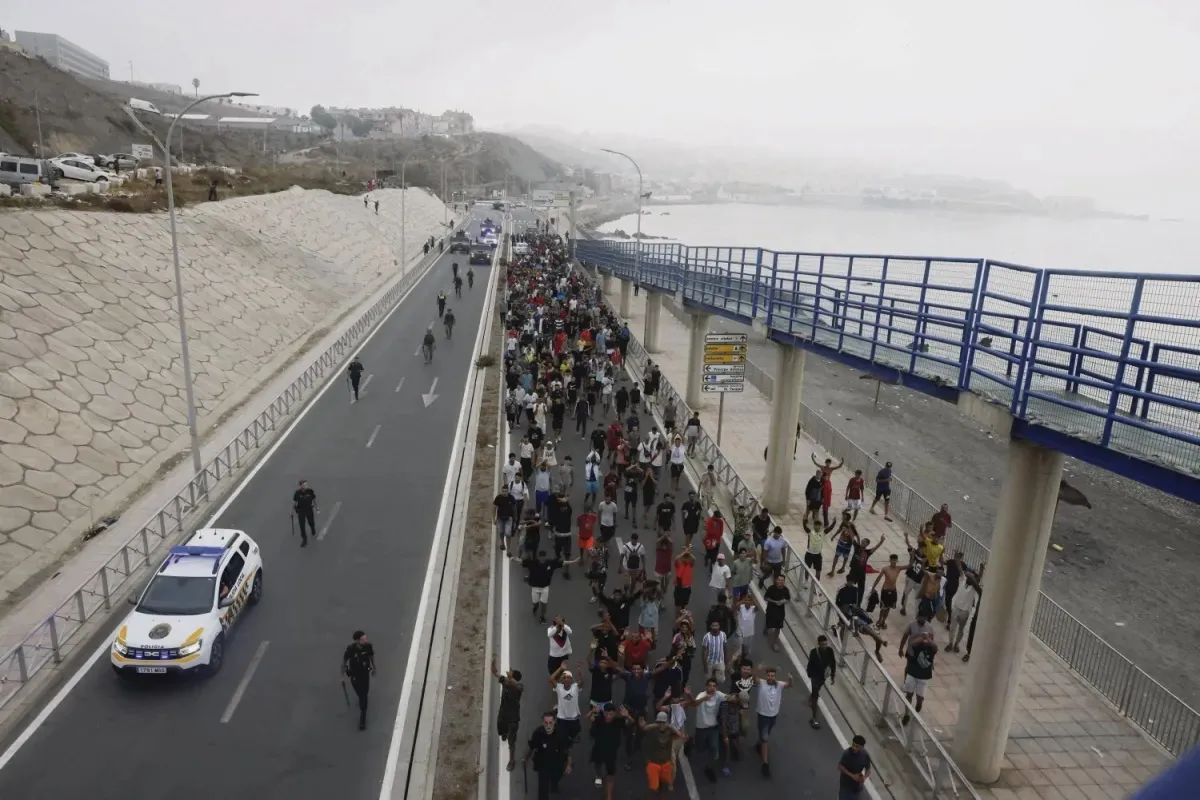
Addressing recent events in Ceuta, the same source suggested that their origin lies in a Spanish court ruling made on July 8. According to them, "the migratory barrier did not give way to traffickers but to a Spanish court decision," reminding that "Morocco has never faltered" in its commitments. The source explained that this ruling ended the automatic repatriation of migrants arriving by sea, which is central to their deterrent framework. In the eyes of traffickers and would-be illegal immigrants, this decision "effectively immunized illegal access by sea," they argued.
The consequence, as per the government source, is that "the deterrent element of the system collapsed, and the barrier gave way, not under the weight of criminals but under a judge's decision." They added that this ruling "was well known to the Spanish authorities: they could not ignore that it weakened the entire system," questioning, "Did anyone alert Morocco to prepare? No! Did anyone anticipate the highly predictable consequences? No!" In this context, "it is therefore not surprising that networks seized the opportunity," the source assessed, considering that the "game changer" lies in the "discrepancy between the triggering factor (the judge's decision) and the delayed reaction."
Beyond this episode, the government source questioned the viability of the current migration management model, asserting that "we are neither the gendarme nor the concierge of Europe; we are a sovereign partner, not a subcontractor." They also expressed disappointment that "it is disheartening to see that the events in Ceuta have been exploited for electoral gains and political score-settling," adding that "when the crisis peaked, under the weight of sensationalist and alarmist media coverage, we heard the most hateful comments and the wildest analyses." The source lamented how certain political actors fell short of the historical moment and were disappointing in their reactions.
Believing that the current partnership must evolve, they concluded that "we arrive at a clear conclusion: the rules of engagement must change!" They reiterated that "Morocco protects its territory, but no one does it in its place." They pointed out that "everyone must assume their responsibilities: Morocco is neither the gendarme nor the concierge of Europe. We operate as a reliable and committed partner within a well-understood partnership that cannot be one-sided," asserting that the partnership rules must be updated. The government source also highlighted that "it should not be believed that simply injecting funds will make everything work like magic," clarifying that funding has never been a motive for action for the Kingdom.
They stressed that "there is no exclusive security answer to the migration question," arguing that recent voluntary returns from Ceuta demonstrate this. According to them, "these young people returned because they saw firsthand that the situation in Morocco is better than the Eldorado they fantasized about." "Their return was therefore voluntary. Spain claims that 95% of individuals left Ceuta," they continued, emphasizing that these departures result from personal choice rather than actions by Spanish authorities. The government source suggested that this evolution confirms the relevance of the development choices made under the leadership of His Majesty King Mohammed VI, recalling that over 430,000 jobs have been created in the northern provinces. In conclusion, they stated that "the Eldorado is a myth that our youth have dismantled themselves by returning voluntarily. The best response to illegal migration is development." They believe that Europe must now align more closely with a development support logic for Morocco and avoid decisions that could penalize its economy, particularly in the port, automotive, financial, services, transport, and offshoring sectors.
As reported by laquotidienne.ma.