
The ongoing territorial ambitions of Morocco have raised significant concerns regarding Spanish sovereignty, especially as evidenced by recent maps that even the Spanish government has inadvertently endorsed through platforms like the now-corrected Casa 47 housing portal. A closer examination of Morocco's strategies in the Strait ports reveals a growing dominance that appears intent on suffocating Spanish enclaves, Ceuta and Melilla. This burgeoning influence is reportedly underpinned by approximately 600 million euros in funding from European multilateral banks, of which Spain is a key shareholder, including the European Investment Bank (EIB) led by former Vice President Nadia Calviño, and the European Bank for Reconstruction and Development (EBRD).
Moreover, Morocco's state-owned enterprise, Marsa Maroc, has recently acquired a 45% stake in Boluda Maritime Terminals (BMT), a subsidiary of the Boluda Group, marking its presence in nine Spanish ports, five of which are located in the Canary Islands. This strategic investment illustrates Rabat's intent to leverage its proximity to the Spanish territories of Ceuta and Melilla, both located less than 30 kilometers from Morocco's Tangier Med and Nador ports. Analysts, such as Miguel Ayerra from the University of Navarra, have noted that Morocco aims to "squeeze these cities either by obstructing their economic growth or by fostering a dependency on Moroccan ports."
The geopolitical and strategic significance of Ceuta and Melilla for Spain cannot be understated, as highlighted by Manuel Gazapo Lapayese, a doctor in international relations. These cities provide Spain with vital control over the Strait of Gibraltar and access to critical fishing and agricultural resources. In his coronation speech in 2002, King Mohammed VI outlined a vision for controlling the Strait, initiating this plan with the construction of the Tangier Med port in 2007. Following its expansion in 2019, Tangier Med surpassed Algeciras to become the Mediterranean's leading port and has since established itself as Africa's foremost port. By 2024, Tangier Med had processed 10.24 million TEUs (Twenty-foot Equivalent Units), significantly outpacing Algeciras, which managed only 4.7 million TEUs.
Investment in Moroccan Ports
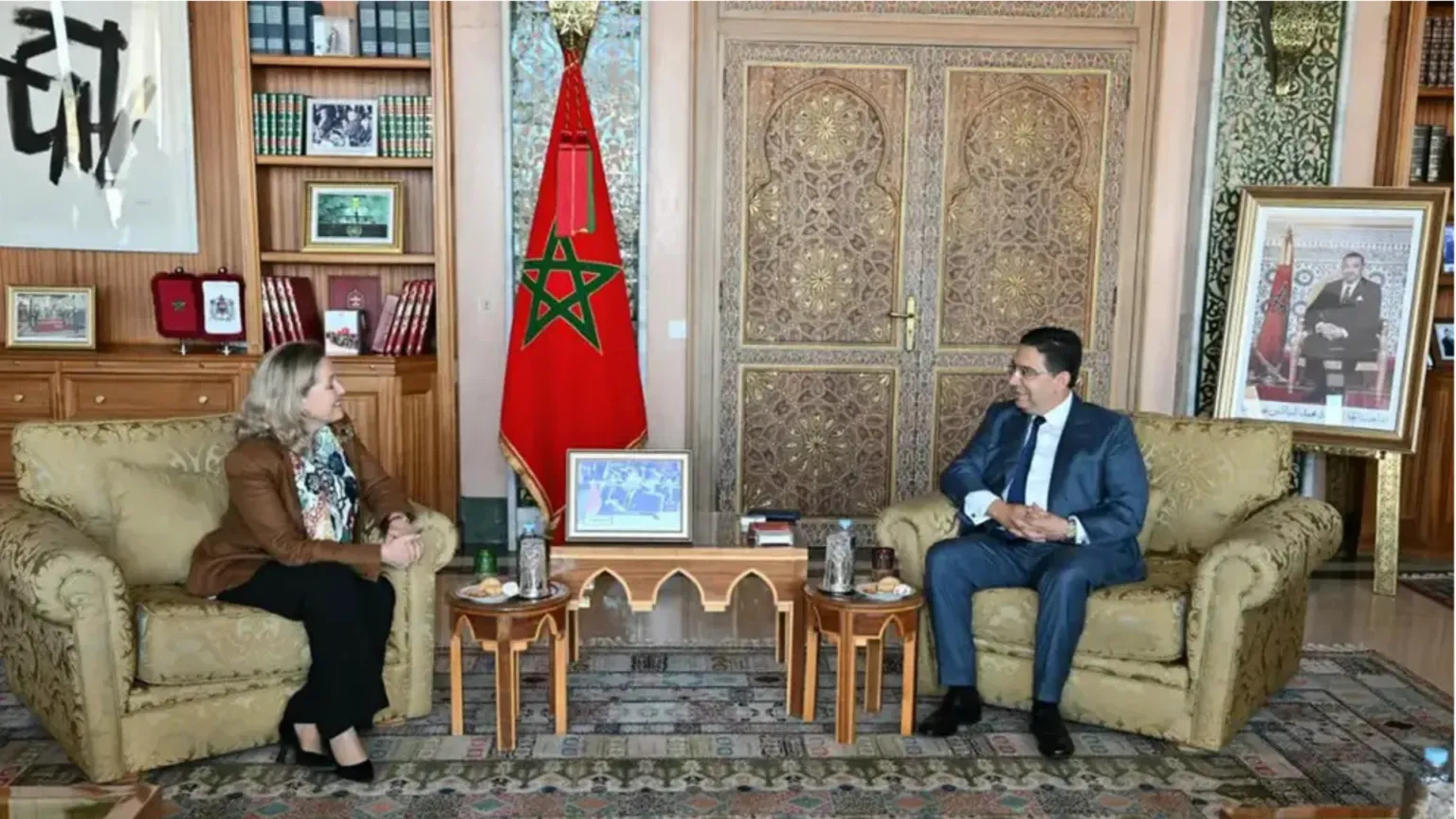
The European Investment Bank has already contributed at least 220 million euros to the Tangier Med port. In a visit to Morocco on June 30, Nadia Calviño reaffirmed the bank's commitment to investing 700 million euros in Morocco by 2026, during which she met with Moroccan Foreign Minister Nasser Bourita and Minister of Economy and Finance Nadia Fettah. The first phase of the Nador West Med port is expected to commence operations between late 2026 and early 2027, with an initial capacity of 3.5 million TEUs annually, expandable to 5.5 million in subsequent phases, positioning it close to the traffic levels of Algeciras in 2024 and approaching those of Valencia. The container terminal will be operated by Marsa Maroc in collaboration with CMA CGM, a major French shipping company.
Additionally, the EBRD has allocated 310 million euros to this port initiative, which has stirred discontent among Spanish business circles. The EBRD, established in 1989 to aid in the reconstruction of former Soviet republics, also has ties to Calviño, who, during her tenure as the bank's governor while serving as Spain's Minister of Economy, reportedly placed her newly graduated son in a position of some relevance, as revealed by Vozpópuli.
Growing Influence in the Canary Islands
This strategic positioning is further enhanced by Marsa Maroc's acquisition of Boluda's operations by the end of 2025 and the increasing number of contracts being awarded in the Canary Islands. Fouad Brini, the chairman of the Tanger Med Special Agency (TMSA) and the board of Nador West, is set to join the board of Boluda Maritime Terminals, granting him full access to the port business landscape of Las Palmas, as reported by Canary Maritime.
A recent Royal Communication from Morocco emphasized that following the international success of Tangier Med, which has become the primary port center in Africa and the Mediterranean, the new Nador West Med project is aimed at extending Morocco's ambition to create an efficient national port system that complements the competitiveness of the national economy, creates jobs, and fosters balanced territorial development.
As reported by articulo14.es.