
Unraveling the Migrant Crisis Amidst Territorial Disputes
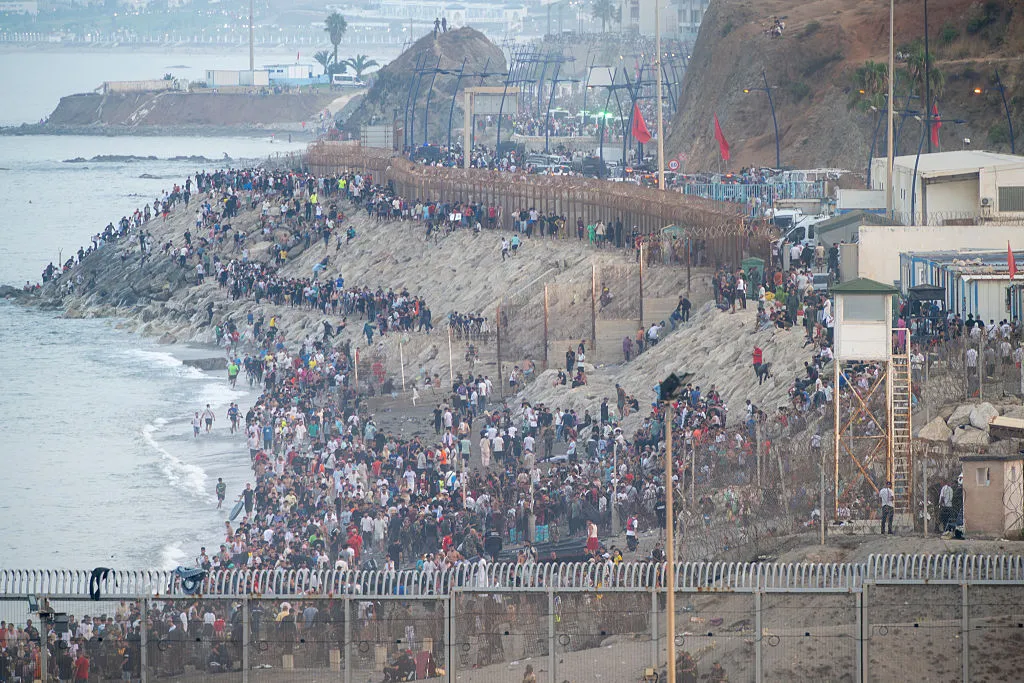
According to a former Spanish ambassador to Morocco, the territorial claims made by Morocco on the Spanish enclaves in North Africa represent a significant factor contributing to the recent migrant crisis in Ceuta. The arrival of over 72,000 migrants in this small Spanish city at the end of July has triggered a political shockwave throughout Spain and across Europe, reigniting a long-standing territorial dispute that has persisted for years. Jorge Dezcallar, who has also served as the head of Spain's intelligence services (CNI), stated in an interview with Euractiv that Rabat has never relinquished its claims over Ceuta and Melilla. The unresolved tensions between the two nations have, in part, set the stage for the massive influx of migrants that overwhelmed Ceuta.
Dezcallar elaborated that Morocco appears to be "testing the waters" at a time when it perceives a weak government in Madrid. The leftist Spanish government, led by Pedro Sánchez, is currently grappling with mounting corruption scandals involving high-ranking officials within its ranks. This political turmoil has often led to clashes with European counterparts, particularly due to Sánchez's pro-immigration policies and criticisms directed at the United States.
Ongoing Claims and Diplomatic Tensions
Relations between Spain and Morocco, according to Dezcallar, are characterized more by passion than by rationality, often fluctuating in intensity. However, both nations share significant ties through trade and, more critically, through essential cooperation regarding migration, counter-terrorism, and regional security. Moroccan ministers and media outlets increasingly emphasize their sovereignty over Ceuta and Melilla—territories that have been part of Spain for centuries, long before Morocco existed as a modern state. Justice Minister Abdellatif Ouahbi stated in an interview that this issue remains pertinent, asserting that they consistently raise the matter in discussions with the Spanish.
In response, Spanish Defense Minister Margarita Robles firmly declared, "Let it be very clear: Ceuta and Melilla are unequivocally Spanish. They are off limits." Notably, King Felipe VI of Spain has never visited Ceuta or Melilla, and it was only recently that a Spanish Foreign Minister made the trip, an act seen by Spanish media as an attempt to avoid inciting Morocco's ire. Despite this, both Madrid and Rabat argue that the immediate trigger for the recent crisis was actually human trafficking networks exploiting a July ruling from Spain's Supreme Court, which prohibited the immediate expulsion of migrants arriving by sea to Ceuta and Melilla. Dezcallar highlighted that there has been at least a degree of permissiveness or negligence on the part of Moroccan authorities regarding this situation.
Dezcallar cautioned that Madrid lacks the necessary resources to manage this influx effectively, stressing that this is not the first occurrence of such a crisis. A diplomatic rupture arose in 2021 when Spain permitted the hospitalization of Sahrawi leader Brahim Ghali, prompting Morocco to respond by sending nearly 10,000 migrants to Ceuta—an act that Robles described as "blackmail." He remarked that while one can forgive a mistake once, it cannot be overlooked a second time, expressing disbelief that the government was unaware of the warnings issued by Ceuta authorities regarding a gradual increase in irregular arrivals. Intelligence sources warned of a potential new influx into Ceuta on August 15, coinciding with rising calls on social media for a mass assault on the city. Police and Civil Guard unions have also confirmed this looming threat.
In conclusion, Dezcallar asserted, "If anyone thinks that Morocco will renounce its claims over Ceuta and Melilla, they are mistaken." This ongoing saga highlights the complexities of diplomatic relations between Spain and Morocco, with implications that extend far beyond just migration.
As reported by euractiv.com.