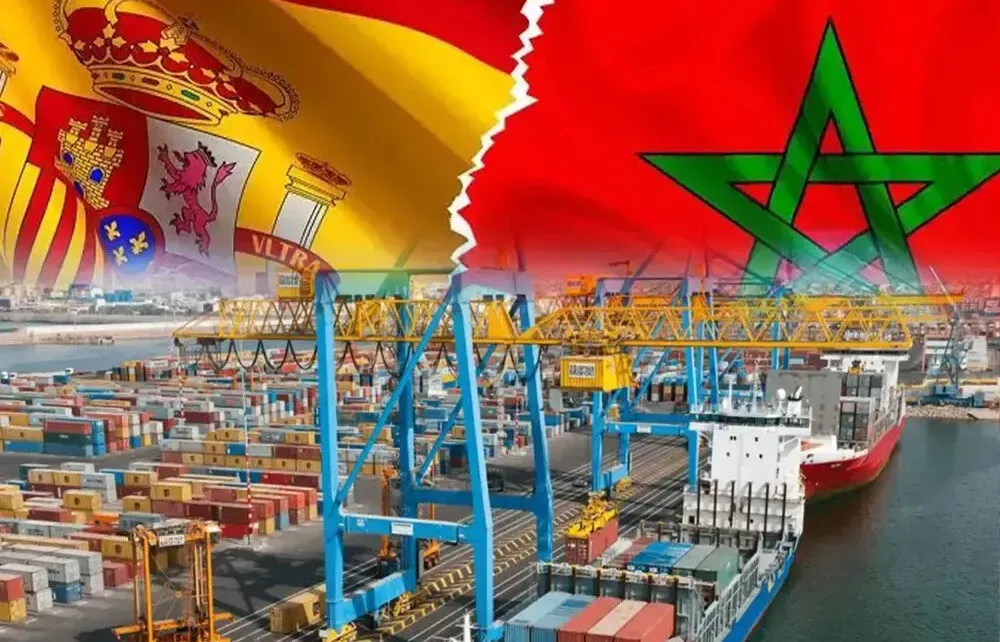

Transformative Changes in Morocco-Spain Trade Relations
In a noteworthy development, trade relations between Morocco and Spain have undergone a significant transformation, particularly in 2025, marking a pivotal moment where the trade balance shifted in favor of Rabat for the first time in decades. This change signifies the end of Spain's long-standing dominance in exporting to the Moroccan market, highlighting Morocco's growing economic prowess. According to data from the United Nations COMTRADE database, Morocco's exports to Spain surged to an impressive $19.61 billion, while imports from Spain reached $16.51 billion in the same year. This resulted in a remarkable trade surplus of approximately $3 billion for Morocco.
The composition of Morocco's exports to Spain is predominantly made up of high-value goods, including electrical and electronic equipment, which accounted for $5.6 billion, followed by non-knit apparel at $4.2 billion, vehicles at $2.8 billion, and seafood products such as fish and crustaceans, valued at $1.08 billion. Conversely, Morocco's imports from Spain largely comprise vehicles ($2.4 billion), mineral fuels ($2.3 billion), and machinery ($1.9 billion). This trade relationship illustrates Morocco's strategic positioning as a manufacturing hub in Africa, particularly within the automotive sector, where factories in Tangier and Kenitra produce vehicles and electronic components that are integrated into Spain's assembly lines.
Additionally, Morocco has established itself as one of Spain's largest non-EU suppliers of food products, exporting nearly $2 billion worth of mollusks, red fruits, legumes, and vegetables annually. The close economic ties are further reinforced by the operations of major Spanish fashion companies that depend heavily on Moroccan textile factories. This intricate supply chain often sees raw textiles shipped from Spain to Morocco for assembly, only to be rapidly returned to Spain for distribution across European markets.
This favorable trade balance for Morocco not only signifies an influx of hard currency into the Moroccan economy but also underscores the country's successful strategy in leveraging its geographical advantages, political stability, and investor-friendly policies. By fostering an open-market economy and a competitive industrial ecosystem, Morocco has positioned itself as a key player in the global supply chain. Spanish companies increasingly rely on Moroccan factories for the production of essential components, which are then exported back to Spain for final assembly or distribution throughout Europe.
As reported by northafricapost.com.