
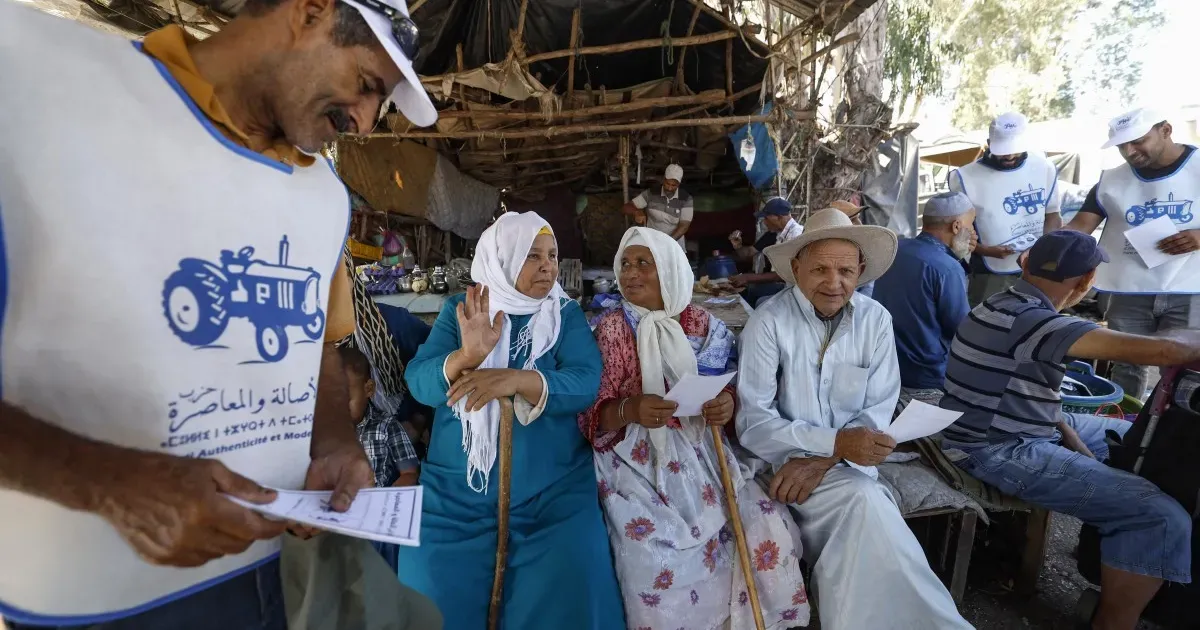

The parliamentary election campaign in Morocco officially commenced on September 10, with a total of 27 political parties vying for 395 seats in the House of Representatives. With over 15.8 million registered voters gearing up for the pivotal vote on September 23, the outcome will not only reshape the Parliament but also play a crucial role in determining the future government. However, the election prompts a more profound inquiry into whether citizens genuinely believe that the political system is equipped to tackle the pressing issues that affect their daily lives.
This inquiry takes on particular significance for the youth demographic in Morocco. A recent Afrobarometer survey revealed that approximately one-third of Moroccans aged 18 to 35 expressed trust in key political institutions, including Parliament and the head of government. Despite this relatively low level of trust, young Moroccans are actively engaging in political discourse through social media and participating in protests, suggesting that their disengagement from the electoral process may not be as pronounced as it seems. The more pressing concern appears to be whether they view electoral politics as an effective mechanism for addressing their pressing challenges.
Political Dynamics and Youth Engagement
Morocco's electoral framework, established by the 2011 constitution, defines the country as a constitutional, democratic, parliamentary, and social monarchy that emphasizes the separation of powers while maintaining the monarchy's influential position. Article 47 empowers the king to appoint the head of government from the political party that secures the most seats in the House of Representatives, while the monarchy also presides over the Council of Ministers. This structure implies that while securing a significant number of parliamentary seats is crucial for forming a government, it does not wholly dictate the political power landscape.
The demographic composition of the electorate further complicates the discourse surrounding political engagement. Official statistics indicate that voters aged 18 to 24 represent only 4 percent of registered voters, in stark contrast to the 29 percent of voters aged 60 and above. This disparity illustrates a registered electorate skewed towards older citizens, raising concerns about the political engagement of younger voters and their representation in the forthcoming elections.
Morocco is also grappling with a severe youth unemployment crisis, with the International Monetary Fund (IMF) estimating that unemployment among the general population stood at 13 percent in 2025, while youth unemployment for those aged 15 to 24 soared to an alarming 37.3 percent. Furthermore, a staggering 25.2 percent of young people were reported to be neither in employment, education, nor training during the third quarter of 2025. The IMF points to factors such as skills mismatches, limited private sector dynamism, and significant gender disparities within the labor market as contributing to this crisis. In this context, promises related to economic growth, job creation, and improved purchasing power are not merely abstract campaign slogans; they serve as tangible benchmarks for assessing the political system’s ability to provide opportunities that resonate with the everyday lives of citizens.
Recent events have underscored these tensions beyond the formal electoral landscape. In late July, around 60,000 individuals crossed into the autonomous Spanish city of Ceuta from Morocco, marking the largest influx in recent history, as reported by Reuters. This surge was attributed to a confluence of factors, including economic hardship, social unrest, and misinformation circulating on social media, alongside migration aspirations and unrealistic expectations regarding Spanish court rulings. While this incident may not directly reflect electoral sentiment or a unified political motive, it highlights the intersection of economic expectations, migratory ambitions, and perceptions of opportunity.
The Economic Debate and Political Promises
As the election approaches, the economic discourse becomes increasingly salient. Despite the IMF's projection of robust economic growth—4.9 percent in 2025 and 4.4 percent in 2026—high unemployment rates, particularly among youth, remain a significant hurdle. The governing coalition, comprising the National Rally of Independents (RNI), the Authenticity and Modernity Party (PAM), and Istiqlal, has crafted programs emphasizing employment and purchasing power. The RNI's agenda for 2026–2031 aims to create one million jobs and gradually increase the minimum wage to 5,000 dirhams (approximately $530) per month. PAM has pledged a similar job creation goal, with its five-year program estimated to cost 350 billion dirhams ($37.1 billion), while Istiqlal has prioritized public services, healthcare, housing, and food security in its campaign.
The variations in each party's focus reveal a unified understanding of the critical importance of employment, household purchasing power, and public services as measures of political credibility. The challenge for the next government will be to translate investment and economic growth into meaningful job creation and improved living standards for citizens. The Justice and Development Party (PJD), under the leadership of former Prime Minister Abdelilah Benkirane, enters this election seeking to regain its footing after significant losses in 2021, when it plummeted from 125 seats to just 13. As the PJD attempts to rebuild its electoral base, it presents a program with 467 measures across institutional, economic, social, and foreign policy realms, emphasizing concrete reforms rather than extensive numerical targets.
Ultimately, the upcoming election will serve as a litmus test for Morocco's political system and its ability to forge a credible connection between an ambitious development agenda and the expectations of citizens eager to witness its benefits in their daily lives. For younger Moroccans, the interplay of low trust in political institutions and high rates of youth unemployment indicates a potential shift in political expression, as they seek alternatives to traditional electoral avenues in a climate where employment and living standards take precedence. Economic researcher Nouh El Harmouzi aptly notes that the challenges facing Morocco's economy are fundamentally structural and cannot be resolved through fleeting electoral promises.
As reported by aljazeera.com.
