
Strategic Framework for Digital Transformation
The ambitious initiative known as "Digital Morocco 2030" outlines a comprehensive strategy centered on two primary pillars: the digitalization of public services and the stimulation of the digital economy. This endeavor is further supported by four key catalysts, which include the development of digital expertise and talent, hybrid cloud solutions, artificial intelligence (AI), cybersecurity, the Internet of Things (IoT), and widespread connectivity.
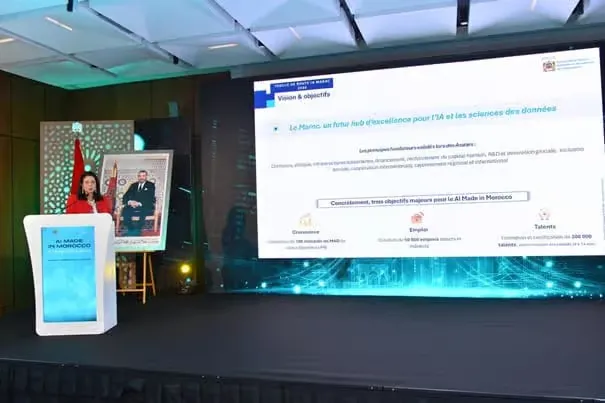
Building upon the success of the National AI Conferences, which convened over 2,500 participants, including government officials, institutional representatives, international experts, startups, and academics, the "AI Morocco 2030" strategy aims to position Morocco as a center of excellence for artificial intelligence and data sciences. This vision is underpinned by principles such as trust, ethics, sovereign infrastructure, funding, enhancement of human capital, research and development, innovation, social inclusion, international cooperation, and regional and global influence.
By the year 2030, Morocco has set three primary objectives: to generate 100 billion dirhams in added value to the GDP, create 50,000 direct and indirect jobs, and ensure the training and certification of 200,000 talents, with a focus on introducing AI education from a young age. This roadmap is structured around three significant pillars and ten strategic programs, which encompass the foundations of sovereignty and trust, drivers of innovation and competitiveness, and the impact, adoption, and visibility of AI solutions.
Building Digital Sovereignty and Connectivity
The first pillar emphasizes establishing a foundational framework of sovereignty and trust, enabling Morocco to control the infrastructure, data, and tools necessary for developing artificial intelligence. A significant project within this framework is Digital X.0, which presents a national framework for responsible AI, encompassing regulations, ethics, security, and fundamental rights, as well as interoperability and digital identity. The goal is to harmonize information systems and progress towards an integrated platform that serves citizens effectively.
This vision relies heavily on the substantial enhancement of digital infrastructure. The strategy outlines several projects aimed at increasing national data center capacity to nearly 1 GW. Notable developments include a mega-campus of green data centers in Dakhla, with a potential capacity of 500 MW, and a 50 MW data center in Rabat, linked to a sovereign cloud. Additionally, the expansion of the Benguerir data center and the implementation of the "Move to Cloud" program will facilitate the migration of public administrations to cloud-based solutions.
Connectivity is another crucial aspect of this infrastructural development. The strategy aims for 99.63% 4G coverage by 2024, with a target of achieving 70% 5G coverage by 2030. Furthermore, it projects an increase in the number of households eligible for fiber-optic internet from 1.5 million in 2022 to 4.4 million by 2026, ultimately reaching 5.6 million by 2030. Complementing these infrastructures is a national Data Factory, tasked with centralizing the collection, structuring, and engineering of massive datasets, alongside a national Software Forge designed to pool source codes and reusable software components across administrations, thereby reducing development costs and timelines.
As reported by lebrief.ma.