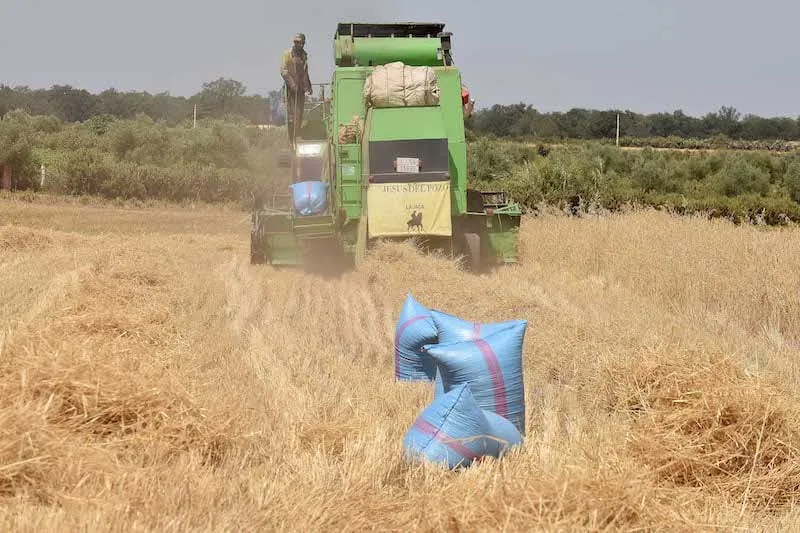

In a recent statement, Morocco's Minister of Agriculture, Fisheries, Rural Development, Water, and Forests, Ahmed Bouari, announced that the current agricultural season is on track to yield approximately 90 million quintals of grain, largely due to improved climatic conditions and heightened production efficiency in certain regions, reaching up to 57 quintals per hectare. During a question-and-answer session in the Council of Advisors, Bouari provided insights into the ongoing harvesting operations, which indicate promising production levels ranging from 15 to 57 quintals per hectare, depending on the area. He emphasized that harvesting and marketing activities have commenced gradually across various regions of the kingdom.
The minister highlighted that the quantity of grain collected had exceeded 100,000 quintals daily by June 15, with the Casablanca-Settat, Fes-Meknes, and Marrakech-Safi regions accounting for approximately 84% of the total harvested amounts. Bouari attributed these favorable results to a significant increase in rainfall, which averaged around 571 millimeters by June 12, marking a 94% increase compared to the previous season and 45% more than the average of a typical year.
To support the agricultural season, the ministry implemented a series of proactive measures, including the provision of 734,000 quintals of certified seeds at subsidized prices and ensuring the market is supplied with approximately 500,000 tons of fertilizers. Additionally, the ministry has continued to roll out its direct seeding program and has launched a supplementary irrigation initiative aimed at reaching one million hectares by 2033, alongside expanding agricultural insurance.
According to the minister's estimates, the anticipated production is expected to consist of 44 million quintals of soft wheat, 21 million quintals of durum wheat, and 25 million quintals of barley. On the topic of stock management, Bouari confirmed that the ministry is working to enhance grain storage capacities through the establishment of new units with a capacity nearing two million quintals, while also increasing the investment support for storage infrastructure from 10% to 25%.
Furthermore, the government has set a reference price for the purchase of national soft wheat intended for industrial mills at 280 dirhams per quintal and has decided to suspend import tariffs on soft wheat during June and July 2026. This policy aims to prioritize local products and strengthen food security. Additionally, an agreement between the state and industry professionals aims to gather between 15 and 20 million quintals of national soft wheat, along with establishing a storage bonus of three dirhams per quintal every two weeks, to build a strategic stock of local production reaching up to 8 million quintals, ensuring coverage for the country’s needs for six months instead of the usual three.
As reported by ar.telquel.ma.