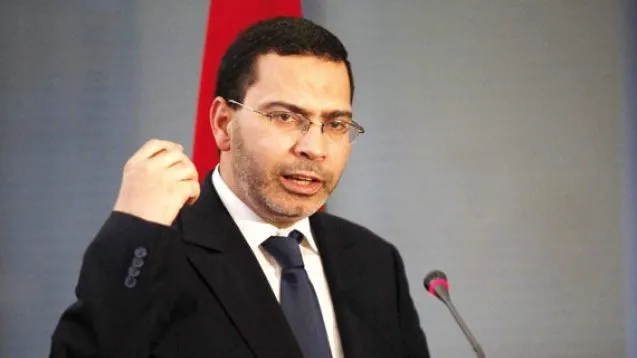

The former Moroccan government spokesperson, Mustapha El Khalfi, who served as the Minister of Communication from 2012 to 2019, has made significant claims regarding the recent influx of migrants into Ceuta, correlating it with Spain's legislative proposal to grant Spanish nationality to Sahrawis born before 1977. This proposed law, backed by the political coalition Sumar, has raised concerns in Morocco, as it could potentially naturalize between 8,000 and 200,000 Sahrawis, thereby bolstering separatist sentiments for Western Sahara from within Spain.
In an interview with Moroccan television, El Khalfi articulated that the events of the mass crossing into Ceuta represent a pivotal strategic turning point in Moroccan-Spanish relations. He attributed the surge in irregular crossings to two primary factors: a ruling by the Spanish Supreme Court on June 29, which stated that those who cross the border by sea cannot be returned, and the manipulation of social media by artificial intelligence (AI) to amplify these crossings. El Khalfi suggests that this judicial decision has been exploited by human trafficking networks and anonymous social media accounts, creating a conducive environment for the mass movement.
Notably, El Khalfi pointed out that while his explanation aligns with the official narratives from both Rabat and Madrid, he also highlighted the legislative initiative concerning Sahrawis as a second critical factor. He explained that the bill, which gained traction in the Spanish Congress on July 23, received broad support from the ruling coalition, with only the far-right party Vox opposing it. This legislative move is perceived as a direct threat to Moroccan territorial integrity, as it could potentially create a new stronghold for Sahrawi separatism within Spain, thereby complicating the geopolitical landscape further.
El Khalfi's reflections on these developments are particularly insightful. He noted that history teaches us that solving one issue often leads to the emergence of another. He referenced Pedro Sánchez's recognition of Moroccan sovereignty over Western Sahara in 2022, suggesting that while this acknowledgment may have been a diplomatic victory for Morocco, it could simultaneously cultivate a new center of support for separatism within Spain. This precarious situation is underscored by the fact that a substantial population of naturalized Sahrawis could emerge, potentially supporting the independence of their homeland from abroad.
In a broader context, El Khalfi emphasized the interconnectedness of the Supreme Court's ruling, the social media dynamics, and the citizenship proposal as catalysts for the recent crisis in Ceuta. He noted that the admission of the citizenship bill sparked a different phenomenon, encouraging a surge of nearly 80,000 irregular migrants within a single day. The implications of these events extend beyond immediate humanitarian concerns, indicating a need for careful diplomatic navigation between Spain and Morocco.
The Spanish government has publicly denied any connection between the Ceuta invasion and the proposed citizenship law, attributing the situation instead to misinformation campaigns on social media. Spanish Foreign Minister José Manuel Albares has stated that the government maintains robust relations with Algeria and that granting nationality to Sahrawis is a sovereign decision of the Spanish parliament. He has also indicated ongoing cooperation with Morocco to manage the situation effectively.
As reported by elespanol.com.