
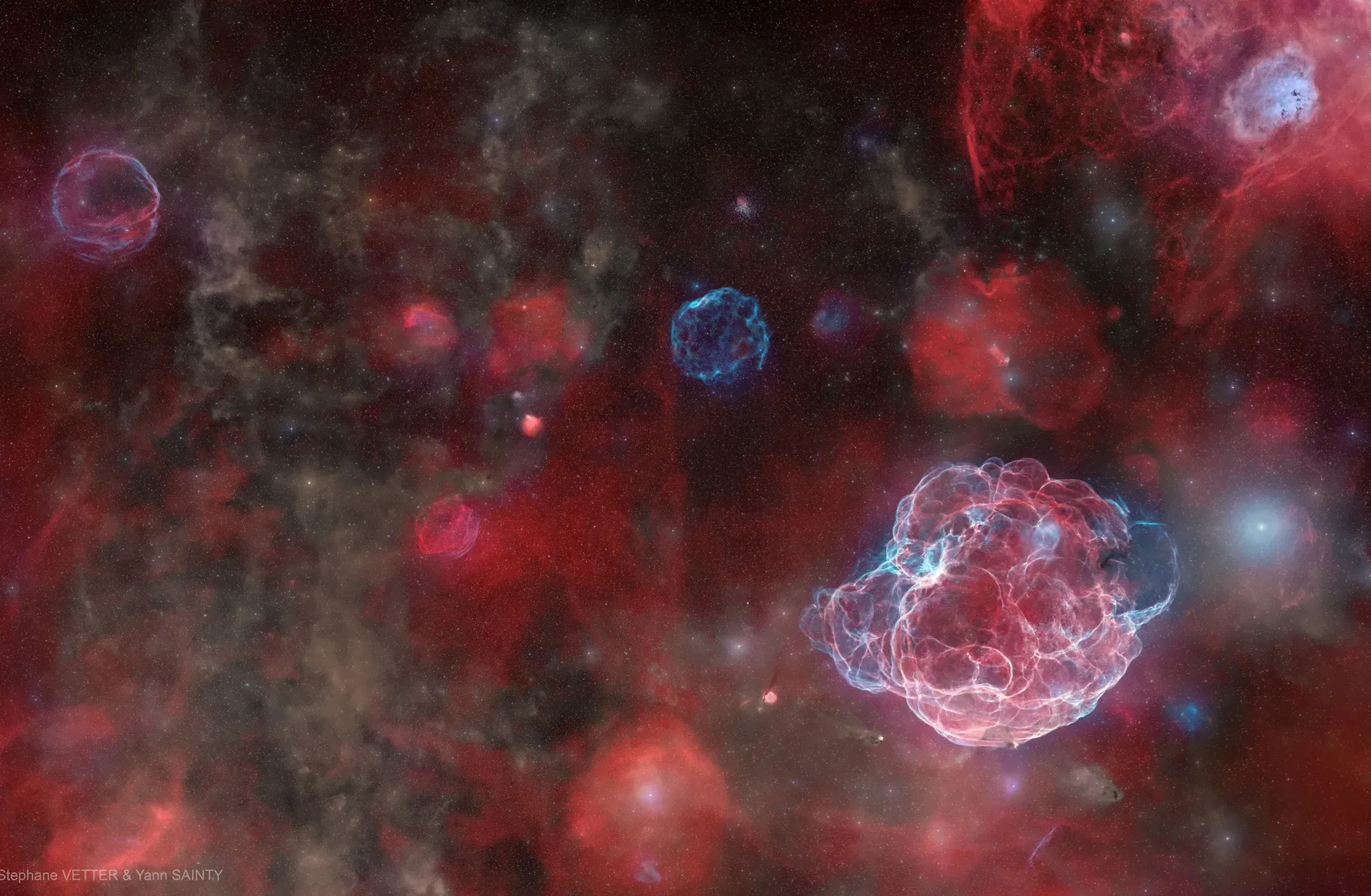

The National Aeronautics and Space Administration (NASA) has selected an exceptional astronomical image that unveils a captivating scene within the constellation of Auriga, showcasing the remnants of five ancient stellar explosions within a single celestial canvas. This remarkable photograph was taken by astronomers Stéphane Vetter and Yann Sainty at the Oukaimeden Observatory, nestled in the Atlas Mountains of Morocco. After approximately 200 hours of meticulous observation, the image reveals a celestial area nearly equivalent to the size of one thousand full moons aligned side by side.
In this striking image, the five observable remnants are not the result of simultaneous explosions; rather, they are independent remnants of supernovae, each at varying distances from Earth, with some dating back tens of thousands of years. NASA has spotlighted these remnants in an annotated image, which also includes the open star cluster M37 and the Tadpole Nebula.
The Ghostly Remnants of Five Supernovae
From left to right in the image, the remnants of five supernovae can be seen, with the most notable among them being G180.0, also known as the Spaghetti Nebula, due to its intricate, tangled gas filaments stretching across the sky. According to databases of supernova remnants, these five celestial bodies are classified as independent remnants within our galaxy. When a star reaches the end of its life cycle and explodes, the shockwave propels its material into space, forming a shell of colliding gas and revealing delicate filamentary structures within.
In the captured image, these intricate structures are displayed in red, indicating hydrogen emissions, while oxygen is represented in blue, bestowing the remnants with their striking ghostly appearance. Scientific studies suggest that these remnants exhibit varying characteristics and stages of evolution. For instance, studies indicate that the G181 nebula is a relatively advanced remnant, with a shell extending about 16 parsecs across, and an estimated age of approximately 16,000 years. On the other hand, the G179 nebula is recognized as a faint remnant with a broad shell, featuring an apparent diameter of about 70 arc minutes.
Oukaimeden: A Celestial Observatory
The Oukaimeden Observatory is perched at an elevation of nearly 2,750 meters in the Atlas Mountains, located approximately 50 kilometers south of Marrakech. Operated by Cadi Ayyad University, the observatory benefits from its altitude and its placement in a semi-desert region, providing a pristine sky ideal for astronomical observations. It is equipped with advanced facilities and telescopes dedicated to scientific research and celestial observation.
Designated with the code "J43" by the International Astronomical Union, the observatory also hosts the Oukaimeden Sky Survey (MOSS), which partakes in tracking small bodies within the solar system alongside other projects and observatories engaged in exoplanet research. The clarity of the skies in Oukaimeden has transformed the site into a hub for international astronomical collaboration, rather than merely a local observation station.
This latest image exemplifies the value of the Oukaimeden location, showcasing not a single bright celestial body, but rather the subtle and expansive remnants of ancient stellar explosions, some of which still retain the light and structure that reflect the violent endings of stars that perished thousands of years ago.
As reported by aljazeera.net.
