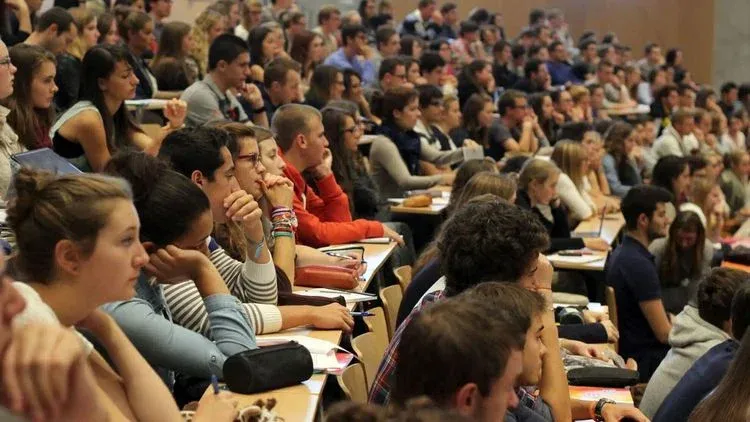

In the words of Lara, a student residing in Montpellier and originally from Marrakech, "Sometimes we forget that there are two entirely different student realities." Gaining university admission often marks only the beginning of a lengthy journey filled with hurdles. After overcoming the visa process and securing accommodation, students are confronted with a stark new reality that encompasses living costs, administrative procedures, feelings of loneliness, and sometimes the necessity to balance work with studies.
On paper, these students all fall under the label of "Moroccan students in France," yet their individual experiences reveal significant disparities from the outset. For Lara, who is 21 years old, her transition to France was relatively smooth. Holding both French and Moroccan citizenship and having studied at a French high school in Marrakech, many steps came more easily for her. She asserts that her educational background allowed her to navigate various procedures with greater confidence, and she experienced minimal difficulties in securing university acceptance. To her, France represented a broader horizon and greater opportunities.
However, even with these favorable circumstances, the initial phase was not devoid of challenges. From the very first steps, housing emerged as one of the largest obstacles. Finding an apartment in Montpellier from a distance proved to be a daunting task, given the stringent requirements imposed by landlords. As a result, her family had to enlist the help of a specialized agency to facilitate the process, an effective but costly solution, which Lara acknowledges she would not have been able to manage on her own.
Similarly, Ayman, a 21-year-old studying for a bachelor’s degree in economics and management in Angers, also benefited from his family's support to ease his transition to France. He candidly states, "Without the financial backing from my parents and the experience of my older siblings who had previously studied in France, the process would have been complicated." This support has allowed him to devote himself entirely to his studies without the need to work simultaneously.
Nonetheless, this familial support comes with its own form of pressure, stemming from the imperative to succeed in recognition of the sacrifices made. He expresses, "They have done everything they can for me to succeed, so I feel that I must succeed." For both Lara and Ayman, family support serves as a financial and emotional safety net that provides them with a greater sense of stability, even though it does not eliminate the pressures associated with academic life. For other Moroccan students, the challenges often begin before they even set foot in the lecture halls.
Balancing Studies and Financial Independence
Before discussing accommodation, integration, or academic success, many Moroccan students face a fundamental hurdle: financial resources. Securing a visa necessitates proving the availability of approximately 85,000 dirhams, equivalent to around 8,500 euros, as sufficient financial resources. While this is an administrative requirement, it doubles as a genuine social test and is often crucial in determining who can travel and who cannot.
For Anas, a 21-year-old from Ksar el Kebir who is currently pursuing a bachelor’s degree in finance in Angers, this issue surfaced early on. After a stint at an engineering school in Tangier and then at a national school of commerce and management in Fez, he managed to enroll in the third year of his bachelor’s degree in France, a journey he recognizes as unusual. Yet, the challenges he faced were not solely academic; he succinctly summarizes his experience, saying, "I was fortunate to gain admission, but the difficulties start afterwards."
He affirms that the real challenge for him, as for many students, lies in gathering the necessary financial resources. He adds, "If it weren't for my parents at the beginning, and that frozen amount, I would not have been able to secure the visa, and thus I could not have come to France." Anas arrived in Angers in September, and just a few weeks later, he began working in the restaurant sector to cover his expenses and attain a greater degree of financial independence. However, balancing studies with work is not always straightforward. He states, "I work to take full responsibility and fund my education, even though the pace can be harsh at times."
This desire for independence is similarly felt by Amin, but in a more intense manner. The 28-year-old has been living in Montpellier for five years and has continued his academic journey since arriving in France. After graduating from the Higher Institute of Audiovisual Professions and Cinema in Morocco, he pursued further studies and is now in his second year of a master’s program. From an outsider's perspective, his academic path may seem like a model of success and control over the future, yet the reality is far more complex. Securing the required amount for the visa was itself a significant challenge. Once he managed to gather it, he found himself burdened with debt upon arriving in France. Since then, working has become not merely an option but a daily necessity. He explains, "Today, I don’t work to live; I work to stay alive."
Amin juggles studying, internships, and night shifts, clarifying, "Most of the time, I work at night from 10:45 PM to 6 AM, then head straight to classes that start at 8 AM, not including the hour of commuting to school." On some days, sleep becomes a rare luxury, as he admits he sometimes only manages to get half an hour of sleep at night. Behind the often idealized image of studying abroad, Amin describes his daily life as a "battle that won’t stop until..." For him, work remains the only path to stability, regardless of the physical and mental toll it takes.
Despite all these students sharing the same ambition and desire for success, they do not all start from the same baseline. Behind the student mobility that appears synonymous with opportunities and openness, profound social and economic disparities emerge, weighing heavily on many from their very first steps in their academic journey.
As reported by ar.yabiladi.com.