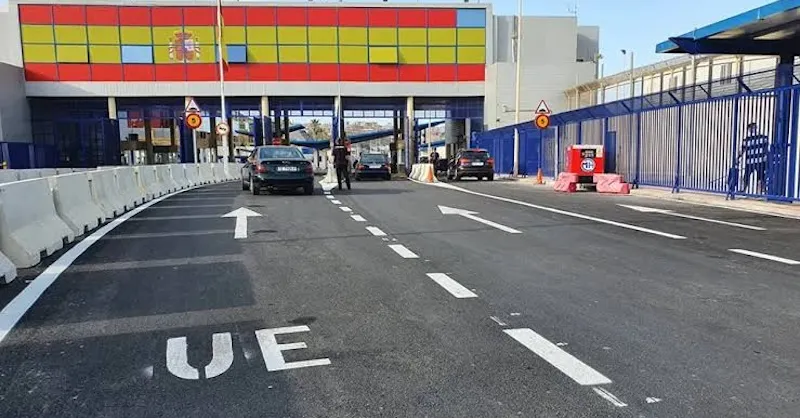
The recent dismantling of the Gibraltar border has created a powerful political image: a physical boundary vanishing, allowing thousands of workers to regain fluidity, and a territory that is effectively integrating into a Schengen-like logic with controls shifted to the port and airport. The treaty between the European Union and the United Kingdom specifically outlines this shift in controls, with Spain assuming responsibility for Schengen inspections at these entry points, alongside a framework for fiscal, customs, social, and environmental cooperation. While this agreement has already been implemented, it has not escaped criticism regarding Spain's perceived lack of position, which some view as yet another concession by the Sánchez government.
However, the notion that Gibraltar serves as a template for Ceuta and Melilla stems from a misdiagnosis, often driven by undisclosed interests. These autonomous cities are not a British enclave surrounded by Spanish territory nor a Brexit-related issue between Western partners bound by a shared legal framework. Rather, they represent Spain’s land border, as well as the European Union's and Schengen's external frontier with Morocco. This boundary is subject to migratory tensions, political claims, institutional asymmetries, episodes of diplomatic pressure, and a bilateral relationship where public cooperation exists alongside deep-seated strategic mistrust.
The Fundamental Difference: Gibraltar as an Internal Border; Ceuta and Melilla as External Frontiers
The Gibraltar model operates on a premise that does not exist at Tarajal or Beni Enzar: the ability to transfer Schengen control to limited, predictable entry points subject to operational cooperation between administrations with homologable legal guarantees. In Gibraltar, the main flow is channeled through an urban crossing between La Línea and the Rock, while international access is concentrated at the port and airport under Spanish control. In contrast, Ceuta and Melilla's land boundary directly separates Spanish and European territory from a third state. Easing this border does not equate to eliminating a local barrier; it would necessitate changing how an external Schengen border is protected. Any redesign must ensure identification, traceability, entry and exit control, document verification, irregular crossing prevention, and responsiveness to migratory pressure peaks or unilateral decisions from the neighboring country.
Political Trust Cannot Be Decreed
Spain and Morocco collaborate on sensitive matters such as terrorism, irregular immigration, emergencies, security, and flow management. This cooperation is essential, yet it does not negate Morocco's unique political stance regarding Ceuta and Melilla, nor does it dismiss the fact that borders have been used at various times as instruments of pressure, negotiation, or diplomatic messaging. The trust required for a Gibraltar-type model cannot rely solely on public declarations of good neighborliness; it necessitates predictability, reciprocity, legal security, and stable compliance with agreements—a situation that does not currently exist with Morocco. Controversies surrounding trade customs, goods, temporary closures, or uncommunicated restrictions foster an uncomfortable conclusion: the Spain-Morocco border does not operate in an environment equivalent to negotiations between the European Union and the United Kingdom concerning a post-Brexit territory.
Furthermore, an open border not only facilitates legitimate transit but also expands the space for intelligence activities, social pressure, information gathering, informal economies, and influence networks. In small, densely connected territories where everyday life is intertwined with border crossings, security extends beyond visible police control; it encompasses the protection of public services, registries, permits, assistance, employment, effective residency, and economic circuits.
This introduces another politically delicate factor: the notion of 'fifth column' activities, understood as organized actions or internal discourse that, under a local or civic appearance, could support pro-Moroccan narratives regarding the future of the two cities. It is not about criminalizing identities, beliefs, or communities but rather about recognizing that any weakening of border control may be exploited by actors interested in undermining Spanish and European institutional presence in Ceuta and Melilla.
Ceuta and Melilla are not merely managing a local crossing; they are managing a European border. This status imposes control obligations that affect the entire Schengen area. The debate should not be limited to whether queues are long or daily transit is uncomfortable; it must address a larger question: how can we ensure that those entering through this border meet the conditions for entry, residency, movement, and access to rights in Spanish and European territory?
The case of Gibraltar is exceptional because controls do not disappear; they are merely relocated. In Ceuta and Melilla, transferring controls without a real and verifiable equivalent would create difficult-to-audit grey areas. At an external border, agility is only acceptable when accompanied by increased technology, more inspections, enhanced information exchange, and greater punitive capacity, rather than a reduction in state presence.
Moreover, there exists an administrative dimension that often remains outside diplomatic discussions: the use of formal residency in Spain to access benefits, services, or rights while actual life unfolds on the other side of the border. In Ceuta, constant movement through Tarajal may complicate the verification of the effective residency of certain aid beneficiaries, registrations, or administrative situations linked to access to public services. The General State Administration has an unresolved task here that cannot be delegated to the rhetoric of cross-border cooperation. Tax authorities, social services, labor departments, social security, immigration, and inspection units must have the capability to cross-reference data, verify actual presence, confirm effective addresses, detect instrumental registrations, and review cases when fraud indicators arise. This is not about restricting legitimate rights but about preventing the system from being exploited by those who simulate residency that does not correspond with reality.
It is legitimate to demand more agile borders, shorter queues, and better technological means. It is also valid to explore formulas that facilitate the transit of workers, students, families, and small economic operators. However, improving mobility should not be conflated with deactivating control. The border of Ceuta and Melilla is too sensitive to transform a supposed diplomatic success story in Gibraltar into a catchphrase applicable without nuances.
The state must modernize, not dilute. It must reduce waiting times but increase verification. It must cooperate with Morocco, but without naivety. It must protect internal coexistence while ensuring that the border does not become a lever for external pressure or an administrative loophole. This balance is more complex than simply removing a fence; it demands presence, data, inspection, firm diplomacy, and a clear notion of sovereignty.
In conclusion, while Gibraltar may serve as a reference for negotiation, technology, and cooperation, it should not be an automatic template for Ceuta and Melilla. Gibraltar has addressed a post-Brexit anomaly between the European Union and the United Kingdom, not without controversy and without the input of Spanish representation; here we manage an external border with a third state that has its own interests concerning these two Spanish cities. The difference is significant: it is structural. Therefore, before discussing the elimination of barriers, it is crucial to address the state, inspector capacity, Schengen control, effective residency, social fraud, security, intelligence, and verifiable trust. Above all, we must assert Ceuta and Melilla for what they truly are: Spanish cities and Europe’s advanced frontier in North Africa.
As reported by ceutaahora.com.