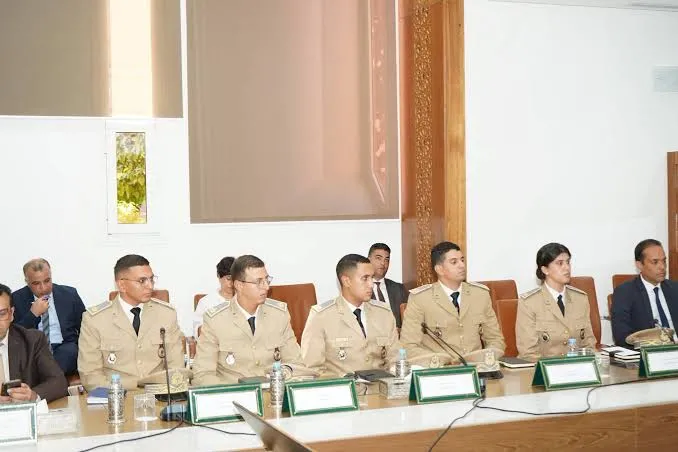

On August 17, 2026, the headquarters of the Marrakech-Safi region witnessed the inauguration of several new officials appointed in the Marrakech prefecture as part of the internal ministry's transfer movement aimed at renewing human resources within local administration. This initiative is designed to enhance the presence of these officials in various urban districts and administrative areas.
The recent appointments included six officials, one of whom is a woman. These new appointees are graduates from the 61st cohort of the Royal Institute of Territorial Administration, assigned to various positions across the jurisdiction of the Marrakech prefecture. The newly designated responsibilities span various administrative districts, including Isil, Kasbah, Hay Hassani, Maatallah, and Atlas, along with roles within the general secretariat of the Marrakech prefecture. This distribution reflects a trend towards bolstering local structures that directly engage with citizen issues and handle daily local administrative matters.
New Appointments Across Various Urban Areas
The appointments have been spread across diverse administrative sites within Marrakech and its surroundings, including the Isil administrative annex in the Hay Mohammedi urban area and the Kasbah administrative annex under the jurisdiction of the Kasbah Bashawiya. Furthermore, the movement included the Hay Hassani administrative annex in the Hay Hassani urban area and the Maatallah administrative annex associated with the Menara area, as well as the Atlas administrative annex in the Tamansourt Bashawiya. The appointments also extended to the general secretariat of the Marrakech prefecture, creating a balance between direct field positions and central administrative functions within the prefecture.
This distribution of responsibilities establishes a functional link between local governance in neighborhoods and urban areas and the levels of coordination and management within the prefecture. The integration of graduates from the 61st cohort of the Royal Institute of Territorial Administration showcases the ongoing effort to rejuvenate local administration with fresh talent following their training completion. The involvement of these new graduates represents one of the mechanisms employed by the Ministry of Interior to renew its human resources and ensure continuity within the authority's ranks.
Emphasizing Community Engagement and Development
During the inauguration ceremony, the Governor of the Marrakech-Safi region and Head of the Marrakech Prefecture, Khalid Al-Habil, emphasized the pivotal role of local officials within the framework of local administration. He urged the new officials to embody responsibility, discipline, vigilance, and impartiality in their duties. Furthermore, he highlighted the importance of adopting a policy of proximity, listening, and direct communication with citizens, considering these as essential mechanisms for enhancing the relationship between administration and the public.
This directive is closely tied to the nature of the work of local officials, especially at the administrative annexes, which are among the most visible institutions of local administration in citizens' daily lives. The Governor also stressed the necessity of ensuring the safety and security of citizens, aligning with the responsibilities of local authorities in coordination with other relevant bodies. Local security remains a primary area of focus within local administration, alongside compliance with laws, oversight of various activities, and management of public spaces.
Moreover, the new appointments are not only aimed at enhancing administrative and security aspects but also at supporting developmental projects within the prefecture's jurisdiction. This means that the role of local administration extends to monitoring projects being executed within their jurisdiction and facilitating coordination among the relevant services. Marrakech and its surrounding areas are undergoing significant urban and developmental dynamics that require continuous administrative monitoring, particularly concerning infrastructure, services, and land use planning.
In conclusion, while the inauguration of these new officials represents an important organizational step, the effectiveness of local administration is ultimately linked to how responsibilities are exercised post-appointment. The policy of proximity advocated by the Governor necessitates tangible field presence, while simplifying procedures requires improving workflows. Simultaneously, supporting projects demands ongoing coordination among various departments. The goal is to ensure a local governance approach that responds effectively to the increasing demands for accessibility, efficiency, and quick response from citizens.
As reported by attasiaa.com.