
Understanding the Dynamics of Power in Morocco
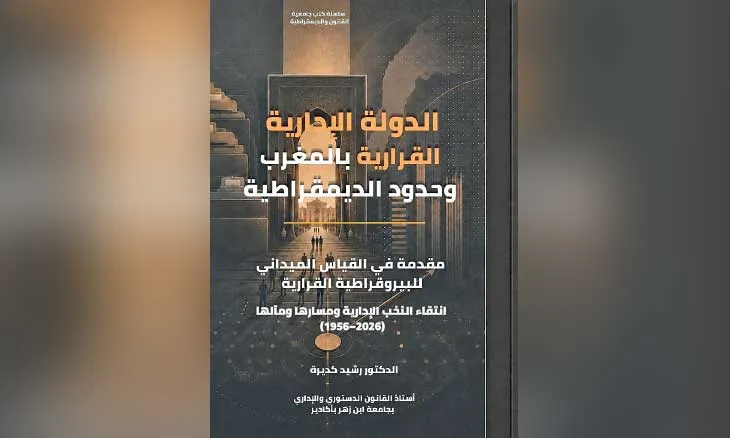
The discourse surrounding Morocco's political framework has recently gained momentum, particularly with the emergence of Rashid Kdira's latest publication, titled "The Administrative Decision-Making State in Morocco and the Limits of Democracy: An Introduction to the Field Measurement of Bureaucratic Decision-Making." In this extensive work, spanning approximately 700 pages, Kdira, a constitutional and administrative law professor at Ibn Zohr University in Agadir, aims to bridge the gap left by classical theoretical tools that have struggled to comprehend the profound transformations within Moroccan governance since his original thesis on administrative elites in 2004.
This book does not merely update previous empirical data but marks a significant epistemological shift. Kdira moves away from the traditional inquiry into the closure of elite structures, instead focusing on the deeper structural actions that perpetuate this closure, rendering it resistant to democratic disintegration. He critiques the prevailing narratives in literature that address the dominance of decision-making in Morocco, identifying two predominant analytical responses that have historically lacked depth in understanding the issue.
Analyzing the Structural Failures of Moroccan Governance
The first of these responses highlights the normative shortcomings of positive law, which has failed to explain the selection process of individuals within the administrative elite, despite extensive statistical data collected over several decades. The question remains as to why certain individuals are favored over others who meet the same criteria, and why recycled administrative elites continue to occupy positions rather than integrating into society. Meanwhile, cultural and anthropological approaches, often rooted in concepts of historical stagnation and loyalty structures, have inadvertently shifted the focus from political and legal analysis to a framework of inevitability, thus obstructing any potential for transformative change within the administrative structure.
Kdira's work stands out for its rigorous examination of Moroccan political and constitutional reforms against the backdrop of direct empirical testing. Since 2011, Morocco has undergone a series of legislative and institutional reforms, including the establishment of a new constitution that emphasizes accountability, regulatory frameworks for high-level appointments, and an administrative decentralization charter. Despite these advancements, statistical analyses reveal that the core of the administrative hierarchy remains unchanged, with consistent age demographics, geographic monopolies, and a marked underrepresentation of women in decision-making roles. This stark contrast between legislative flow and the stability of the existing bureaucratic framework raises critical questions about the effectiveness of these reforms.
To unravel this complexity, Kdira incorporates the philosophical and jurisprudential concept of administrative decision-making, drawing on debates from German scholars Carl Schmitt and Hans Kelsen, as well as the evolution of the American experience where legal foundations gradually ceded authority to administrative powers. However, Kdira's significant contribution lies in his rejection of a simplistic importation of Western models. He elucidates that the roots of decision-making in the West emerged from representative democracy's inability to manage crises, whereas in Morocco, the tradition of decision-making predates legal frameworks, originating from a historical administrative order.
Consequently, Kdira concludes that the constitutional transformations post-2011 did not serve to mitigate administrative decision-making but instead absorbed modernist concepts and procedural texts, repurposing them to reinforce the existing administrative authority through contemporary legal language and procedural legitimacy. Thus, Kdira's book represents a significant addition to Arab legal and political literature, not only for its precise diagnosis of the administrative elite's structure in Morocco but also for opening a new horizon for analyzing institutions in the Global South through a field study that transcends mere textual admiration to scrutinize the bureaucracy's capacity to assimilate modernization concepts and reassert its dominance.
As reported by alquds.co.uk.