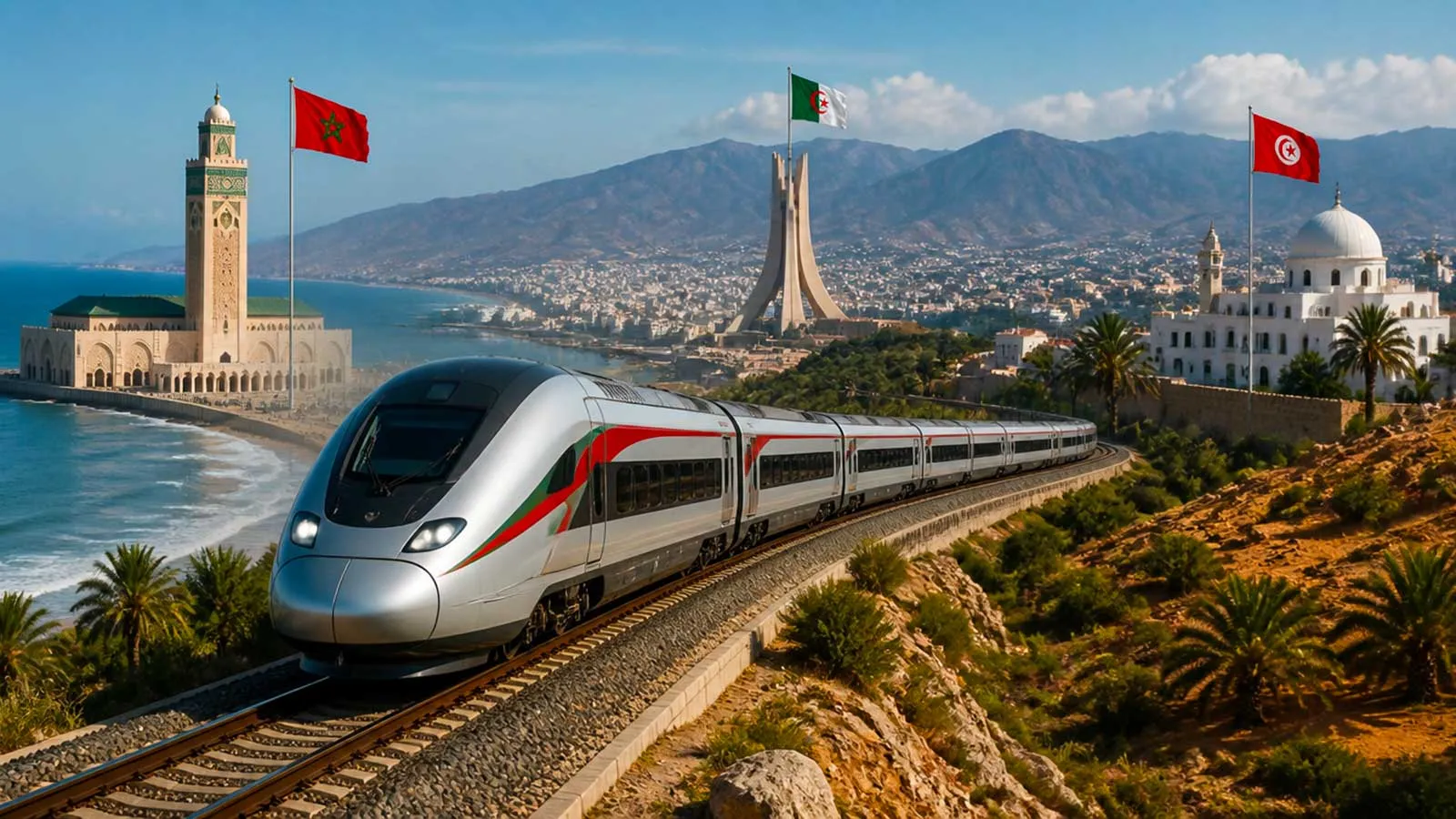

The Trans-Maghreb Railway Corridor Project Takes a Significant Step Forward
The ambitious project aimed at establishing a railway corridor linking Casablanca, Algiers, and Tunis has recently made notable progress with the completion of a feasibility study funded by the African Development Bank (AfDB). While the study has identified an optimal modernization scenario, particularly for the Algeria-Tunisia segment, there remains a significant gap in securing comprehensive funding, and the realization of this vital connection hinges on various technical, institutional, and political conditions.
The dream of a train service connecting Casablanca, Algiers, and Tunis is not yet set to launch, but the trans-Maghreb railway initiative has taken a significant step forward in terms of planning and studies. On June 26, 2026, the AfDB released a report detailing the completion of a study focused on the rehabilitation and modernization of critical segments of this historic railway line. The report confirms the feasibility of multiple technical options and identifies a scenario deemed optimal for modernizing the corridor that links these three major cities. However, it should be noted that this does not constitute an investment decision or an announcement of construction commencement.
Overview of the Proposed Railway Corridor
The proposed railway corridor spans approximately 2,350 kilometers, connecting the three key cities. The objective of the study was to assess the technical, economic, environmental, social, and institutional conditions required for modernizing critical sections of the railway. This initiative does not aim to construct a new 2,350-kilometer line but rather focuses on rehabilitating existing infrastructure and completing missing links to facilitate smoother rail connectivity among the three countries.
In particular, the AfDB has highlighted that the study was intended to propose modernization scenarios for strategic cross-border segments, including the Fez-Oujda-Akid Abbas link between Morocco and Algeria, as well as the Annaba-Jedeida connection between Algeria and Tunisia. For the Annaba-Jedeida segment, three scenarios were examined. The first relies primarily on existing infrastructure over a distance of approximately 351 kilometers. The second scenario involves constructing a new link between Annaba, El Tarf, and Jendouba over about 130 kilometers, before utilizing existing infrastructures between Jendouba, Béja, and Jedeida. The third scenario proposes a new infrastructure connecting Annaba, El Tarf, Tabarka, and Béja. Ultimately, the second scenario emerged as the optimal and viable option, as it better meets the comprehensive criteria evaluated in the report.
This conclusion is particularly significant for Tunisia, as it identifies a key link that would enhance rail continuity with the Algerian network. However, it is essential to clarify that the release of the AfDB report does not indicate that the project is now fully funded or that construction will begin imminently. On the contrary, the document emphasizes that the investment phase still requires considerable preparation.
The study aimed to make the project “bankable” and facilitate the mobilization of necessary resources for its implementation. A regional roundtable held in Tunis brought together over 80 representatives from banks, investors, construction firms, and international organizations. Nevertheless, the report explicitly states that no formal financial commitments were confirmed following this meeting.
Moving forward, the next steps will involve transforming the expressed interest from partners into concrete financial commitments and establishing a timeline for implementation. The frequently cited cost of approximately $3.8 billion should also be approached with caution, as this figure does not reflect new financing announced by the AfDB in 2026, but rather an earlier estimate for upgrading the continuous Casablanca-Algiers-Tunis railway connection. Recent estimates have suggested figures close to $4 billion.
The funding allocated for the studied phase is vastly different, with the completion report indicating funding of around $1.7 million dedicated to preparation and studies. The disparity between these two amounts illustrates one of the project's primary challenges: transitioning from a technically comprehensive study to a multi-billion dollar regional investment.
The envisioned modernization aims to significantly reduce travel times, with the AfDB report indicating a long-term goal of cutting the journey from approximately 48 hours to 25 hours across the entire corridor. However, this goal must be viewed within the framework of long-term aspirations outlined in the study and does not reflect a service that will be operational in the near future. Furthermore, modernization is expected to enhance the transportation conditions for both passengers and goods, reduce logistical costs, and promote interoperability between the rail networks of the three countries.
For Tunisia, there has been a concrete advancement as the Tunis-Annaba railway service resumed commercial operations in August 2024 after several decades of interruption. This reopening is a significant element in improving rail continuity between Tunisia and Algeria, although the AfDB-studied corridor goes further by necessitating the modernization of several segments and addressing various links to connect the networks of the three countries. The selected scenario for Annaba-Jedeida aligns perfectly with this vision.
Beyond infrastructure issues, the report underscores another critical challenge: the governance of the future corridor. The study was intended to propose an institutional framework involving the three countries. A draft tripartite agreement has been submitted to the Arab Maghreb Union (UMA), but the report specifies that the finalization and approval of this agreement by the three states remain pending.
The AfDB thus recommends establishing a monitoring mechanism following the donor roundtable, potentially in the form of a working group, a regional coordination platform, or a technical secretariat. The goal is to track financial partners’ commitments, coordinate investments, and prepare for the next phase effectively. In addition to these financial and institutional challenges, a significant political question remains: the continuity of rail service between Morocco and Algeria, especially given that the land border between the two countries has been closed since 1994 and diplomatic relations have been severed since 2021. This situation presents an obvious barrier to the operation of a continuous rail link connecting Casablanca, Algiers, and Tunis.
However, attributing the delays in the project solely to the border issue would be an oversimplification. The AfDB report also points to the lack of formal financial commitments, difficulties in coordination among the three countries, and the need to finalize the institutional framework. The project is therefore confronted with multiple simultaneous conditions before it can transition from the study phase to execution.
After several years of preparation, the three countries now possess a study that identifies needs, compares different scenarios, and selects an option deemed optimal for the Annaba-Jedeida link. For Tunisia, this advancement is particularly relevant, given that the selected scenario includes a new connection between Annaba and Jendouba before linking up with the existing network to Jedeida. Yet, the next steps will be significantly more challenging: mobilizing the billions required, securing commitments from states and donors, finalizing the governance framework, and creating the political conditions necessary for cross-border operation of the corridor.
In conclusion, while progress has been made on the Casablanca-Algiers-Tunis train project, it remains largely theoretical at present. The AfDB’s study provides a clearer roadmap; however, it does not yet represent the boarding pass for the first trans-Maghreb train.
As reported by lapresse.tn.