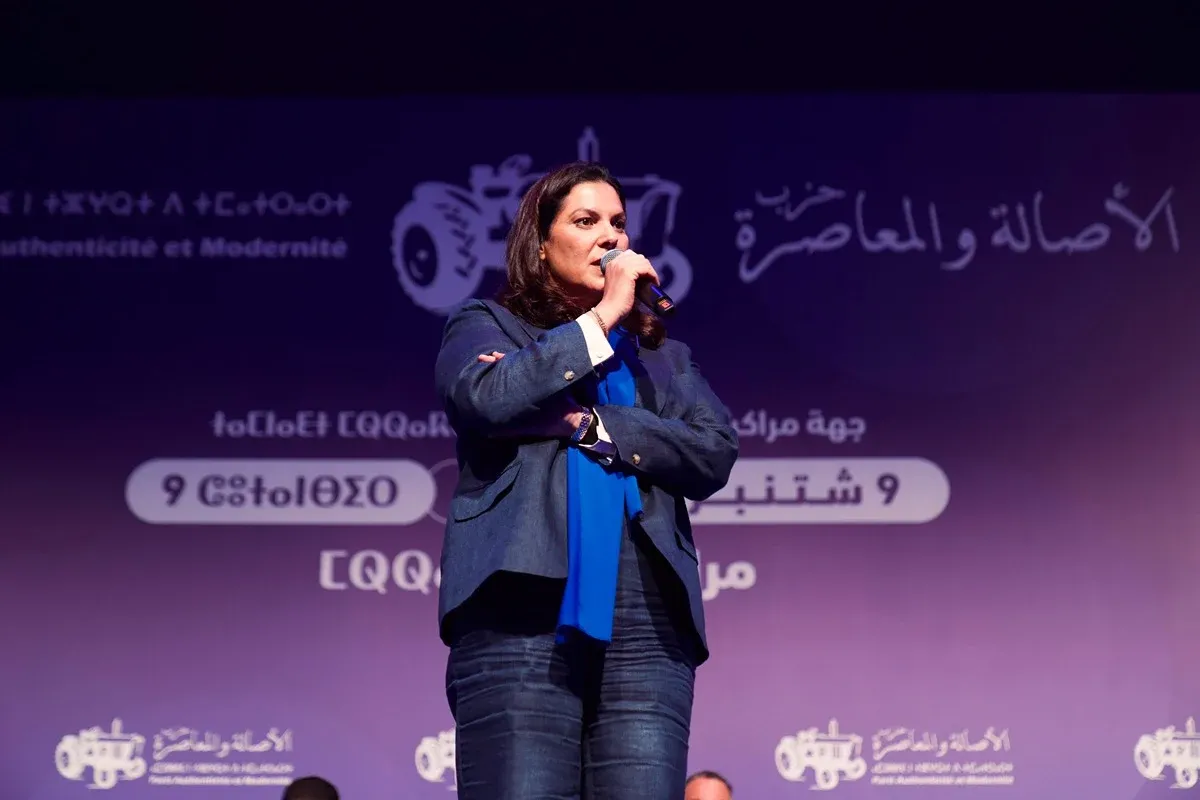

Unity and Ambition at the PAM Rally
Before the official commencement of its electoral campaign, the Authenticity and Modernity Party (PAM) convened in Marrakech on Wednesday, gathering thousands of supporters and activists in a rally aimed at showcasing its unity and outlining the major themes of its political discourse. Within a venue that resonated with enthusiasm for the party, key figures articulated their governmental achievements, affirmed their unique position within the ruling coalition, and endeavored to sketch the contours of a new electoral platform focused on purchasing power, employment, and youth engagement.
The assembly featured notable interventions from Fatima-Zahra El Mansouri, the party's collegiate leadership coordinator, Mohamed Mehdi Bensaïd, a member of the same leadership team, and the newly joined Fouzi Lekjaa. In her address, El Mansouri sought to position the PAM as a lasting political entity, referencing the eighteen years since its inception. In response to recurrent criticisms aimed at certain parties accused of only mobilizing around election periods, the Mayor of Marrakech emphasized the PAM's continuous commitment to activism.
"The Authenticity and Modernity Party is not seeking to position itself for posts. We carry a comprehensive project for Morocco," she declared, showcasing the party's longevity as evidence of its organizational strength and political grounding. Reflecting on the PAM's origins amid high voter abstention in the 2007 legislative elections, she underscored that youth mobilization remains at the heart of the party's political ambition. According to her, the enhancement of democracy hinges on increased youth participation in institutions and public discourse.
Defending Achievements and Addressing Challenges
El Mansouri dedicated a significant portion of her speech to defending the actions of PAM ministers within the government. She characterized their record as "honorable" and free from conflicts of interest, highlighting several reforms and social programs initiated by party officials. Among the initiatives she cited were the Youth Pass, direct housing assistance, and various judicial reforms led by Justice Minister Abdellatif Ouahbi. "Our objective is not to destroy the future of a young person who has made a mistake, but to offer them a second chance," she articulated, referring to provisions related to alternative sentencing.
El Mansouri also touched on the recent inclusion of new figures within the party, including Fouzi Lekjaa. In light of criticisms surrounding this addition, she defended Lekjaa by asserting that the fiscal and budgetary reforms implemented in recent years had generated the necessary resources to fund several social policies. Moreover, the PAM leader reaffirmed her party's loyalty to the governmental majority, stating, "We have not changed course. We have a project, a vision, and we are ready to defend them without compromise for narrow electoral interests," addressing the crowd of 4,000 supporters in Marrakech.
A few moments later, Mohamed Mehdi Bensaïd adopted a more assertive tone. While asserting the party's achievements within the executive branch, the Minister of Youth, Culture, and Communication recognized the limitations of governmental actions, moving away from an exclusively self-congratulatory narrative. "We have succeeded in some sectors and failed in others. We acknowledge this and refuse to claim that everything is fine," he stated, earning applause from the audience.
This acknowledgment of shortcomings served as a foundation for an implicit critique of the functioning of the majority. Bensaïd revealed that multiple proposals aimed at alleviating the effects of rising prices had been presented by his party without securing the support of its partners. "We have never hidden from Moroccans that life has become more expensive. We stated this in our program and had already proposed measures within the majority to relieve this pressure on households," he affirmed, adding, "What we propose today, we had presented yesterday to the majority, but we were not supported." Through this stance, the PAM seeks to distinguish itself within the governmental coalition by presenting itself as a force attentive to social concerns, particularly those related to purchasing power.
Bensaïd also emphasized the importance of youth at the center of his party's electoral project. He summarized that the expectations of young Moroccans are clear and do not revolve around seeking privileges. "Young people are not asking for special advantages. They want quality education, decent employment, equal treatment, and territorial justice," he articulated, defending a program he presents as well-structured and backed by identified funding sources.
The final significant intervention of the evening came from Fouzi Lekjaa, who advocated for an electoral campaign based on the exchange of ideas rather than controversies. The current Minister Delegate in charge of the Budget stressed the necessity of evaluating proposals based on their feasibility and real impact. Specifically referencing the idea of raising the minimum wage to 5,000 dirhams, he asserted that every measure must be examined seriously to assess its economic and social consequences. "We must build a Morocco that guarantees dignity, achieves better growth rates, and provides real solutions to unemployment," he declared, highlighting the importance of economic and social integration for youth.
In Marrakech, the PAM aimed to project an image of a party that is both supportive of the government’s record while eager to assert its own political identity. Through the defense of achievements, acknowledgment of difficulties, and promises of reforms, its leaders endeavored to establish a narrative of responsibility in the lead-up to an election that promises to be critical.
As reported by fr.hespress.com.