
The political repercussions of the Ceuta crisis are spiraling out of control, placing Spanish Prime Minister Pedro Sánchez in a precarious position as increasing numbers of Spanish politicians question why his party continues to defend the Moroccan government. The influx of approximately 80,000 individuals from Morocco into the Spanish enclave in North Africa has plunged Spain into a severe national security crisis, triggering internal disputes within the Spanish cabinet regarding what the government knew about the surge and when they were informed. Sánchez labeled the breach of the Spanish border in July as a "violation of Spain's territorial integrity." However, when pressed about the responsible parties, Spanish ministers, in alignment with their Moroccan counterparts, pointed to human smuggling rings and misinformation circulating on social media, even implicating Russia and Israel in the situation.
Back in Madrid, the finger of blame was pointed at Moroccan leadership, compelling Sánchez to field questions from across the political spectrum regarding whether his long-standing policy of friendship with Morocco has not only failed but may have even emboldened the kingdom. Morocco claims sovereignty over Ceuta and Spain's other African enclave, Melilla.
Morocco in the Spotlight
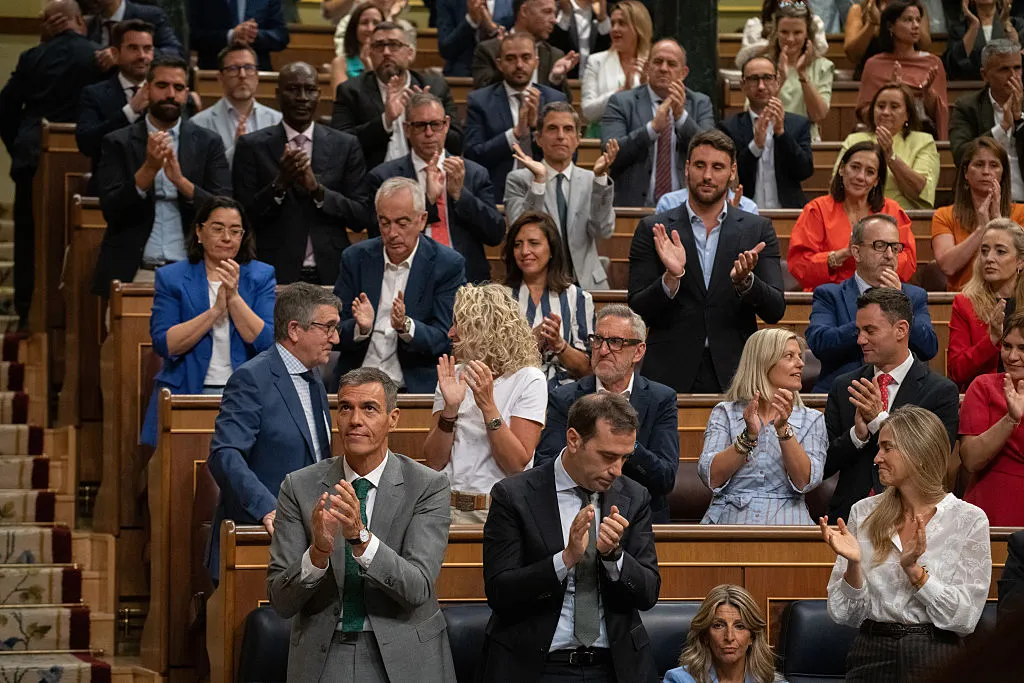
On Thursday, one month after the border incident, which claimed over 100 lives, Sánchez delivered his first address before Parliament to explain his handling of the crisis. The socialist Prime Minister asserted that there is no "solid evidence" linking Rabat, described as a "trustworthy ally," to the catastrophic influx. His statement contradicted a police report released the day prior, which claimed that Moroccan security forces had "planned" and "actively facilitated" the surge of migrants at a normally tightly controlled border. Sánchez later confirmed that Moroccan gendarmerie had allowed individuals to cross the border for ten hours but refrained from accusing Moroccan authorities of orchestrating the exodus. He insisted that should evidence against Morocco emerge, the government would act decisively.
Neither the opposition nor his left-wing allies seem convinced. The leader of the conservative People's Party, Alberto Núñez Feijóo, stated, "The surge originated from Morocco, was permitted by Morocco, and the government was aware because it had been warned." Meanwhile, far-right politician Santiago Abascal questioned, "Who attacked us? Why are you alone in defending Morocco?" The left has demanded Sánchez clarify Morocco's role in the crisis. Ione Belarra, a member of the leftist party Podemos, called for transparency and urged for the cessation of diplomatic and economic relations with Rabat. Gabriel Rufián, a deputy from the Catalan Republican Left (ERC), an ally of Sánchez, accused Morocco of sending 80,000 individuals to its border to destabilize the Spanish government, labeling Moroccan King Mohammed VI as a murderer.
Spanish Police Highlight Morocco's Role in Ceuta Crisis
Amid rising criticism, Sánchez announced plans to release all security and intelligence reports preceding the influx to demonstrate that his government did not receive "prior warnings." On the left, lawmakers criticized what they consider Madrid's appeasement policy towards Rabat, marked by Spain's historical shift in the Western Sahara issue—a former Spanish colony annexed by Morocco since 1975. Rufián criticized, "With the Sahara, you sacrificed your credibility to pursue a so-called 'flawless diplomacy.'" In 2022, Sánchez's Socialist Party (PSOE) deviated from a long-standing policy of neutrality and support for the Sahrawi self-determination movement, widely regarded in Spain as a concession aimed at placating Rabat following a deadly surge of migrants in 2021, when 10,000 individuals stormed Ceuta.
Consequently, Moroccan security forces eased border controls after Spain allowed Sahrawi leader Brahim Ghali to receive treatment in a local hospital—a decision that infuriated Rabat. Morocco, whose cooperation on migration and security is crucial for Spain and the European Union, made it clear that its actions were nothing short of retaliatory. Karima Benyaich, the then Moroccan ambassador to Spain, stated at the time, "There are actions that have consequences." Now, with lawmakers, security services, and former high-ranking Spanish officials pointing directly to Morocco’s ambitions to annex Ceuta and Melilla, pressure is mounting on Sánchez to take action. Sánchez admitted that "cooperation must look different" in light of the events of July, yet he maintained that Spain cannot engage in a larger diplomatic conflict with a neighboring country without adequate supporting evidence. "I call for restraint," Sánchez urged.
As reported by euractiv.com.